
(© sitthiphong - stock.adobe.com)
SUITA, Japan — The road to 6G wireless networks just got a little smoother. Scientists have made a significant leap forward in terahertz technology, potentially revolutionizing how we communicate in the future. An international team has developed a tiny silicon device that could double the capacity of wireless networks, bringing us closer to the promise of 6G and beyond.
Imagine a world where you could download an entire season of your favorite show in seconds or where virtual reality feels as real as, well, reality. This is what scientists believe terahertz technology can potentially bring to the world. Their work is published in the journal Laser & Photonics Review.
This tiny marvel, a silicon chip smaller than a grain of rice, operates in a part of the electromagnetic spectrum that most of us have never heard of: the terahertz range. Think of the electromagnetic spectrum as a vast highway of information.
We’re currently cruising along in the relatively slow lanes of 4G and 5G. Terahertz technology? That’s the express lane, promising speeds that make our current networks look like horse-drawn carriages in comparison.
Terahertz waves occupy a sweet spot in the electromagnetic spectrum between microwaves and infrared light. They’ve long been seen as a promising frontier for wireless communication because they can carry vast amounts of data. However, harnessing this potential has been challenging due to technical limitations.
The researchers’ new device, called a “polarization multiplexer,” tackles one of the key hurdles in terahertz communication: efficiently managing different polarizations of terahertz waves. Polarization refers to the orientation of the wave’s oscillation. By cleverly manipulating these polarizations, the team has essentially created a traffic control system for terahertz waves, allowing more data to be transmitted simultaneously.
If that sounds like technobabble, think of it as a traffic cop for data, able to direct twice as much information down the same road without causing a jam.
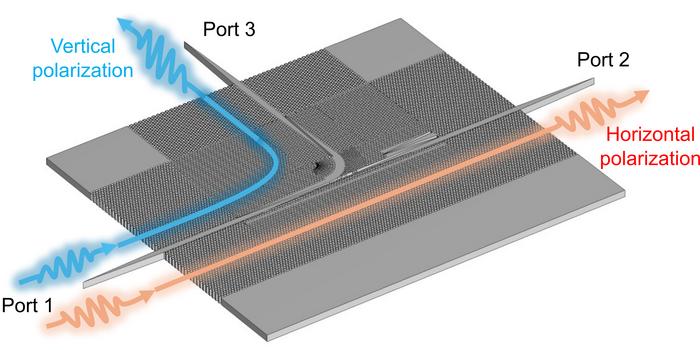
“Our proposed polarization multiplexer will allow multiple data streams to be transmitted simultaneously over the same frequency band, effectively doubling the data capacity,” explains lead researcher Professor Withawat Withayachumnankul from the University of Adelaide, in a statement.
At the heart of this innovation is a compact silicon chip measuring just a few millimeters across. Despite its small size, this chip can separate and combine terahertz waves with different polarizations with remarkable efficiency. It’s like having a tiny, incredibly precise sorting machine for light waves.
To create this device, the researchers used a 250-micrometer-thick silicon wafer with very high electrical resistance. They employed a technique called deep reactive-ion etching to carve intricate patterns into the silicon. These patterns, consisting of carefully designed holes and structures, form what’s known as an “effective medium” – a material that interacts with terahertz waves in specific ways.
The team then subjected their device to a battery of tests using specialized equipment. They used a vector network analyzer with extension modules capable of generating and detecting terahertz waves in the 220-330 GHz range with minimal signal loss. This allowed them to measure how well the device could handle different polarizations of terahertz waves across a wide range of frequencies.
“This large relative bandwidth is a record for any integrated multiplexers found in any frequency range. If it were to be scaled to the center frequency of the optical communications bands, such a bandwidth could cover all the optical communications bands.”
In their experiments, the researchers demonstrated that their device could effectively separate and combine two different polarizations of terahertz waves with high efficiency. The device showed an average signal loss of only about 1 decibel – a remarkably low figure that indicates very little energy is wasted in the process. Even more impressively, the device maintained a polarization extinction ratio (a measure of how well it can distinguish between different polarizations) of over 20 decibels across its operating range. This is crucial for ensuring that data transmitted on different polarizations doesn’t interfere with each other.
To put the potential of this technology into perspective, the researchers conducted several real-world tests. In one demonstration, they used their device to transmit two separate high-definition video streams simultaneously over a terahertz link. This showcases the technology’s ability to handle multiple data streams at once, effectively doubling the amount of information that can be sent over a single channel.
But the team didn’t stop there. In more advanced tests, they pushed the limits of data transmission speed. Using a technique called on-off keying, they achieved error-free data rates of up to 64 gigabits per second. When they employed a more complex modulation scheme (16-QAM), they reached staggering data rates of up to 190 gigabits per second. That’s roughly equivalent to downloading 24 gigabytes – or about six high-definition movies – in a single second. It’s a staggering leap from current wireless technologies.
Still, the researchers say it’s not just about speed. This device is also incredibly versatile.
“This innovation not only enhances the efficiency of terahertz communication systems but also paves the way for more robust and reliable high-speed wireless networks,” adds Dr. Weijie Gao, a postdoctoral researcher at Osaka University and co-author of the study.
The implications of this technology stretch far beyond faster Netflix downloads. We’re talking about advancements that could revolutionize augmented reality, enable seamless remote surgery, or create virtual worlds so immersive you might forget they’re not real. The best part? This isn’t some far-off dream.
“We anticipate that within the next one to two years, researchers will begin to explore new applications and refine the technology,” says Professor Masayuki Fujita of Osaka University.
So, while you might not find a terahertz chip in your next smartphone upgrade, don’t be surprised if, in the not-too-distant future, you’re streaming holographic video calls or controlling smart devices with your mind. The terahertz revolution is coming, and it’s bringing a future that’s faster, more connected, and more exciting than we ever imagined.
Paper Summary
Methodology
The researchers created their device using a high-purity silicon wafer, carefully etched to create precise microscopic structures. They employed a technique called deep reactive-ion etching, which allowed them to shape the silicon at an incredibly small scale. The key to the device’s performance is its use of an “effective medium” – a material engineered to have specific properties by creating patterns smaller than the wavelength of the terahertz waves being used.
Key Results
The team’s polarization multiplexer demonstrated impressive performance across a wide range of terahertz frequencies (220 to 330 GHz). It effectively separated two polarizations of light with minimal signal loss. In practical demonstrations, they successfully transmitted two separate high-definition video streams simultaneously without interference. The device also achieved data transmission rates of up to 155 gigabits per second, far exceeding current wireless technologies.
Study Limitations
Despite the promising results, challenges remain. Terahertz waves have limited range and struggle to penetrate obstacles, potentially restricting their use to short-range applications. Generating and detecting terahertz waves efficiently is still a technical hurdle. The researchers noted that refining the manufacturing process could further improve the device’s performance by reducing imperfections.
Discussion & Takeaways
This research marks a significant advancement in terahertz communications. The ability to efficiently manipulate terahertz waves in a compact device could be crucial for future wireless technologies. The wide frequency range of operation provides flexibility for various applications. The researchers suggest their approach could potentially be scaled to even higher frequencies, opening up new possibilities in fields like sensing and imaging.
“Within a decade, we foresee widespread adoption and integration of these terahertz technologies across various industries, revolutionizing fields such as telecommunications, imaging, radar, and the Internet of things,” Prof. Withayachumnankul predicts.
Funding & Disclosures
This research was supported by grants from the Australian Research Council and Japan’s National Institute of Information and Communications Technology. The team also received funding from the Core Research for Evolutional Science and Technology program of the Japan Science and Technology Agency. The authors declared no conflicts of interest related to this work.


Maybe this has everything to do with the coming Total Spectrum Dominance, Space Fence, Smart Cities and the total control grid. This is Certainly Dual Use Tech. Eleana Freeland has written extensively about all this tech in her trilogy of horrifying books, which are not for the feint of heart.
Fact checked means it’s not. also if true 6g will be more injurious to human (animals/birds) health.
nothing to be happy about.
Absolutely nothing mentioned about how this type of RF will affect human cells… especially brain tissue and ears near a phone. Same with 5G… little to no testing. 5G works on on phased array signal beam… pointed right at the user… very dangerous. 6G sounds like it will literally fry people if the same phased array technology is used. When will we EVER quit inventing technology no one needs or wants and especially without adequate testing? Is this actually designed to kill people? Makes you wonder…
It has been shown that prolonged exposure to terahertz does cause harm to the physical body. I follow terahertz info because of its potential use for both scanning for security and health monitoring. It has a much higher resolution potential than X-rays(infinite?).
So unnecessary. Just make sure everyone gets 5G speed. We have an embarrassment of riches and are never satisfied. What do we need 6G speeds for? We never have the public conversations about the benefits and risks of this technology. Some poorly attended fcc vote greenlights it and we’re off to the races and suddenly there are strange cylindrical transmitters everywhere. Which i am not afraid of btw; I’m just saying we should have a public discussion about whether we really need this.
Terahertz is suited for short range perfect LOS communications only. In many cases both transmitter and receiver must be equipped with a tracker, which adds to the cost of transceivers operating in this block of spectrum.
It is Absolutely necessary if you plan to enslave and control the planet
terahertz wifi will be total junk, worse than the unstable 5ghz garbage companies like comcast and verizon are forcing customers to use, there is already an ocean of problems created by 5ghz wifi for example wireless security devices and CCTV equipment rely and require 2.4ghz connections specifically because it’s a more robust signal with high penetrative qualities and low attenuation meaning less packet loss, and making it less susceptible to EMI, countless ISP services have switched to 5ghz wifi adaptors that are incompatible with 90% of home automation, CCTV and security devices creating a tidal wave of issues and services outages for equipment ranging from ring doorbells to, door and window sensors, lights, thermostats, and even high end PTZ camera equipment costing thousands of dollars, terahertz radiation has a limit of about 10meters and is slightly weaker than microwaves when it comes to penetrating materials such as wood, cardboard, plastics any further than a mm meaning that while the data and labrats claim that it has a range of 10m (32ft) even if being used only as an indoor wifi extender setup it flat out wont penetrate further than 1 room at a time if youre lucky, and thats through plain drywall with no other furniture in the way, and forget about penetrating through appliances, ductwork, safes, brickwork or old board and plaster walls- and if they contain a metal lath fucking forget it you might as well be in a faraday cage ect, terahertz technology also requires line of sight like a remote control from the 80s and has a typical diameter of about 4-6mm or about as wide as a pencil so i dont know how the hell they expect to adapt it for any practical commercial use, although i can see practical use for things lke in data centers and server farms
The polarization rejection figure of only 20 dB is pretty poor. There will be a need to take the opposing polarization signal, put it out of phase, and inject it into the main signal to take that down to well over 40 dB to really be a viable system. Then, a 1 dB (albeit a pretty small loss) loss across the device is greater than what most passive devices have in other systems. Their losses are less than .5 dB, and those losses are considered to high if they are at .5 dB. Not knocking the research here, but it is a significant way away from being something useful.
No mention as to WHY we need such tech advances (faster data for what purpose – is our reality not enough that we need billions of permutations of artificial “realities” and the track & trace capability of every item and human on earth??? — Sounds like a different kind of prison) and never a thought to implications to the cellular, mitochondrial and mental/brain and heart HEALTH of humans as a result of higher frequencies permeating our immediate atmosphere, constantly bathing us in EMF and RF radiation as if neither has ANY effect at all. Regardless of their “short range”, it is not improbable that cities and corridors will not have, at some point, cheaply made antennas placed closely together, not unlike 5G arrays or that the advance is made in battery and phone chips that cellular devices work as their own broadcast stations working amid a ‘shared mesh network’.
Revelation of the Method: They have to tell us what they are planning to do to us. If we don’t resist, then we consented. This is about the dystopian electronic control grid that we are rapidly moving into. Think Neural Link and zombie ppl being basically Connected to one of those ugly towers. Think I am kidding, read Elana Freeland’s works, or even the book reviews on Amazon. Most can not begin to understand the evil these ppl have planned for humanity.
The higher the frequency the more “line of sight” the signal. So this 6G will be very short range. If you can’t see the tower your phone can’t either.
Yea, we read that in the article.
If you can’t see my mirrors…
A single sheet of paper can block signals in that frequency range. Just saying.
So unnecessary. Just make sure everyone gets 5G speed. We have an embarrassment of riches and are never satisfied. What do we need 6G speeds for? We never have the public conversations about the benefits and risks of this technology. Some poorly attended fcc vote greenlights it and we’re off to the races and suddenly there are strange cylindrical transmitters everywhere. Which i am not afraid of btw; I’m just saying we should have a public discussion about whether we really need this.
Ha Ha Ha…Public Discussion. Start Researching what is Really being planned for humanity. Most are so mind conditioned they are sheep in a pen and don’t know it. Commenting period has passed, I’m afraid. Most will be Shocked at what is going to take place in the next 3- 5 years.