

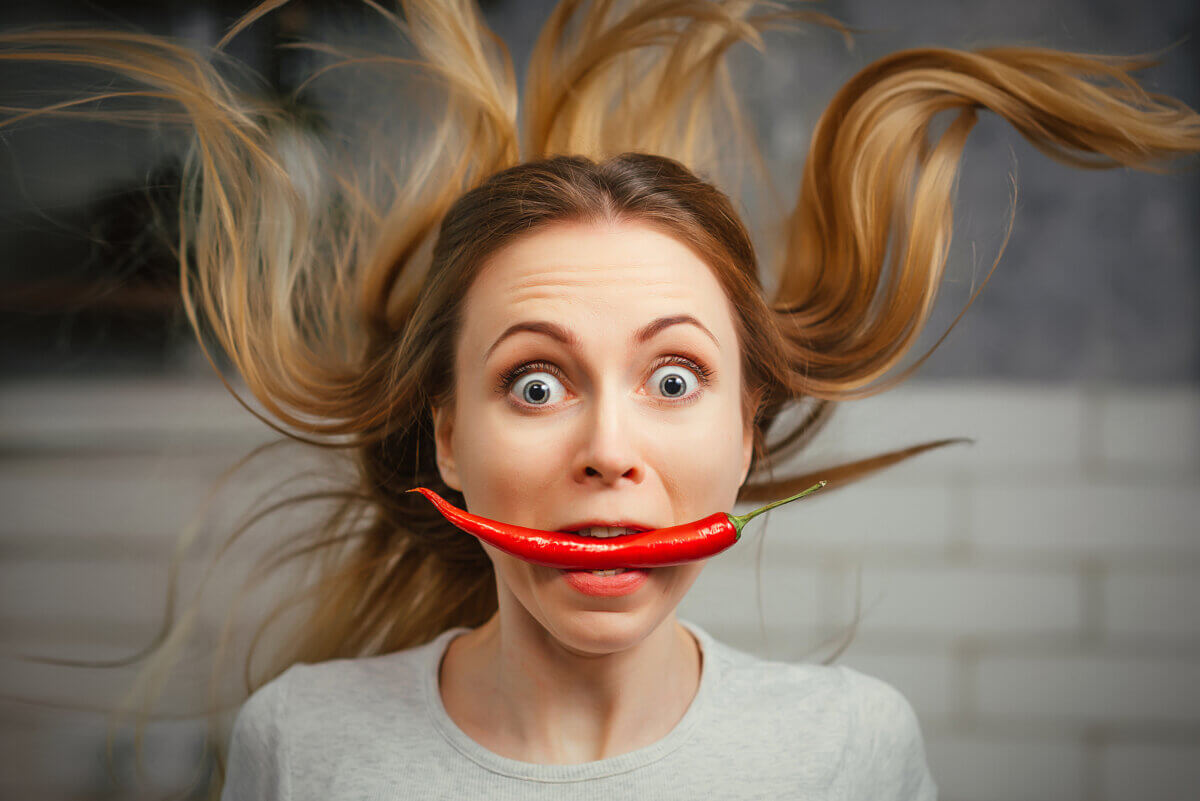
(© Vatthana - stock.adobe.com)
In a nutshell
- Chili peppers contain three natural compounds—capsianoside I, roseoside, and gingerglycolipid A—that actually suppress spiciness rather than enhance it
- Even when peppers contain identical amounts of capsaicin, these “fire extinguisher” compounds can make one pepper feel significantly less spicy than another
- This discovery means the traditional Scoville scale doesn’t tell the full story about how hot a pepper will actually taste
COLUMBUS, Ohio — Ever wondered why some chili peppers burn your mouth more than others, even when they contain the same amount of capsaicin? A study out of Ohio State University shows that chili peppers also harbor natural compounds that act like built-in fire extinguishers—suppressing the fiery sensation we associate with spicy food.
Researchers identified five compounds in chili peppers that were negatively correlated with perceived pungency. Of those, three — capsianoside I, roseoside, and gingerglycolipid A — were shown to significantly reduce the burn when consumed alongside capsaicin, the compound typically blamed for chili heat.
This discovery adds a surprising twist to what actually determines how hot a pepper feels.
“Despite normalizing for the total amount of the two major capsaicinoids (capsaicin and dihydrocapsaicin), the maximum intensity ranged from 7.1 to 11.8 units across the samples,” the researchers note in their paper, published in the Journal of Agricultural and Food Chemistry. Even when peppers contained identical amounts of the compounds traditionally thought to cause spiciness, they felt dramatically different to taste testers.
Consider two glasses of water, each with the same dose of hot sauce. Conventional wisdom says they’d taste equally spicy. But the study shows that one might contain natural “cooling” compounds that significantly reduce the perceived burn — even if the capsaicin levels are identical.
When the researchers added capsianoside I, roseoside, and gingerglycolipid A to a capsaicin solution, trained sensory panelists consistently rated the mixtures as less spicy than capsaicin alone.
Putting Anti-Spice Theory To The Test
To explore this mystery, scientists analyzed ten varieties of chili peppers from four Capsicum species, including familiar types like Serrano and Scotch Bonnet as well as more exotic ones like African Bird’s Eye and Wiri Wiri. They adjusted all pepper samples to contain the same amount of capsaicin and dihydrocapsaicin—equivalent to 800 Scoville Heat Units—before testing began.
Nine trained panelists evaluated the peppers using time-intensity analysis, rating the burn sensation over eight minutes. But to get an even more precise comparison, the team employed a “half-tongue” test: 37 volunteers had filter papers soaked in either pure capsaicin or capsaicin plus one of the suppressing compounds applied to opposite sides of their tongue at the same time.
Participants consistently judged the capsaicin-only side as more intense. The suppressing compounds reduced perceived heat by 0.7 to 1.2 points on a 15-point scale—a statistically significant and perceptible difference.
How These Natural Fire Suppressors Work
While the exact mechanism is still being investigated, the researchers propose that these compounds may reduce capsaicin’s interaction with TRPV1 receptors—the molecular sensors responsible for detecting heat and pain. One of the compounds, gingerglycolipid A, has previously been shown in animal studies to activate TRPV1 without causing a burning sensation, suggesting it may block capsaicin’s full effect.
When tested alone in water, the three compounds had no detectable taste. Their role seems to be purely as modulators, influencing the body’s heat sensors without contributing flavor of their own.
What This Means for Spicy Food Lovers
This discovery helps explain why some peppers feel milder than others despite high capsaicin levels—and why the Scoville scale doesn’t always reflect what your mouth feels. It turns out that pungency isn’t just about how much capsaicin is present, but also about what other compounds are tagging along.
Food manufacturers could potentially use these natural suppressors to engineer more precisely tuned spicy products. Meanwhile, pepper breeders may someday select for specific combinations of these compounds to dial the heat up or down without touching capsaicin content.
“If you’re at home and you’ve ordered cuisine that has spice to it that’s a little too hot for some tastes, you can just sprinkle on a form of chili pepper that has got these suppressant agents in them that will dial it down,” said senior study author Devin Peterson, a professor of food science and technology at The Ohio State University in a statement. “I think the idea of using a natural material as an anti-spice, especially for somebody with kids, would have value as a household ingredient.”
Paper Summary
Methodology
Researchers analyzed ten chili pepper varieties from four species, normalizing all samples to contain identical amounts of capsaicin and dihydrocapsaicin (800 Scoville Heat Units). Nine trained panelists performed time-intensity analysis, rating pungency over eight minutes using a 15-point scale. Scientists used liquid chromatography/mass spectrometry to identify chemical compounds and employed statistical modeling to correlate compound presence with sensory data. To validate findings, 37 volunteers participated in half-tongue discrimination tests comparing pure capsaicin solutions with capsaicin mixed with identified compounds.
Results
Despite identical capsaicin content, pepper varieties showed maximum pungency intensity ranging from 7.1 to 11.8 units. Statistical analysis identified five compounds negatively correlated with pungency perception, with three showing significant suppression effects: capsianoside I, roseoside, and gingerglycolipid A. In sensory testing, these compounds reduced perceived spiciness by 0.7 to 1.2 points on the intensity scale when added to capsaicin solutions. The compounds showed no detectable flavor when tested alone, suggesting they function as modulators rather than taste contributors.
Limitations
The study examined only ten pepper varieties and may not represent the full diversity of Capsicum species. Chemical analysis methods were biased toward semi-polar compounds soluble in the extraction solvents used. The research focused on immediate pungency perception without examining longer-term effects, individual sensitivity variations, or real-world eating conditions beyond laboratory settings.
Funding and Disclosures
This research was supported by the Flavor Research and Education Center at The Ohio State University and its supporting members. The authors declared no competing financial interests.
Publication Information
“Identification of Chili Pepper Compounds That Suppress Pungency Perception” by Joel Borcherding, Edisson Tello, and Devin G. Peterson, published in the Journal of Agricultural and Food Chemistry as part of the special issue “17th International Weurman Flavour Research Symposium: From Flavour Generation to Flavour Perception, Analytics, Modelling and Health.” The paper was received February 1, 2025, revised April 11, 2025, and accepted April 15, 2025.


