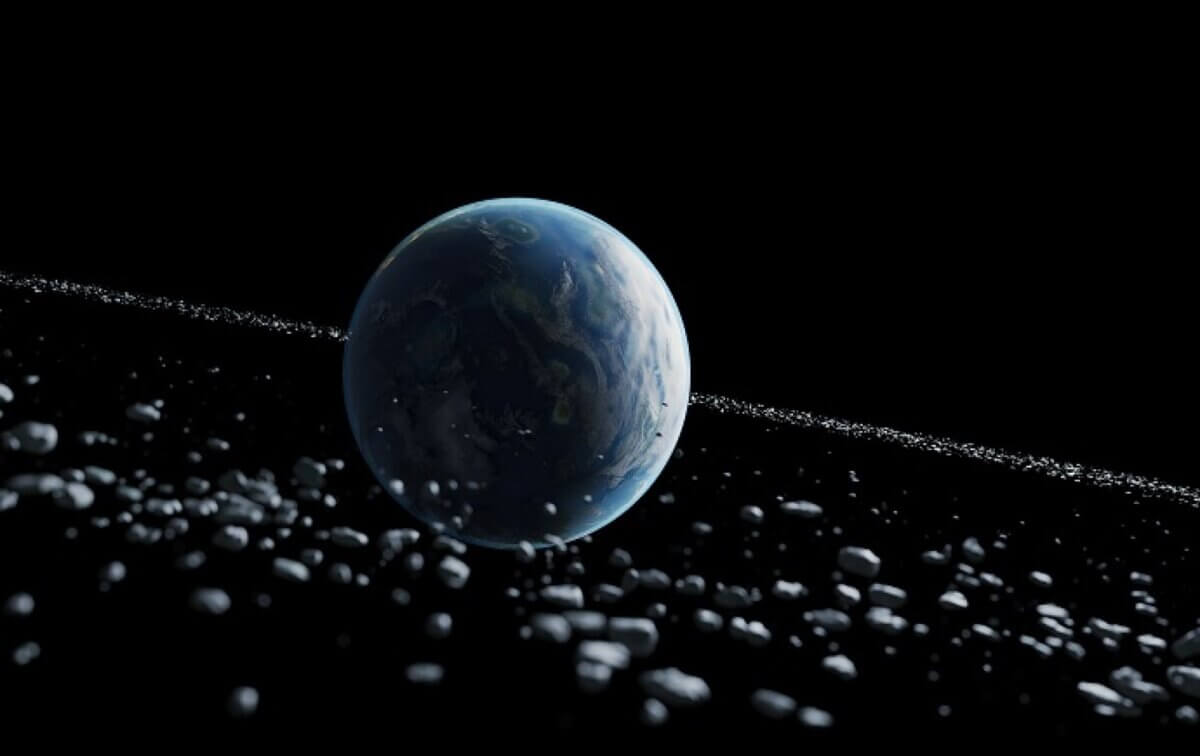
Artist's impression of Earth with a ring of rocks in space. (Credit: Oliver Hull)
MELBOURNE — Did Earth once look a lot more like Saturn? Scientists believe the answer is yes! In a groundbreaking study, researchers in Australia are proposing that Earth may have once sported its own spectacular ring system.
This provocative idea, published in the journal Earth and Planetary Science Letters, offers a novel explanation for a puzzling period in our planet’s history known as the Ordovician impact spike. Around 466 million years ago, Earth experienced an unusual surge in asteroid impacts that lasted for about 40 million years. During this time, the planet was bombarded by space rocks at a rate far higher than normal. Until now, scientists struggled to explain why this happened and why it stopped.
The research team, led by Professor Andy Tomkins from Monash University, presents a compelling hypothesis: a large asteroid had a close encounter with Earth, broke apart due to our planet’s gravitational forces, and formed a temporary ring of debris around the equator.
This ring, they suggest, gradually decayed over millions of years, periodically dropping fragments onto Earth’s surface. These fragments would have created the numerous impact craters we’ve observed from that time period.
What makes this theory particularly intriguing is the distribution of these ancient impact craters. The researchers found that all known craters from the Ordovician period are located within 30 degrees of the equator. This pattern is highly unlikely to occur by chance if the impactors were coming randomly from the asteroid belt.
“Over millions of years, material from this ring gradually fell to Earth, creating the spike in meteorite impacts observed in the geological record,” says Prof. Tomkins in a media release. “We also see that layers in sedimentary rocks from this period contain extraordinary amounts of meteorite debris.”

To test their hypothesis, the scientists used advanced statistical methods and plate tectonic reconstructions. They calculated that the probability of this impact distribution along the equator happening randomly was extremely low – about one in 25 million.
The implications of this celestial ring extend beyond just explaining the impact spike. The researchers speculate that it may have had significant effects on Earth’s climate. Much like how Saturn’s rings cast shadows on its surface, Earth’s ring could have shaded parts of the planet, potentially triggering a major global cooling event known as the Hirnantian Ice Age.
This cooling period, which saw global temperatures plummet by about eight degrees Celsius (over 14 degrees Fahrenheit), has long puzzled scientists because it occurred despite high levels of carbon dioxide in the atmosphere. The presence of a debris ring could help explain this paradox.
Moreover, the researchers suggest that the ring’s eventual dissipation might account for the rapid warming that followed the Ice Age. As the ring thinned and disappeared, more sunlight would have reached Earth’s surface, potentially causing temperatures to rise.
“The idea that a ring system could have influenced global temperatures adds a new layer of complexity to our understanding of how extra-terrestrial events may have shaped Earth’s climate,” Prof. Tomkins adds.
While more evidence is needed to confirm this hypothesis, it opens up exciting new avenues for research in planetary science and paleoclimatology. If confirmed, it would mean that Earth once had its own ring, joining the ranks of the gas giants in our solar system (Jupiter, Saturn, Neptune, Uranus) – if only for a geological blink of an eye.
Paper Summary
Methodology
The researchers used multiple approaches to test their hypothesis. They analyzed the paleogeographic positions of 21 known impact craters from the Ordovician period using six different tectonic plate reconstruction models. They also estimated the area of continental crust capable of preserving Ordovician impact craters. Using statistical methods, including binomial probability calculations and multi-distance spatial cluster analysis, they assessed the likelihood of the observed crater distribution occurring by chance. Additionally, they performed calculations to estimate the Roche limits for Earth, which is the distance within which a celestial body would break apart due to tidal forces.
Key Results
The study found that all 21 known Ordovician impact craters are located within 30 degrees of the paleo-equator. Statistical analysis showed that the probability of this distribution occurring randomly was extremely low (about 1 in 25 million). The spatial cluster analysis confirmed that the Ordovician impacts were significantly more clustered than impacts from other time periods. These findings support the hypothesis of a temporary debris ring around Earth during the Ordovician period.
Study Limitations
The study relies on the current known set of Ordovician impact craters, which may not be a complete record. The ages of some craters have large uncertainties. The researchers acknowledge that their estimates of the initial asteroid size and ring composition are speculative and require further investigation. The climate effects of the proposed ring are also hypothetical and need more detailed modeling to confirm.
Discussion & Takeaways
The researchers suggest that their hypothesis could explain several puzzling aspects of the Ordovician period, including the impact spike, the equatorial distribution of craters, and the onset of a major ice age. They propose that the breakup of a large asteroid near Earth, rather than in the distant asteroid belt, better explains the observed evidence. The study opens up new avenues for research, including more detailed analysis of Ordovician sediments for extraterrestrial material and advanced modeling of the proposed ring system’s evolution and climatic effects.
Funding & Disclosures
The research was supported by Australian Research Council grants. The authors declared no competing financial interests or personal relationships that could have influenced the work reported in the paper.


