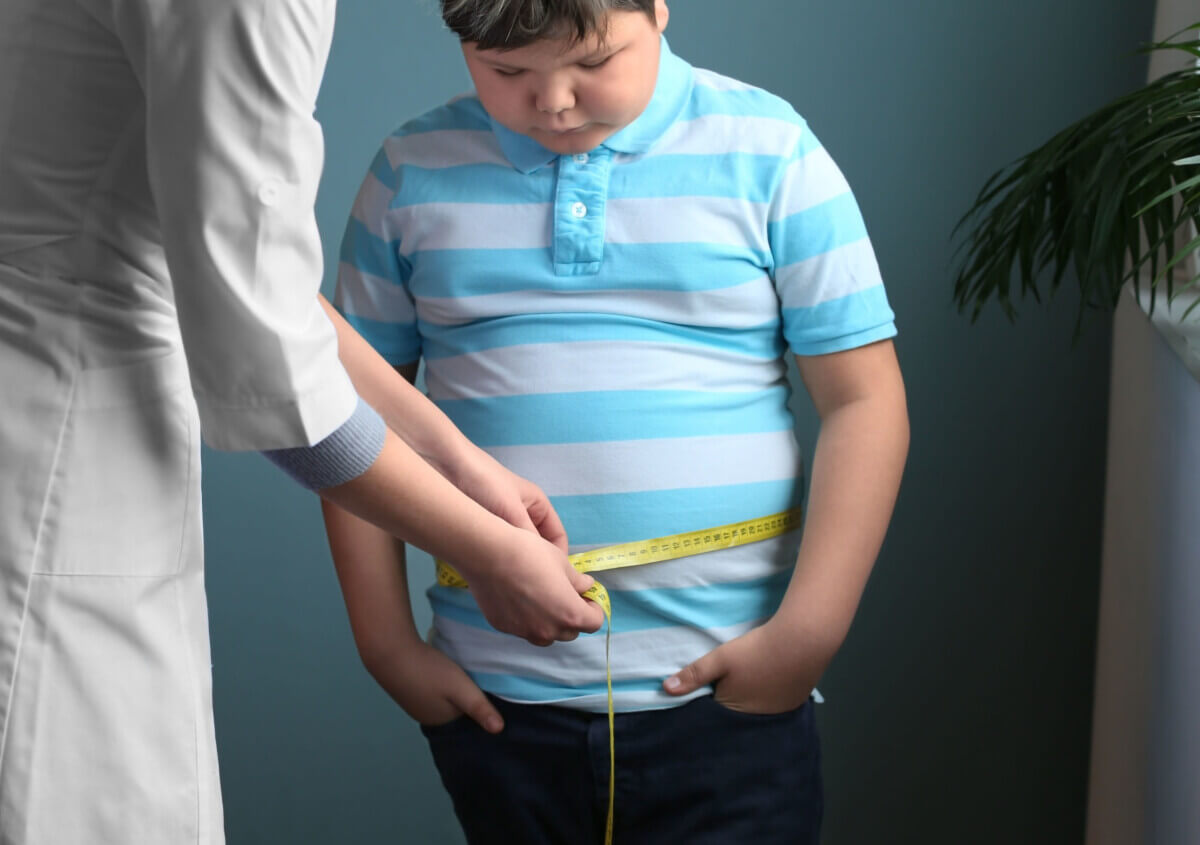
Doctor measuring waistline of overweight child. (© Africa Studio - stock.adobe.com)
PHILADELPHIA — Does childhood obesity all come down to the genes? Researchers at Children’s Hospital of Philadelphia (CHOP) and the University of Pennsylvania have pinpointed a specific genetic variant that appears to play a significant role in a child’s risk of becoming overweight or obese — and it all comes down to a single “letter” change in the genetic code.
The study, published in the journal Cell Genomics, focused on a region of chromosome 12 that scientists previously flagged in genome-wide association studies (GWAS) as having a link to childhood obesity risk. These powerful studies scan the genomes of large populations to spot genetic markers associated with particular traits or diseases.
The region in question, dubbed the “chr12q13 locus,” has been a bit of a mystery. It was clearly important, ranking among the top hits in childhood obesity GWAS. However, the specific gene or genes responsible for the effect and how they might influence body weight were unclear.
Using state-of-the-art genomic techniques, researchers narrowed down the suspects to a single genetic variant – a change from a “G” to an “A” in a particular spot of DNA. This tiny alteration, known as rs7132908, sits in a region that helps regulate the activity of nearby genes.
One of those nearby genes is called FAIM2. It’s not a household name, but it plays an important role in the development and survival of neurons, particularly in the hypothalamus. This small but mighty brain region is the control center for regulating appetite and body weight.
“By focusing specifically on this locus, we were able to pinpoint a causal variant associated with one of the strongest genetic signals we have implicated in childhood obesity,” says first study author Dr. Sheridan H. Littleton, a postdoctoral research associate who conducted this work as a member of the Center for Spatial and Functional Genomics team at CHOP, in a media release. “With more research, there’s potential to learn how the target of this variant’s action may be a target for new therapies specifically designed to treat childhood obesity.”

Here’s where it gets really interesting. Researchers found that the rs7132908 obesity risk variant decreases the expression of FAIM2 in hypothalamic neurons. In essence, it dials down the activity of this important gene during a key stage of brain development.
To study this effect, the team used stem cells to grow hypothalamic neurons in the lab. By using CRISPR gene editing, they were able to create neurons with either the “G” (non-risk) or “A” (obesity risk) variant of rs7132908, but were otherwise genetically identical.
The results were striking. The neurons with the “A” risk variant not only had lower FAIM2 levels, but they were much less likely to mature into the specialized neurons that help regulate appetite. While 61 percent of the “G” variant neurons developed into these key cells, only 11 percent of the “A” variant neurons did.
What does this mean for a child’s waistline? Researchers propose that lower FAIM2 levels during a critical window of hypothalamic development could lead to an imbalance of appetite-stimulating versus appetite-suppressing neurons. Over time, this could translate into a propensity to overeat and gain excess weight.
More importantly, this variant doesn’t doom a child to obesity. Environmental factors like diet and physical activity still play major roles. However, it does suggest that some children, due to their genetic makeup, may be more vulnerable to weight gain in today’s obesity-promoting world.
“In spite of a series of challenges, a study like this demonstrates how extra effort can reveal important information about hitherto uncharacterized genetic variants and the role they play in a variety of childhood and adult illnesses,” notes Dr. Struan F.A. Grant, director of the Center for Spatial and Functional Genomics and the Daniel B. Burke Endowed Chair for Diabetes Research at CHOP. “This work further underscores how the brain is central to the genetics of obesity and provides us with a strategy for further study.”
StudyFinds’ Matt Higgins contributed to this report.


