
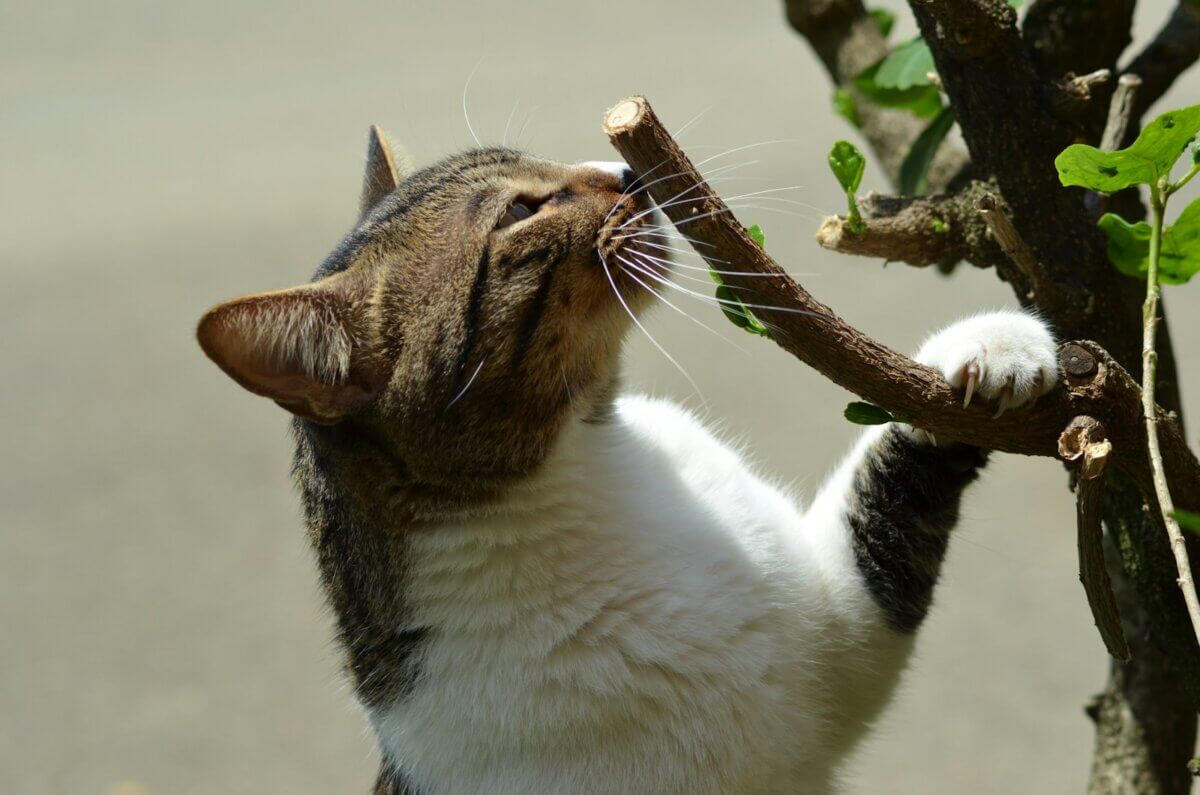
(Photo by Juan Camilo Guarin P from Unsplash)
COLUMBUS, Ohio — Our feline friends enjoy a sense of smell that’s roughly 14 times stronger than that of a human. While we have about five million odor sensors in our noses, cats have over 200 million! Cats use their sense of smell as their primary means of identifying people and objects. However, until now, the exact mechanism behind their olfactory prowess remained a mystery. Exciting research from Ohio State University scientists has uncovered the secret behind cats’ extraordinary sense of smell.
Study authors say cats owe their strong sense of smell to a collection of tightly coiled bony airway structures. These findings, published in PLoS Computational Biology, were reached via the first ever detailed analysis of the domestic feline’s nasal airway.
The research team developed a new 3D computer model of the cat nose, and then used that to simulate how inhaling air containing common cat food odors would flow through the coiled structures. This led to the discovery that the air actually divides into two separate flow streams; one that is cleansed and humidified and another that delivers the odorant quickly and efficiently to the system responsible for smelling (the olfactory region).
In other words, the study suggests that a cat’s nose functions as a highly efficient and dual-purposed gas chromatograph, a sophisticated device typically found in chemistry labs for separating and analyzing complex mixtures. Researchers explain the feline nose is so efficient at this function, its structure and design could actually inspire improvements to the gas chromatographs used today in countless labs.
This discovery not only sheds light on why cats have such a keen sense of smell but also provides insights into the evolution of mammalian olfactory systems.
While the long nose of an alligator has also been found to mimic gas chromatography, researchers theorize that the compact head size of cats drove an evolutionary change resulting in a labyrinthine airway structure that helps felines adapt to diverse environments.
“It’s a good design if you think about it,” says Kai Zhao, associate professor of otolaryngology in Ohio State’s College of Medicine and senior author of the study, in a media release.
“For mammals, olfaction is very important in finding prey, identifying danger, finding food sources and tracking the environment. In fact, a dog can take a sniff and know what has passed through – was it a friend or not?” he continues. “That’s an amazing olfactory system – and I think potentially there have been different ways to evolve to enhance that.”
“By observing these flow patterns and analyzing details of these flows, we think they could be two different flow zones that serve two different purposes.”
Prof. Zhao’s lab had previously developed models of both rodent and human noses in order to study air flow patterns, but this latest high-resolution cat model and subsequent series of simulation experiments are the most complicated to date. This was achieved via micro-CT scans of a cat’s head and microscopic-level identification of tissue types throughout the nasal cavity.
“We spent a lot of time developing the model and more sophisticated analysis to understand the functional benefit that this structure serves,” he notes. “The cat nose probably has a similar complexity level as the dog’s, and it’s more complex than a rodent’s – and it begs the question – why was the nose evolved to be so complex?”
Computer simulations of breathing revealed the answer. During a simulated inhalation, study authors noted two distinct regions of air flow; respiratory air that is filtered and spreads slowly above the roof of the mouth on its way to the lungs, as well as a separate stream containing odorant that moves rapidly through a central passage directly to the olfactory region closer to the back of the nasal cavity.
The analysis also accounted for both the location of flow and the speed of its movement through turbinates, or the bony structures inside the nose.
“We measured how much flow goes through specific ducts – one duct that delivers most odorant chemicals into the olfactory region, versus the rest, and analyzed the two patterns,” Prof. Zhao comments. “For respirant breathing, turbinates branch to divert flow into separate channels, sort of like a radiator grid in a car, which would be better for cleansing and humidifying.
“But you want odor detection to be very fast, so there is one branch that delivers odor at high speed, potentially allowing for quick detection rather than waiting for air to filter through the respiratory zone – you could lose most of the odor if air has been cleansed and the process is slowed down.”
In a gas chromatograph, a sample is vaporized and carried through a long, coiled tube. Different components of the sample travel at different speeds based on their chemical properties, allowing for their separation and identification.
The cat’s nose works on a similar principle. As air is inhaled, it passes through the coiled turbinates. Odor molecules in the air interact with the mucus-covered walls of these passages, with different molecules “sticking” to the walls at different rates. This process effectively separates the odor molecules, allowing the cat’s brain to process them more efficiently.
The simulation also revealed that the air sent to the olfactory region is eventually recirculated in parallel channels when it gets there. “That was actually a surprise,” Prof. Zhao says. “It’s like you take a sniff, the air is shooting back there and then is being processed for a much longer time.”
This setup provides cats with two significant advantages. First, it allows for rapid detection of odors, which is crucial for sensing potential prey or predators. Second, it enables more detailed analysis of complex odors, which could be useful for identifying subtle differences in scents left by other animals.
This project was the first ever to quantify the difference in gas chromatography between mammals and other species. Prof. Zhao and his team estimate a cat’s nose is over 100 times more efficient at odor detection than an amphibian-like straight nose in a similarly sized skull. This study was also the first to produce a parallel gas chromatography theory: parallel olfactory coils feeding from the high-speed stream to increase the effective length of the flow path while slowing down the local airflow speed, potentially to produce better odor processing.
“We know so much about vision and hearing, but not so much about the nose. This work could lead to more understanding of the evolutionary pathways behind different nose structures, and the functional purpose they serve,” Prof. Zhao concludes.
Paper Summary
Methodology
The researchers used a combination of high-resolution imaging techniques and computer modeling to study the cat’s nasal passages. They started with a micro-CT scan of a cat’s head, using a contrast agent to highlight the delicate nasal airways. This provided a detailed 3D map of the nasal passages.
They then used histology (examination of tissue under a microscope) to identify different types of nasal tissue. This information was combined to create a comprehensive computational model of the cat’s nasal airway. Using this model, they simulated airflow and odor transport through the nose under various breathing conditions.
Key Results
The study revealed several key findings. First, they identified a distinct separation between respiratory and olfactory airflow in the cat’s nose. A high-speed “dorsal medial stream” of air bypasses the main respiratory area and delivers odors quickly to the olfactory region.
The olfactory region itself consists of complex, coiled passages that function like a parallel gas chromatograph. This structure was found to be over 100 times more efficient at separating odors than a simple “straight tube” nose. The researchers also found that the cat’s nose is particularly efficient at absorbing certain types of odor molecules, which may explain cats’ sensitivity to specific scents.
Study Limitations
While this study provides valuable insights, it does have some limitations. The research was based on a single cat specimen, so it doesn’t account for potential variations between individual cats or different breeds. The computational model, while advanced, is still a simplification of the complex biological system. Additionally, the study focused on airflow and odor transport but didn’t directly measure odor perception or brain activity related to smell.
Discussion & Takeaways
This research suggests that the complex structure of the mammalian nose, particularly the ethmoid turbinates, plays a crucial role in enhancing olfactory performance. The parallel, coiled structure of these turbinates allows for efficient odor separation and analysis, similar to a gas chromatograph. This finding could explain why mammals generally have a more developed sense of smell compared to other vertebrates.
The study also highlights the importance of the dorsal medial airstream in quickly delivering odors to the olfactory region, a feature that could be crucial for rapid odor detection. These insights could have applications in various fields, from medical diagnostics to security technology, inspiring new designs for artificial odor detection systems.
Funding & Disclosures
The study was partly funded by Mars Petcare UK and a National Institute of Health grant. One of the authors, S.J. McGrane, is an employee of Mars Petcare UK, a manufacturer of pet food and provider of veterinary services. Mars Petcare UK is also a corporate sponsor of the Monell Chemical Senses Center, where some of the research was conducted. Another author, K. Zhao, disclosed being a paid consultant to Diceros Therapeutics, Inc., though this was unrelated to the current project.


Lol no wonder catnip drives them nuts? Sensory overload.