
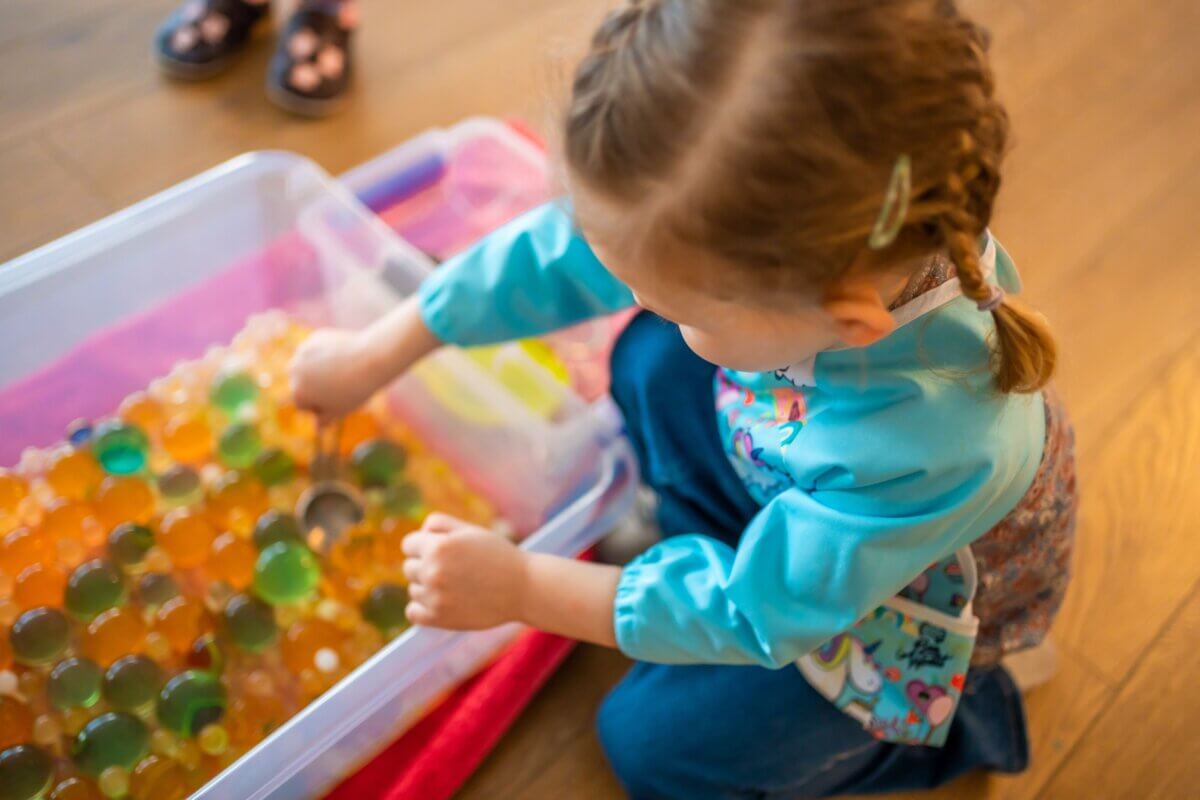
(Credit: Tatiana Diuvbanova/Shutterstock)
COLUMBUS, Ohio — In recent years, a seemingly innocuous toy has been causing serious injuries in children across the United States. Water beads, those colorful, marble-sized spheres that expand when soaked in water, have become increasingly popular as sensory toys and decorations. However, a new study reveals a disturbing trend: emergency room visits related to water bead injuries in children have more than doubled in just one year.
Water beads, made from superabsorbent polymers, can expand to hundreds of times their original size when exposed to fluids. Originally marketed as soil alternatives for plants, they’ve found their way into children’s play as sensory toys, decorations, and even ammunition for toy “gel blaster” guns. However, their harmless appearance hides a serious threat, especially to young children who might mistake them for candy.
The study, published in the American Journal of Emergency Medicine, analyzed data from U.S. emergency departments over a 16-year period. The results are eye-opening: In 2022 alone, there were an estimated 3,300 water bead-related emergency room visits involving children and teenagers. This marks a staggering 130% increase from the previous year.
What makes these tiny spheres so dangerous?
When ingested, water beads can expand to many times their original size inside a child’s body, potentially causing intestinal blockages or other serious complications. They can also pose risks when inserted into ears or noses, leading to painful and sometimes damaging outcomes. In one tragic incident not included in the study, a 10-month-old child died after ingesting water beads.
“The number of pediatric water bead-related emergency department visits is increasing rapidly,” says Dr. Gary Smith, senior author of the study and director of the Center for Injury Research and Policy at Nationwide Children’s Hospital, in a statement. “Although swallowing objects and putting them into an ear or the nose are common among children, water beads pose a unique increased risk of harm because of their expanding properties, and they’re hard to detect with X-rays.”
The research team found that children under five years-old were most at risk, accounting for more than half of all emergency room visits related to water beads. Ingestion was the most common type of injury, followed by insertion into the ear canal. While most cases were treated and released from the emergency department, some required hospitalization, especially among the youngest patients.
One particularly concerning finding was that children as young as seven months-old were among those injured. This challenges the notion that current safety measures, such as warning labels for children under three, are sufficient to prevent accidents.
The study’s findings have caught the attention of consumer safety advocates and lawmakers. In response to growing concerns, major retailers, including Amazon, Walmart, and Target, have announced they will stop selling water beads marketed to children. Additionally, legislation has been introduced in both the U.S. House of Representatives and Senate to ban or restrict the sale of expandable water beads.
However, the researchers argue that current safety standards and regulations may not go far enough. The existing toy safety standard, ASTM F963, which limits the size to which water beads can expand, doesn’t account for the possibility of multiple beads forming a gelatinous mass in the intestines. It also doesn’t address injuries from insertion into ears or noses.
“Serious outcomes have occurred to children younger than 18 months, and one-fifth of the water beads swallowed in this study were among children younger than 18 months with the youngest child being 7 months old. Therefore, using intestinal measurements for 18-month-olds is not adequate,” Dr. Smith points out.
Study authors are calling for a more comprehensive approach to regulating water beads. They suggest focusing on the core characteristic that makes these products dangerous: their ability to expand when exposed to fluids. Drawing a parallel to regulations on high-powered magnets, which focused on magnetic strength to reduce ingestion risks, the researchers propose limiting water bead expansion to no more than 50% of their original size.
“Many parents are not aware that water beads can be harmful to children,” adds Dr. Marcel Casavant, co-author of this study and physician at Nationwide Children’s Hospital. “If children younger than six years or with developmental delays live in or visit your home, keep water beads out of your home and talk with your childcare directors, preschool teachers, therapists, and others who may be using water beads with young children.”
As the debate over water bead safety continues, parents and caregivers are urged to be vigilant. Experts recommend keeping these products out of reach of young children and supervising their use with older kids. If ingestion is suspected, immediate medical attention should be sought, as symptoms can be non-specific and easily mistaken for other conditions.
Paper Summary
Methodology
The researchers used data from the National Electronic Injury Surveillance System (NEISS), a database that collects information on injuries treated in U.S. emergency departments. They looked at cases involving water beads from 2007 to 2022 for patients under 20 years-old.
The NEISS data comes from about 100 hospitals across the country, which allows researchers to estimate national numbers. They analyzed details like the patient’s age, what happened, and how serious the injury was.
Key Results
The study found an estimated 8,159 water bead-related emergency room visits from 2007 to 2022. More than half of these cases (55%) involved children under 5 years old. The most common problem was ingestion (45.9% of cases), followed by beads stuck in the ear (32.6%) and nose (11.7%). While most patients were treated and released, some needed to be admitted to the hospital, especially younger children who had swallowed beads. The number of cases jumped from 55 in 2021 to 127 in 2022, a 130.9% increase.
Study Limitations
The study has some limitations. It only looks at emergency room visits, so it doesn’t capture injuries treated elsewhere, like doctor’s offices or urgent care centers. It also might miss some cases if they weren’t correctly identified as water bead-related. The database doesn’t provide long-term follow-up information, so complications that happened after leaving the hospital aren’t included. Additionally, the relatively small number of cases in some years made it challenging to calculate reliable national estimates for certain subgroups.
Discussion & Takeaways
The researchers emphasize that the rapid increase in water bead injuries, especially among young children, calls for urgent action. They argue that current safety standards aren’t enough to protect kids, particularly those under 18 months old. The study suggests that water beads pose unique risks compared to other small objects because they expand and can form masses in the body.
The authors recommend stricter regulations, possibly limiting how much water beads can expand when wet. They also stress the need for more public awareness about the dangers of water beads and better product labeling.
Funding & Disclosures
The study was supported by a student research scholarship from the Child Injury Prevention Alliance. The authors declared no conflicts of interest. They noted that the funding organization had no role in designing the study, analyzing the data, writing the report, or deciding to publish the findings.


