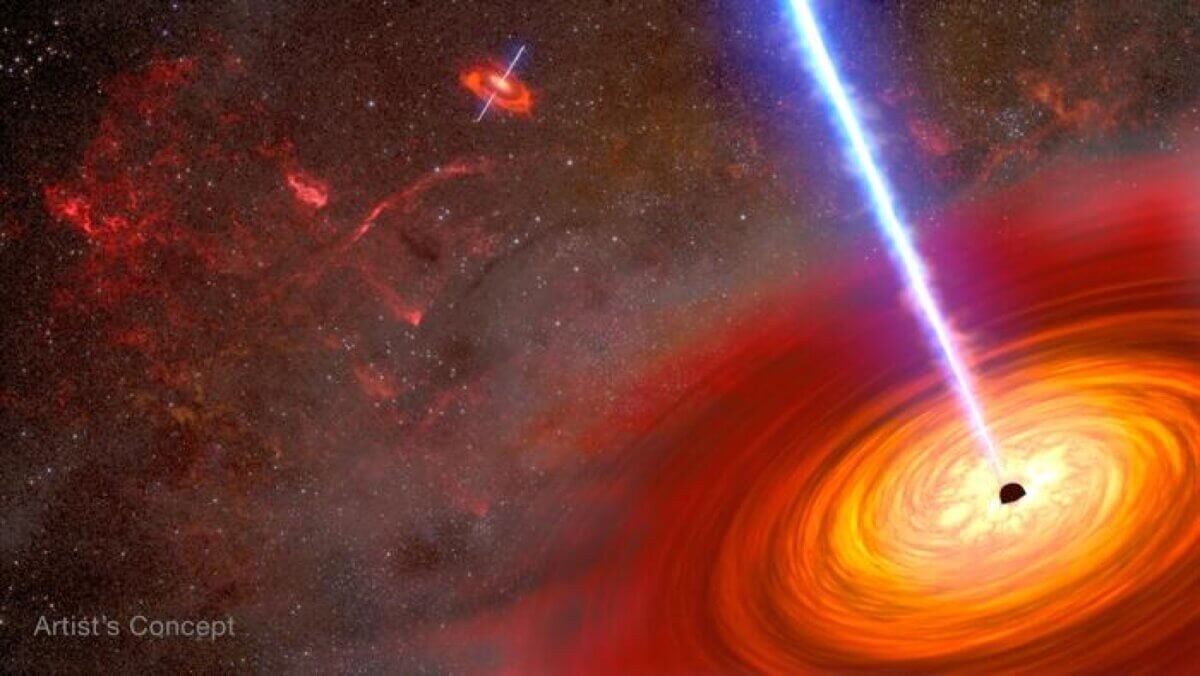
This is an artist's depiction of a pair of active black holes at the heart of two merging galaxies. They are both surrounded by an accretion disk of hot gas. Some of the material is ejected along the spin axis of each black hole. Confined by powerful magnetic fields, the jets blaze across space at nearly the speed of light as devastating beams of energy. (Credit: NASA, ESA, Joseph Olmsted (STScI)
CAMBRIDGE, Mass. — What would happen if two black holes moved extremely close to each other? It’s a question NASA scientists are pondering after discovering two supermassive black holes at the center of two merging galaxies. In 100 million years, scientists predict these black holes will continue to move closer together until they eventually collide. The gravitational waves coming from this union may disturb the fabric of space and time.
The black hole duo is 300 light-years apart, deep inside a pair of galaxies colliding with each other. Astronomers were able to capture evidence of the two spiraling black holes because the gas and dust fueling their movements made them shine as brightly as active galactic nuclei. This was seen through the Hubble Space Telescope and X-ray data. The complete findings are published in The Astrophysical Journal.
Black hole duos, while rare, have been seen before. Astronomers have spotted dozens of these pairs before, but never as close as they are in the gas-rich galaxy MCG-03-34-64. Radio telescopes have seen one other pair of binary black holes as they’ve found in MCG-03-34-64, but this discovery was not confirmed with visible and X-ray observations.
Scientists believe black hole pairs were more common in the early universe because galaxies often merged. The current discovery provides a glimpse of how space might have looked in the distant past, giving astronomers a real-life example 800 million light-years away from the Milky Way galaxy.
The discovery was even more remarkable to scientists because it happened by accident. Hubble showed three optical diffraction spikes inside the host galaxy. Diffraction spikes are the product when light from a small area in space bends around the mirror inside telescopes. The sight of these spikes told astronomers there was a massive concentration of glowing oxygen gas.
“We were not expecting to see something like this,” says lead study author Anna Trindade Falcão, a researcher at the Center for Astrophysics | Harvard & Smithsonian in Massachusetts, in a media release. “This view is not a common occurrence in the nearby universe, and told us there’s something else going on inside the galaxy.”
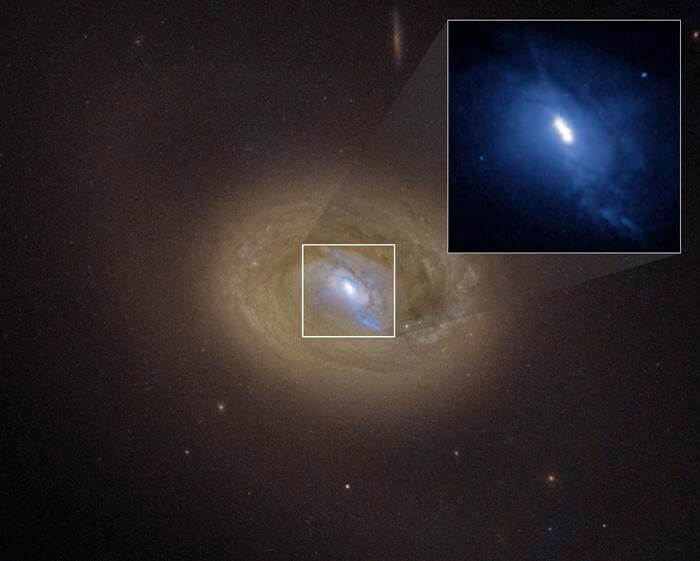
Astronomers then used X-ray lights to look at the galaxy to understand better what was happening in this galaxy.
“When we looked at MCG-03-34-64 in the X-ray band, we saw two separated, powerful sources of high-energy emission coincident with the bright optical points of light seen with Hubble. We put these pieces together and concluded that we were likely looking at two closely spaced supermassive black holes,” explains Falcão.
To support their hypothesis of dual black holes, the researchers used archival radio data to compare it to the powerful radio waves emitted from the holes. Seeing specific wavelengths can rule out other possibilities. In this case, seeing bright light in optical, X-rays, and radio wavelengths told astronomers the only explanation is a black hole duo.
While much has been discovered about this black hole pair, like both being at the heart of their host galaxies, astronomers are still puzzled over the appearance of the third bright light in this region of space. More data will need to be collected from Hubble to identify its origin. Still, some astronomers believe it may come from a gas shocked by energy from one of the black holes — similar to a stream of water from a hose spraying into a pile of sand.
“We wouldn’t be able to see all of these intricacies without Hubble’s amazing resolution,” Falcão concludes.
Paper Summary
Methodology
The researchers used multiple types of telescopes to observe a galaxy named MCG-03-34-64. They gathered data from the Hubble Space Telescope to look at specific areas emitting light, such as the [O III] emission, which indicates ionized gas. They also used the Chandra X-ray Observatory to detect X-ray emissions from the galaxy, focusing on identifying dual black hole activity.
Additionally, they looked at radio signals from the Very Large Array (VLA) to see if radio waves were being emitted by active black holes. The data from these sources were combined and analyzed using specialized computer programs to create images and graphs that show what is happening in the galaxy.
Key Results
The researchers found something very exciting: they might have discovered two supermassive black holes very close to each other in a galaxy! These black holes are about 100 light-years apart. They found this by looking at two spots in the galaxy that are both giving off very powerful X-rays and radio signals. This is important because when galaxies collide and merge, their black holes get closer and closer until they eventually combine into one big black hole. If this discovery is correct, it’s the closest pair of black holes ever found that are about to merge.
Study Limitations
This study faces some limitations. First, the observations could only go so far due to the limitations of the telescopes’ resolution. The study relied on indirect evidence of black holes, like X-rays and radio waves, which can sometimes be caused by other phenomena, not just black holes. Additionally, because the black holes are very close to each other, some of the signals may overlap, making it hard to tell exactly what’s happening. Finally, since these observations were made using different instruments over time, there might be slight differences in the data that affect the conclusions.
Discussion & Takeaways
The main takeaway from this study is that the researchers may have discovered the closest pair of black holes in the process of merging, which is a rare event in the universe. This discovery could help scientists learn more about how black holes grow and merge after galaxies collide. It could also teach us more about how black holes interact with the gas and stars around them.
However, there is still more work to be done to confirm that both X-ray sources are definitely black holes and not something else like gas being heated by another process. Future observations will be needed to confirm this exciting discovery.
Funding & Disclosures
This research was supported by a range of institutions, including the Harvard-Smithsonian Center for Astrophysics and the Catholic University of America, among others. The authors have no conflicts of interest or financial disclosures to report related to this study.


