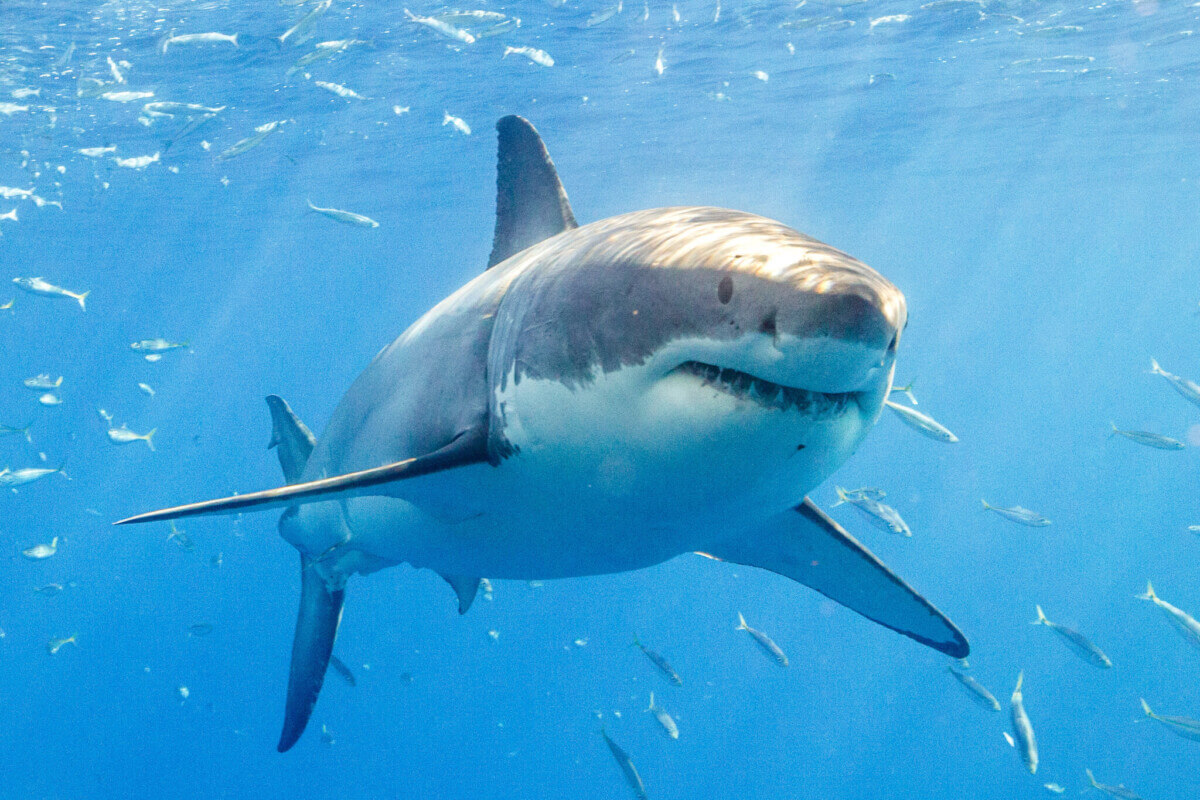
Great White shark (© shanemyersphoto - stock.adobe.com)
ABERDEEN, Scotland — In the depths of our oceans, a surprising family drama is unfolding. The great white shark, that iconic predator that has captured our imaginations and haunted our nightmares, is not the unified global terror we once thought. Instead, it’s a tale of three long-lost cousins, each facing their own struggle for survival.
A study published in the journal Current Biology has revealed that the world’s great white sharks are actually divided into three distinct genetic lineages that rarely interbreed. This discovery, led by researchers at the University of Aberdeen in collaboration with an international team, challenges our understanding of these apex predators and raises alarming questions about their future.
Using cutting-edge genomic techniques, the scientists analyzed DNA samples from 89 white sharks captured across their range, from the Mediterranean to Australia. Their findings paint a picture of a species divided by time and tide. The three lineages – found in the North Atlantic and Mediterranean, the North Pacific, and the southern Indo-Pacific – appear to have separated between 100,000 to 200,000 years ago, during the Penultimate Ice Age.
“At the end of the Penultimate Ice Age – between 100,000 to 200,000 years ago – white shark populations appear to have divided into three discrete lineages which seldom interbreed,” explains Dr. Catherine Jones, lead researcher from the University of Aberdeen, in a media release.
This ancient split has persisted to the present day, with modern ocean currents acting as boundaries between the groups. The implications of this discovery are profound.
Great white sharks are already classified as Vulnerable on the IUCN Red List of Threatened Species, with global populations having dropped significantly in recent decades. Now, we know that each regional population is even more vulnerable than previously thought.
“Successful conservation requires recognition of management units, but this has been unavailable for white sharks, which were suspected to exist as a single global population,” says Professor Les Noble of Nord University in Norway, who also holds an honorary position at the University of Aberdeen.
The study found only a single shark that appeared to be a hybrid between two lineages, suggesting that while some interbreeding is possible, it is extremely rare. This genetic isolation means that if one population were to disappear, it couldn’t simply be replenished by sharks from other areas.
The research team calls for a complete reassessment of white shark conservation strategies, recommending that each lineage be managed as a separate unit. This may include adjusting fishing quotas, expanding marine protected areas, and increasing monitoring of local populations.
However, the challenges facing great whites go beyond just numbers. Professor Galice Hoarau of Nord University warns of a potential “genetic trap” looming on the horizon.
“The lack of interbreeding suggests offspring from cross lineage matings may not be viable. Should recent forecasts of changes in strength and direction of major ocean currents over the next 50 years be accurate, breakdown of these geographic boundaries between lineages may allow more unproductive matings, further endangering white shark populations and the diversity, health and productivity of ocean ecosystems,” Prof. Hoarau notes.
This study serves as a stark reminder that the white shark’s fearsome reputation has long overshadowed its vulnerability.
“It has long been considered that sharks lost from one area would be compensated for with the movement and matings of sharks from other locations. Our findings suggest this is clearly unlikely and this, together with bycatch fishing, depletion of their food reserves, pollution, and poaching, could put this iconic apex predator in real danger of extinction,” Dr. Jones points out.
The great white shark has survived for millions of years, outlasting the dinosaurs and countless other species. But now, faced with the triple threat of genetic isolation, human activity, and a changing climate, these magnificent predators may be swimming towards an evolutionary dead end. The question remains: will we act in time to protect not just one species, but three unique lineages of ocean guardians?
Paper Summary
Methodology
The researchers used two main genetic approaches in this study. First, they performed “target gene capture” on all 89 shark samples. This technique allows scientists to selectively sequence specific parts of the genome that are likely to show variation between individuals.
They then performed more extensive “whole genome sequencing” on a subset of 17 sharks representing different geographic areas. This provides a more complete picture of genetic variation across the entire genome. By combining these approaches, the team could identify genetic differences between sharks from different regions with high accuracy.
Key Results
The genetic analysis revealed three distinct clusters of white sharks, corresponding to different ocean regions. These clusters showed very little genetic mixing, suggesting they rarely interbreed. The only exception was a single shark that appeared to be a hybrid between two lineages. Statistical analyses estimated that these lineages diverged between 100,000-200,000 years ago. The study also found some evidence of finer-scale genetic structure within each main lineage, suggesting there may be even more localized populations.
Study Limitations
While this study provides strong evidence for distinct white shark lineages, there are some limitations to consider. The sample size, while substantial for such a rare and difficult-to-study species, is still relatively small. More extensive sampling could potentially reveal additional genetic complexity. Additionally, genetic data alone cannot fully explain the mechanisms keeping these lineages separate – further research on shark behavior and ecology is needed to understand why interbreeding is so rare.
Discussion & Takeaways
This study challenges our understanding of white shark population structure and has major implications for conservation. The existence of distinct lineages means that losing any one population would result in a significant loss of genetic diversity for the species as a whole.
The research also suggests that white sharks may have more limited dispersal than previously thought, making them potentially more vulnerable to localized threats. The authors argue for a shift in conservation strategy, treating each lineage as a separate management unit. They also highlight the need for further research to understand the ecological and behavioral factors maintaining this genetic separation.
Funding & Disclosures
This project was funded by Nord University, Faculty of Biosciences and Aquaculture, Norway. Some DNA sequencing was performed by the Norwegian Sequencing Centre, which is supported by the Research Council of Norway and the South-Eastern Norway Regional Health Authorities. The authors declared no competing interests related to this research.


