
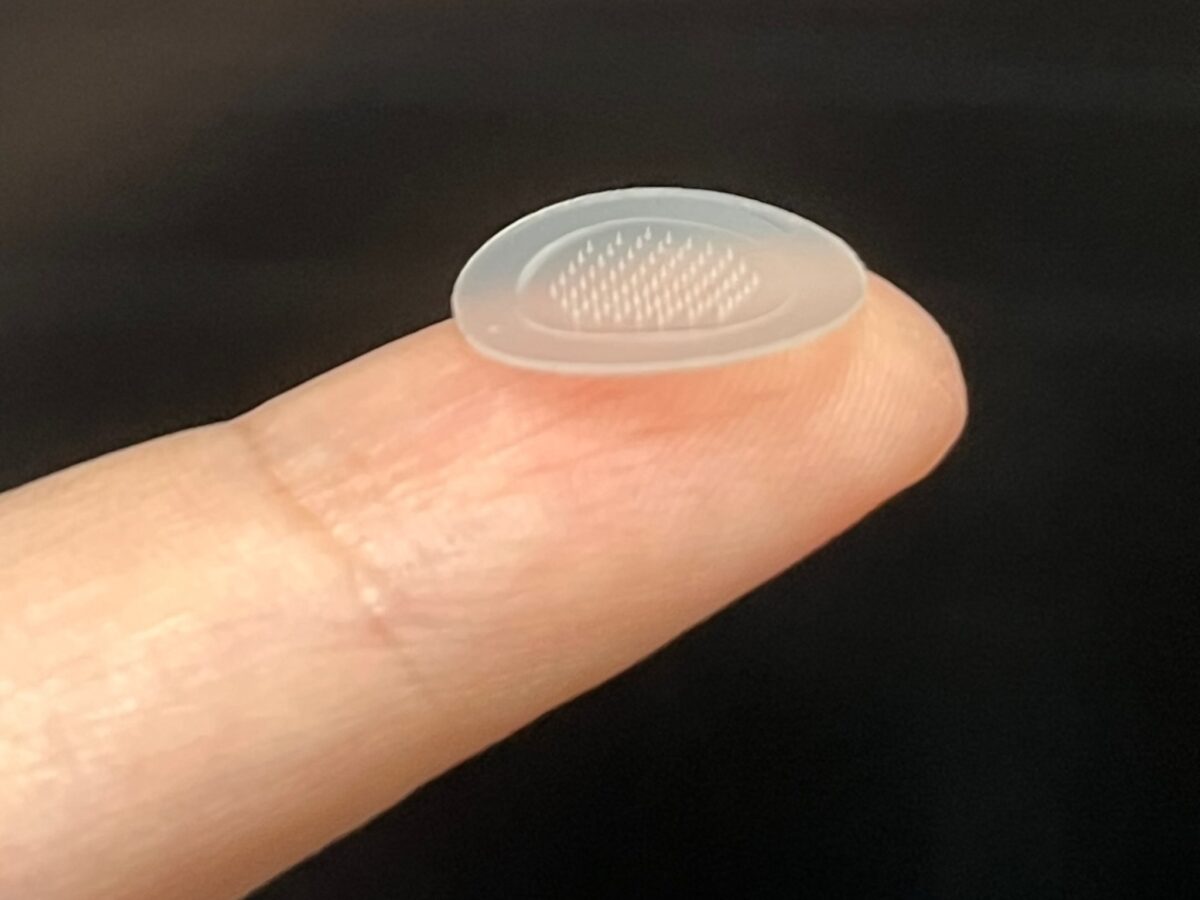
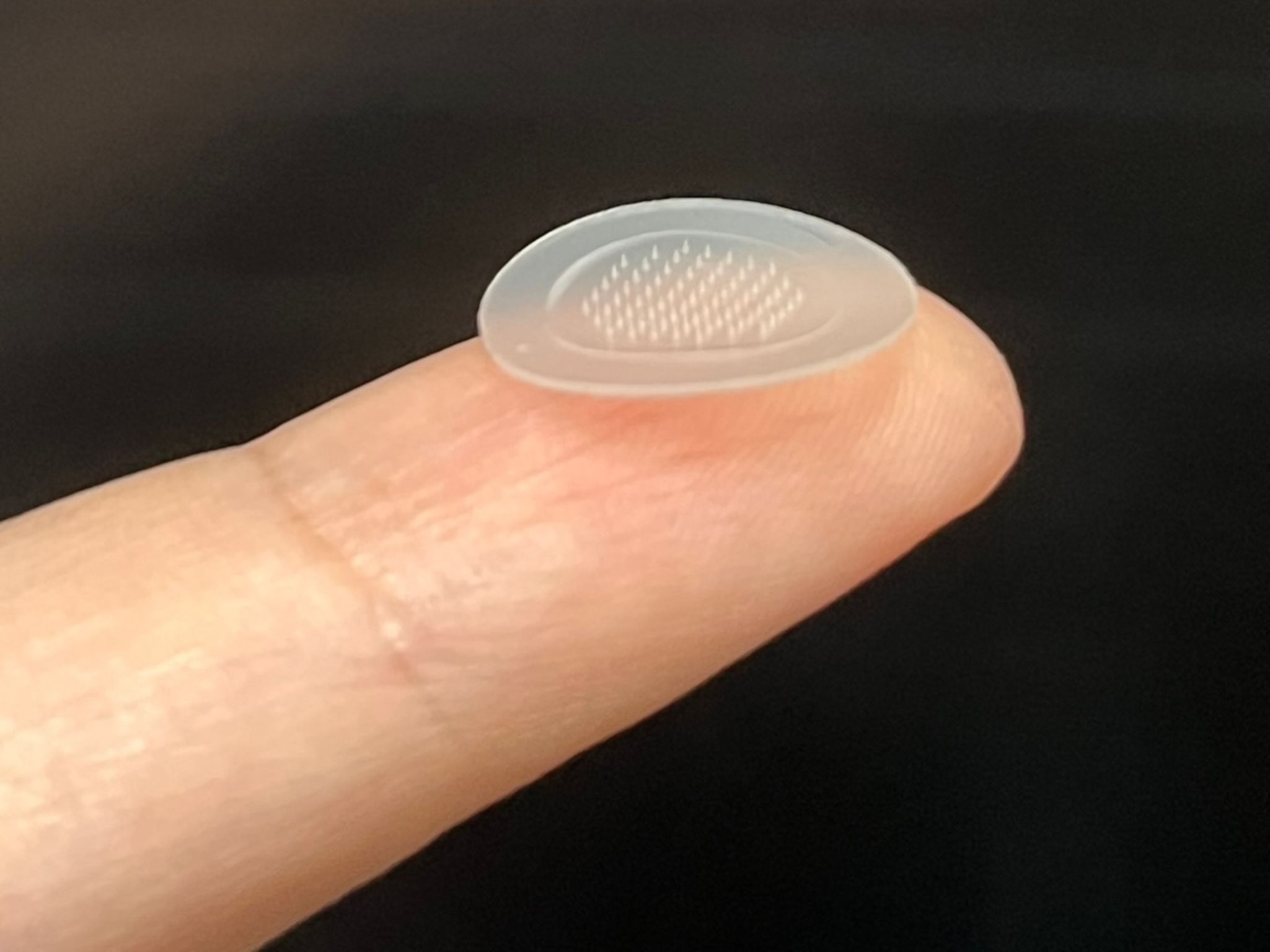
This new pimple patch features a specialized array of tiny spikes to help deliver acne-busting compounds under the skin. (Credit: Adapted from ACS Applied Materials & Interfaces 2025, DOI: 10.1021/acsami.5c07718)
In A Nutshell
- Korean scientists created a dissolving dual-phase acne patch that targets bacteria first, then inflammation.
- In a 7-day clinical trial with 20 participants, treated lesions were fully cleared while controls improved more slowly.
- The patches also cut oil production by 40.7%, breaking the cycle that fuels new breakouts.
- Results are preliminary, but the patch could become a fast, noninvasive alternative to traditional acne treatments.
SEOUL, South Korea — Acne is one of those frustrating conditions that manages to affect nearly everyone at some point. For some, it’s a passing annoyance of adolescence, while for others, breakouts persist well into adulthood. Beyond the bumps and blemishes, acne carries heavy emotional weight, leaving many people embarrassed, discouraged, or even depressed about their appearance. With an estimated 650 million people worldwide dealing with acne at any given time, the search for faster, more effective treatments has never lost urgency.
Now, Korean scientists have designed a new kind of acne patch that could represent a meaningful step forward. In a small but carefully run clinical trial, this “dual-phase self-locking microarray patch” rapidly cleared treated blemishes. By the third day of use, patients already saw significant improvements, and by the end of the first week, the treated spots were completely clear. While the study, published in ACS Applied Materials & Interfaces, was limited in scope and not intended to be the final word on acne treatment, the results hint at a potential breakthrough.
Breaking Through Barriers
Why is acne so stubborn? One reason lies in the skin itself. The outermost layer of our skin is designed to keep things out, not let things in. That makes sense from a protective standpoint, but it means that creams, gels, and ointments often don’t penetrate deeply enough to reach the source of acne inside hair follicles. Oral medications, like antibiotics or isotretinoin, can bypass that barrier, but they come with drawbacks ranging from digestive upset to the risk of long-term side effects.
The Korean research team set out to solve this delivery problem using cutting-edge microarray technology. Each patch is studded with dozens of microscopic needles. These are so small they’re measured in micrometers rather than millimeters. Unlike typical cone-shaped microneedles, they have a “wide-body-to-narrow-base” design that locks them securely into the skin once applied. The needles then dissolve completely within 90 minutes, releasing their active ingredients exactly where acne bacteria multiply and inflammation sets in.
This design means the treatment doesn’t just sit on the surface of the skin. Instead, it penetrates directly into the problem area, delivering medicine more effectively and without the need for swallowing a pill. It’s a minimally invasive approach that feels almost futuristic, yet is already proving itself in early human trials.
A Smarter Two-Step Process
The researchers recognized that acne is not caused by just one thing. It’s the result of excess oil (sebum), bacterial overgrowth, clogged pores, and inflammation working together to create pimples. To tackle all of these factors, they developed a sequence of patches.
On the first day, participants applied antibacterial patches packed with salicylic acid, Cannabis sativa root extract, and additional sebum-controlling agents such as Anti-Sebum P and Madecassoside. These ingredients were selected because they can kill Cutibacterium acnes, the main bacteria associated with breakouts, while also reducing the amount of oil that fuels new pimples. Hyaluronic acid was also included to help support the skin’s natural barrier.
From the second day through the seventh, patients switched to anti-inflammatory patches. These were designed to calm redness, soothe irritation, and help the skin heal more quickly. They contained salicylic acid in a lower dose, chamomile extract, glutathione (a powerful antioxidant), and niacinamide, which is well known in skincare circles for reducing inflammation and oiliness. The goal was not just to wipe out bacteria but to create an environment where the skin could recover and resist new flare-ups.
Clinical Trial Findings
The clinical trial enrolled 20 participants with an average age of 25.7, all diagnosed with mild-to-moderate acne. Each participant served as their own control: one acne lesion was treated with the microarray patches, while a matched lesion of similar size and severity was left untreated. This design allowed researchers to directly compare treated versus untreated areas on the same face, eliminating the variability that comes with comparing different people.
Participants applied the patches daily for seven days, wearing them for two to eight hours each time. By the third day, the treated lesions had already shrunk dramatically, with an 81.4 percent reduction compared with just 41 percent in the untreated controls. By day seven, the treated spots had achieved complete clearance, while the control areas showed about a 71 percent reduction.
The benefits didn’t stop there. The patches also reduced sebum production by 40.7 percent from baseline, a substantial improvement for people prone to oily skin. Since excess oil often creates a cycle of new breakouts, this finding was particularly encouraging. Importantly, no adverse reactions were reported during the study, even with daily use of the patches.
Patient satisfaction was high. More than 90 percent of participants said they were satisfied with the treatment, and nearly 88 percent reported they would recommend the product to others. These satisfaction levels, combined with the visible improvement in acne lesions, point to a treatment that was not only effective but also well tolerated.
Why It Matters
Acne treatments typically demand patience. Topical creams and gels often take weeks or months before showing meaningful results, and oral medications may require long-term use to keep breakouts under control. The idea that a seven-day patch system could bring treated lesions to full clearance is appealing both medically and emotionally.
For people who have struggled with acne for years, faster results could mean more than just clearer skin. It could also restore confidence, reduce the risk of permanent scarring, and provide relief from the emotional toll that acne can take. The fact that the patch design may be manufactured at costs comparable to current topical treatments suggests it might one day be an accessible option rather than a luxury.
Looking Beyond Acne
While this trial focused on acne vulgaris, the technology itself could be applied much more broadly. The same self-locking microarray platform could be adapted for other inflammatory skin conditions such as psoriasis or eczema. It might also be customized for wound healing or even to deliver medications that traditionally struggle to pass through the skin barrier.
Because the patches dissolve fully and leave nothing behind, they could also reduce risks of irritation that sometimes occur with long-term topical treatments.
Proceeding with Caution
As exciting as these results are, it’s important to keep them in perspective. The study involved only 20 people, all with mild-to-moderate acne, and the treatment period lasted just seven days. There’s no data yet on long-term effectiveness, whether results hold up after weeks or months, or how well the patches might work for people with more severe acne. Larger and longer trials will be needed before doctors can know for sure whether this treatment can live up to its early promise.
Still, the trial offers a glimpse of what the future of acne care might look like: targeted, efficient, and much faster than the options we have today. If future research confirms these findings, the humble acne patch could move from a cosmetic novelty to a serious medical tool, one capable of changing the way we treat one of the most common skin conditions on the planet.
Disclaimer: This article is for informational purposes only and is not intended as medical advice. Readers should consult a qualified healthcare provider before making changes to their skincare or treatment routine.
Paper Summary
Methodology
Researchers developed dual-phase self-locking microarray patches using 3D printing technology to create microscopic needles that dissolve in skin. They conducted a 7-day clinical trial with 20 participants (average age 25.7 years) diagnosed with mild-to-moderate acne. Each participant received antibacterial patches on day one and anti-inflammatory patches on days 2-7, applied for 2-8 hours daily. Researchers used each participant as their own control by treating one lesion while leaving a similar untreated lesion for comparison. They measured acne lesion reduction, sebum production changes, and patient satisfaction while monitoring for adverse reactions.
Results
The patches achieved 81.4% acne lesion reduction by day 3 and 100% clearance by day 7 in treated areas, compared to 71.2% reduction in untreated control areas. Sebum production decreased by 40.7% compared to baseline. Over 90% of participants reported high satisfaction, with 95% willing to recommend the treatment. No adverse reactions occurred. Laboratory testing showed the patches completely dissolved within 90 minutes and provided sustained drug release over 24 hours.
Limitations
The study involved only 20 participants over a short 7-day period, limiting the ability to assess long-term safety and effectiveness. All participants had mild-to-moderate acne, so results may not apply to severe cases. The study population was relatively homogeneous, potentially limiting generalizability across different demographics. Researchers noted that future studies should include larger participant groups, longer follow-up periods, and more diverse populations to validate these initial findings.
Funding and Disclosures
Research was partially supported by grants from the Technology Development Program funded by the Ministry of SMEs and Startups (Korea) and the Korea Health Technology R&D Project through the Korea Health Industry Development Institute, funded by the Ministry of Health & Welfare, Republic of Korea. The authors declared competing financial interests as the research was conducted in collaboration with Cursus Bio Inc., and the data may be used in future product advertisements.
Publication Information
The study “Dual-Phase Antibacterial and Anti-inflammatory Self-Locking Microarray Patches for the Effective Treatment of Acne Vulgaris,” was published in ACS Applied Materials & Interfaces on July 31, 2025, volume 17, pages 45438-45447. The research was conducted by Jisook Park, Jaehyun Kim, Shayan Fakhraei Lahiji, and Yong-Hee Kim from Hanyang University and Cursus Bio Inc. in South Korea.


