
Credit: Gorodenkoff on Shutterstock
ICU patients’ needs can change rapidly. The AI studies each patient to make personalized nutrition predictions.
In A Nutshell
- An AI model called NutriSighT predicts which ventilated ICU patients will be underfed during days 3-7 of their hospital stay, updating predictions every four hours based on vital signs and lab results
- The model achieved 81% accuracy on internal testing and 76% on external validation, substantially outperforming traditional machine learning approaches that managed only 58% accuracy
- More than half of ventilated patients in Boston hospitals were underfed on day three of intensive care, compared to 41% in Dutch hospitals, revealing significant gaps in how healthcare systems feed critically ill patients
- Blood sodium levels ranked as the strongest overall predictor of underfeeding risk, but the importance of specific factors like blood clotting measures and sedative use shifted throughout patients’ ICU stays
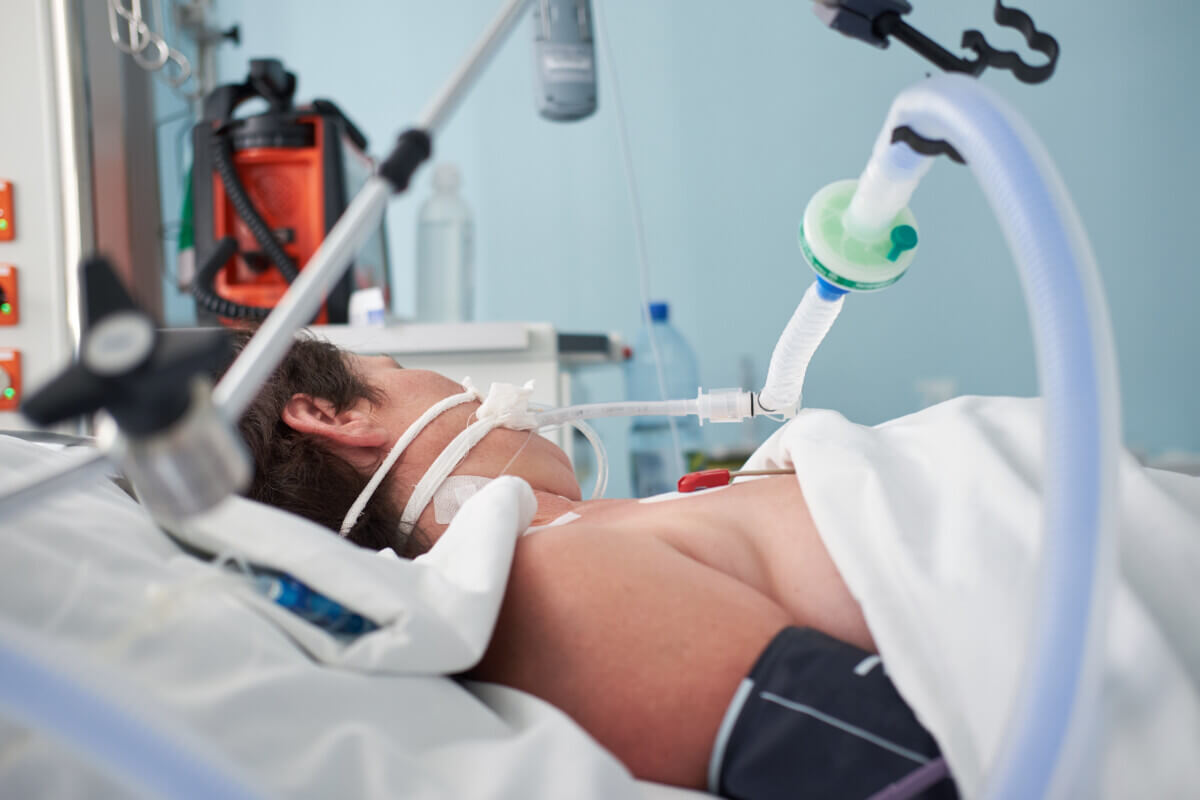
Doctors treating critically ill patients on ventilators face a constant challenge regarding nutrition. Properly feeding ICU patients is of critical importance as their bodies fight for survival. An artificial intelligence model called NutriSighT could help solve this problem by identifying which patients are likely to be underfed in advance.
Researchers at Mount Sinai’s Icahn School of Medicine trained the AI system on data from 3,284 ICU patients in a Dutch medical database, then tested it on 6,456 ICU patients from a Boston-based database. The model predicts every four hours whether a patient will receive less than 70% of their daily calorie needs between days three and seven of mechanical ventilation.
Why Feeding Ventilated Patients Is So Challenging
Getting nutrition right during this critical window matters. During the first two days in intensive care, patients are often too unstable to receive much food. But from day three onward, their bodies start breaking down muscle and their nutritional needs evolve rapidly.
Feed them too little, and they may face longer hospital stays and worse outcomes. Yet many factors conspire against proper feeding: unstable blood pressure, digestive problems, and frequent interruptions for medical procedures.
The research team analyzed 62 different measurements from each patient, including vital signs, lab results, and medication doses. The AI model achieved an AUROC of 0.81 on internal testing and 0.76 on external validation. AUROC measures how well a prediction model separates high-risk from low-risk patients, with 1.0 representing perfect discrimination and 0.5 representing a coin flip.
When compared to a traditional machine learning model called XGBoost, NutriSighT performed markedly better. XGBoost managed only 0.58.
How the AI Model Works and What It Tracks
NutriSighT uses transformer architecture, the same type of AI system that powers language models like ChatGPT. But instead of predicting words, it predicts feeding outcomes by learning patterns in how patients’ vital signs and lab values change over time. The model updates its predictions six times per day as new data comes in.
The system doesn’t just make predictions—it shows doctors which factors are driving them. Blood sodium levels ranked as the most consistently influential predictor overall, followed by blood pressure, red blood cell size (a routine lab marker often linked to overall health status), and blood pH.
However, the importance of specific factors shifted over time. The blood clotting measure INR contributed more strongly to predictions for Days 3–5 but less so later, while the sedative lorazepam gained importance as patients’ ICU stays progressed. Oxygen levels similarly became more important in later predictions, showing how the system adapts to changing clinical situations.
Wide Gaps in How Hospitals Feed ICU Patients
The study, published in Nature Communications, revealed differences in how patients are fed across healthcare systems. Dutch patients in the Amsterdam database received a median of 1,728 calories daily from feeding tubes and sedation medication, while Boston patients received only 1,307 calories.
About 41% of Dutch patients were underfed on day three, dropping to 25% by day seven. In Boston, 53% started underfed on day three, declining to 35% by day seven.
These numbers explain why personalized predictions matter. Research on ICU feeding has produced contradictory results, with some studies showing that increased calories reduce death rates and ventilator time, while others find no benefit or even harm from aggressive feeding. The confusion likely stems from treating all critically ill patients the same way when their individual needs vary dramatically.
NutriSighT doesn’t tell doctors what to do—it flags patients at risk so clinicians can investigate why. A patient flagged as likely underfed might need a different feeding formula, adjustments to their sedation, or in selected cases, consideration of intravenous nutrition. The system gives clinicians time to adjust treatment plans before nutritional deficits accumulate.
Testing the model at different probability thresholds revealed practical tradeoffs for clinical use. At a 0.5 threshold, the system correctly identified 75% of underfed patients while maintaining 61% specificity for patients receiving adequate nutrition.
Raising the threshold to 0.7 improved specificity to 83% but caught only 50% of underfed patients. Hospitals could adjust sensitivity based on their resources and priorities.
What the Model Can’t Yet Do
The research has limitations. As a retrospective study analyzing past records, it can’t account for all the complex factors influencing feeding decisions. The model was trained and tested exclusively in Western hospitals, so its performance in other settings remains unknown.
Calorie requirements were estimated using standard formulas rather than measured directly, though this reflects actual clinical practice where precise measurements are rarely available. The researchers also focused narrowly on underfeeding during days 3-7, leaving other nutritional challenges like overfeeding or interrupted nutrition for future work.
Before NutriSighT can enter hospitals, it will need prospective testing where doctors use it in real-time to make decisions. Implementation will require integration into electronic health records and careful attention to avoiding alert fatigue among busy ICU staff. Previous clinical decision support tools have shown that these challenges can be addressed.
This article is for general informational purposes only and does not provide medical advice. Clinical decisions should always be made by qualified healthcare professionals.
Paper Notes
Limitations
The study used retrospective data subject to selection bias and confounding factors. Training and validation occurred exclusively in Western ICU databases (Amsterdam and Boston), which may limit generalizability to different clinical practices and resource settings. Caloric requirements were estimated using guideline recommendations rather than indirect calorimetry measurements. The definition of underfeeding used a guideline-based threshold rather than individualized energy needs. Model performance declined from day 1 to day 6, partly due to decreasing sample sizes as patients were extubated over time. The study focused specifically on underfeeding during days 3-7 and did not address overfeeding, feeding interruptions, or optimal macronutrient balance.
Funding and Disclosures
This research was supported by National Institutes of Health grant K08DK131286 awarded to Ankit Sakhuja. Girish Nadkarni is a founder of Renalytix, Pensieve, and Verici; provides consultancy to AstraZeneca, Reata, Renalytix, Siemens Healthineer, and Variant Bio; serves on scientific advisory boards for Renalytix and Pensieve; and has equity in Renalytix, Pensieve, and Verici. Lili Chan consults for Vifor Pharma and has received honoraria from Fresenius Medical Care. All other authors declared no competing interests.
Publication Details
- Authors: Mateen Jangda, Jayshil Patel, Akhil Vaid, Jaskirat Gill, Paul McCarthy, Jacob Desman, Rohit Gupta, Dhruv Patel, Nidhi Kavi, Shruti Bakare, Eyal Klang, Robert Freeman, Anthony Manasia, John Oropello, Lili Chan, Mayte Suarez-Farinas, Alexander W. Charney, Roopa Kohli-Seth, Girish N. Nadkarni, and Ankit Sakhuja
- Affiliations: The Charles Bronfman Institute for Personalized Medicine, Icahn School of Medicine at Mount Sinai (New York, NY, USA); Medical College of Wisconsin (Milwaukee, WI, USA); Institute for Critical Care Medicine, Icahn School of Medicine at Mount Sinai (New York, NY, USA); West Virginia University (Morgantown, WV, USA); Division of Data Driven and Digital Medicine, Department of Medicine, Icahn School of Medicine at Mount Sinai (New York, NY, USA); Institute for Healthcare Delivery Science, Icahn School of Medicine at Mount Sinai (New York, NY, USA); Division of Nephrology, Department of Medicine, Icahn School of Medicine at Mount Sinai (New York, NY, USA); Center for Biostatistics, Department of Population Health Science and Policy, Icahn School of Medicine at Mount Sinai (New York, NY, USA)
- Journal: Nature Communications
- Volume: 16 (2025), Article 11189
- DOI: 10.1038/s41467-025-66200-1


