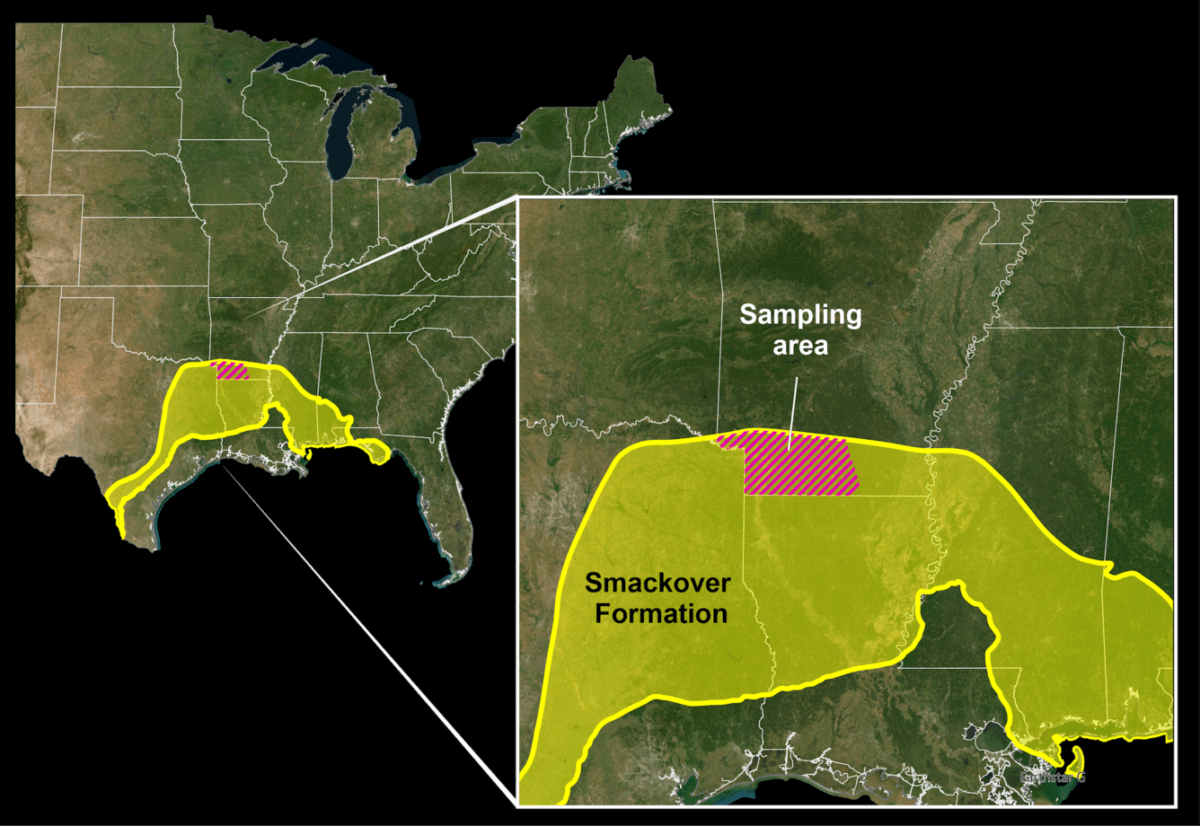
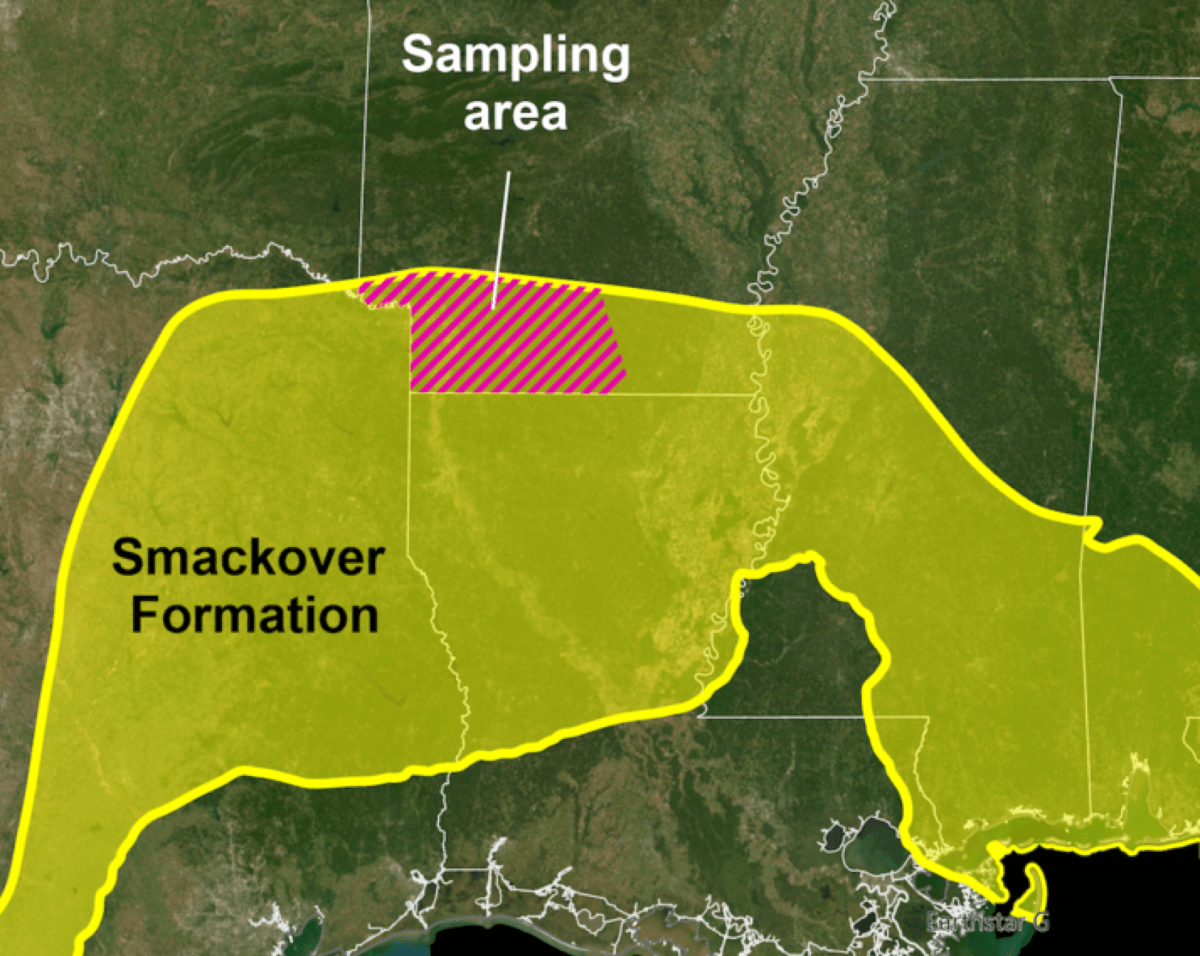
This map of the U.S. shows an inset area displaying highlighted areas for the Smackover Formation and sampling area. The Smackover formation (highlighted in yellow) covers the southern to eastern portion of Texas, southern portion of Arkansas, the upper half of Louisiana and some eastern areas, southern half of Mississippi, southwest area of Alabama, and portions of the Florida panhandle. The sampling area is located in the lower portion of Arkansas (highlighted with red stripes). (Sources/Usage: Public Domain.)
RESTON, Va. — The United States of America may literally be sitting on top of buried treasure! Deep beneath the soil of southwestern Arkansas, scientists have discovered an unexpected fortune: enough lithium to power millions of batteries for electric vehicles. The discovery may even free America from its dependence on foreign imports of this crucial mineral.
The groundbreaking study by the U.S. Geological Survey (USGS) revealed that this region holds between 5 and 19 million tons of lithium reserves. That’s enough to meet the entire world’s projected 2030 demand for electric vehicle batteries nine times over.
The discovery published in Science Advances comes at a crucial point in time, as the global desire to build electric vehicles has sent demand for lithium skyrocketing. The lightweight metal is essential for producing the rechargeable batteries that power everything from smartphones to electric cars, and until now, the United States has had to rely heavily on imports for more than a quarter of its lithium supply.
“Lithium is a critical mineral for the energy transition, and the potential for increased U.S. production to replace imports has implications for employment, manufacturing and supply-chain resilience,” says David Applegate, Director of the USGS, in a media release.
What makes this discovery particularly intriguing is where the lithium is sitting. It’s dissolved in ancient seawater trapped within a geological formation called the Smackover – a vast limestone layer that stretches across several Southern states. This underground reservoir, formed during the age of dinosaurs in the Jurassic period, has long been known for its oil and bromine deposits. Now, it’s revealing another valuable secret in its briny waters.
To map this hidden treasure, researchers employed a sophisticated combination of old and new techniques. They collected water samples from the region and analyzed them in the USGS Brine Research lab in Virginia. Then, using artificial intelligence and machine learning, they created detailed maps predicting lithium concentrations across the entire region – even in areas where they couldn’t take direct samples.
“Our research was able to estimate total lithium present in the southwestern portion of the Smackover in Arkansas for the first time,” explains Katherine Knierim, the study’s lead researcher. “We estimate there is enough dissolved lithium present in that region to replace U.S. imports of lithium and more.”
Knierim cautions that these estimates only show how much lithium is present, not how much can be practically extracted.
“It is important to caution that these estimates are an in-place assessment. We have not estimated what is technically recoverable based on newer methods to extract lithium from brines.”
One particularly promising aspect of this discovery is that much of this lithium-rich brine is already being pumped to the surface as a byproduct of oil and gas operations. Instead of treating this brine as waste, it could be processed to extract the valuable lithium – effectively turning a disposal problem into a valuable resource.
The discovery could hardly come at a better time. As countries worldwide push to reduce carbon emissions, the demand for electric vehicles – and the lithium needed for their batteries – is expected to skyrocket. This Arkansas deposit could help secure America’s position in the growing electric vehicle industry while reducing its dependence on foreign suppliers.
If successfully developed, these lithium reserves could transform southwestern Arkansas into a key player in the green energy revolution, bringing new jobs and industries to the region while helping to power America’s transition to electric vehicles.
Paper Summary
Methodology
To understand the potential for lithium extraction, the researchers used machine learning to analyze lithium levels in the Smackover Formation’s brine samples. They gathered data from both historical and recent samples, examining key factors like depth, temperature, and other geochemical properties.
A machine-learning model called “random forest” was trained to predict lithium concentrations across the region, creating a map to help identify lithium-rich areas for potential extraction. This approach helps avoid costly sampling by predicting areas likely to have high lithium concentrations.
Key Results
The study estimated that the Smackover Formation brines in southern Arkansas contain between 5.1 and 19 million tons of lithium. This represents a large portion — up to 136% — of the United States’ current lithium reserves. By creating a map, the researchers could identify zones within the formation where lithium levels exceed what is needed for commercial extraction, marking these as high-potential areas for future lithium sourcing.
Study Limitations
The study had a few key limitations. First, the study relies heavily on historical data, which may not fully represent current lithium levels. Also, while the machine-learning model is effective, it works best within the sample data range and may not accurately predict extremes (very high or very low lithium levels). Additional data from under-sampled areas would improve the accuracy of future models.
Discussion & Takeaways
This study highlights the Smackover Formation’s potential as a significant lithium source, suggesting it could meet growing lithium demand driven by battery production for renewable energy solutions. However, limitations in data quality and model reach suggest that additional sampling could help refine predictions and provide more accurate resource estimates. If successful, lithium extraction from these brines could reduce U.S. dependence on foreign lithium sources.
Funding & Disclosures
The study was funded by the U.S. Geological Survey, with additional support from state geological agencies. The researchers report no financial interests that would influence the findings.


