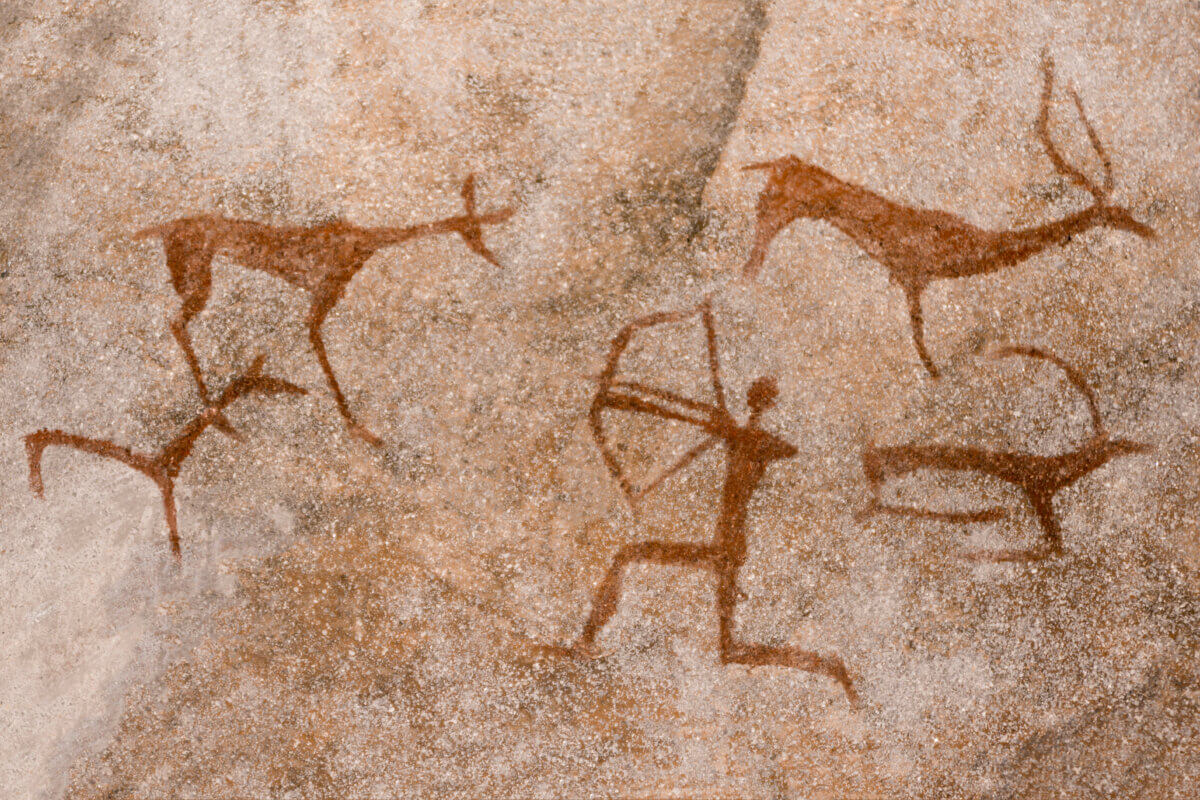
(Image by GAS-Photo on Shutterstock)
DAVIS, Calif. — When elite athletes and marathon runners enter a competition, they’re tapping into an ancient human superpower: one that may have played a crucial role in our species’ survival and evolution. While we might not outpace a cheetah in a sprint, humans possess a remarkable ability to run long distances, even in sweltering heat. This endurance, it turns out, might be more than just a quirk of biology – it could be a testament to how our ancestors hunted, survived, and ultimately thrived across the globe.
A new study published in Nature Human Behaviour provides compelling evidence for a long-debated theory: that humans evolved as persistence hunters, literally running their prey to exhaustion. This research, conducted by paleoanthropologist Eugène Morin of Trent University and anthropologist Bruce Winterhalder of UC Davis, combines cutting-edge analysis of historical records with mathematical modeling to paint a vivid picture of our running ancestors.
“To run long distances, to have an evolved gait that’s uniquely imbued with stamina is unusual in the animal world,” Winterhalder says in a statement. This unique ability has puzzled scientists for decades. Why would a “brainy ape” need marathon-running capabilities? The answer, according to the persistence hunting hypothesis, lies in our distant past.
The theory suggests that early humans, lacking sophisticated weapons, used their superior endurance and heat regulation to chase down faster animals. While an antelope or deer might easily outpace a human in a short sprint, our ancestors could keep up a steady jog for hours, gradually wearing down their prey in the scorching heat of the African savanna.
This hunting technique exploits a key difference between humans and most other mammals. Thanks to our ability to sweat profusely and our nearly hairless bodies, we can regulate our temperature far more effectively during prolonged exercise. Most animals, in contrast, must stop to pant and cool down, giving persistent human hunters a critical advantage in a long chase.

Putting persistence hunting theory to test
The idea of persistence hunting isn’t new – it was first proposed by biologist David Carrier in 1984 and further developed by Dennis Bramble and Daniel Lieberman in 2004. However, the theory has faced skepticism, with critics arguing that running is too energetically costly to be an efficient hunting method. Additionally, there seemed to be limited evidence of the practice among recent hunter-gatherer societies.
Winterhalder and Morin’s research addresses these concerns head-on. Leveraging modern technology, they scoured thousands of digitized historical accounts from explorers, missionaries, and colonial officials. This exhaustive search uncovered a treasure trove of evidence: 391 descriptions of hunts matching the persistence hunting pattern, spanning nearly 500 years and originating from 272 locations worldwide.
“We have software that allows us to search for information that dwarfs what we could do if we were trying to read through all the possible sources ourselves,” Winterhalder explains. This technological assist revealed that persistence hunting was far more widespread than previously thought, practiced in diverse environments from scorching deserts to snowy forests.
The researchers didn’t stop at historical accounts. They also employed sophisticated mathematical models to analyze the energy economics of persistence hunting. Surprisingly, their calculations showed that in certain conditions – like extreme heat or deep snow – running down prey could be as efficient, or even more so, than other hunting methods available to early humans.
Running our way through history

These findings lend strong support to the idea that endurance running played a crucial role in human evolution. Our unique physiological traits – abundant sweat glands, efficient bipedal gait, and mostly hairless bodies – suddenly make much more sense when viewed through the lens of persistence hunting.
The study also hints at the social importance of running in early human societies. Many accounts describe cooperative hunting techniques, with groups working together to track and exhaust prey. This teamwork may have fostered social bonds and allowed individuals to demonstrate their value to the group.
While modern technology has made persistence hunting obsolete in most parts of the world, our evolutionary legacy lives on in our bodies and, perhaps, in our minds. The next time you lace up your running shoes or cheer on marathon athletes, remember – you’re tapping into an ancient, uniquely human superpower that helped our species conquer the globe, one persistent step at a time.
Paper Summary
Methodology
The researchers employed a two-pronged approach. First, they conducted an extensive literature review, analyzing over 8,000 historical and ethnographic documents for descriptions of persistence hunting. They used specialized software to search for relevant keywords and manually verified each potential instance. Second, they applied mathematical models from optimal foraging theory to analyze the energy economics of persistence hunting compared to other hunting methods.
Results
The study uncovered 391 descriptions of persistence hunting from societies around the world, dating from 1527 to the early 20th century. These hunts occurred in diverse environments, challenging previous assumptions about the technique’s limitations. Mathematical modeling showed that persistence hunting could be as efficient as, or more efficient than, other hunting methods in certain conditions.
Limitations
The study relies heavily on historical accounts, which may be subject to biases or misinterpretations. Most descriptions come from before 1950, with fewer recent examples. This could reflect changing practices or reporting biases. While the study provides evidence that persistence hunting was widespread, it cannot definitively prove how common or important it was relative to other hunting methods in most societies.
Discussion and Takeaways
The findings strongly support the persistence hunting hypothesis, suggesting it deserves serious consideration in models of human evolution. The widespread nature of the practice across diverse environments indicates its versatility and potential importance to early human societies. The study also highlights the potential social and cooperative aspects of persistence hunting, which may have played a role in the development of human social structures.
Funding and Disclosures
The research was supported by a grant from the Social Sciences and Humanities Research Council of Canada. The authors declared no competing interests.


