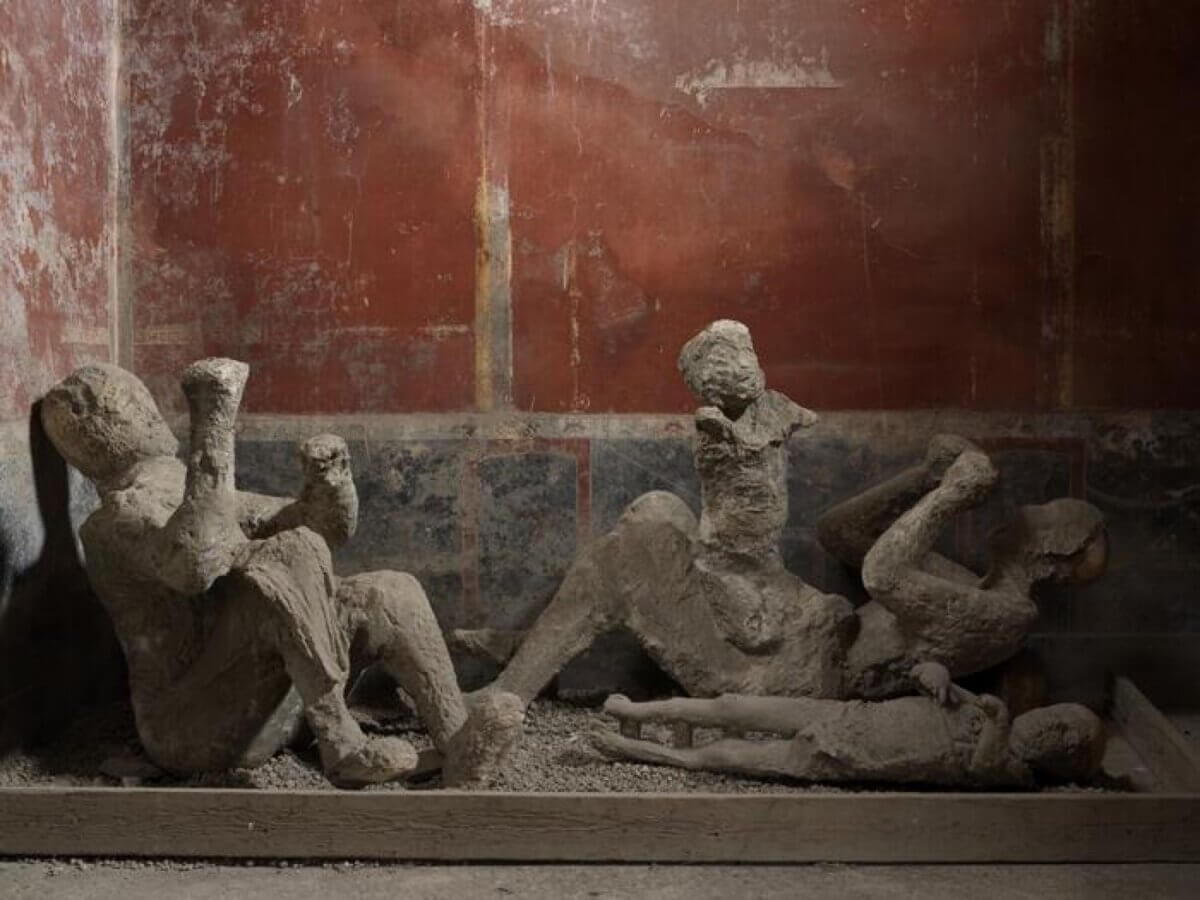
Group of casts from the House of the Golden Bracelet. Casts no. 50-51-52, date of creation 1974. (Credit © courtesy of Archaeological Park of Pompeii)
CAMBRIDGE, Mass. — The eruption of Mount Vesuvius in 79 CE was one of the most devastating natural disasters in ancient history, burying the thriving Roman city of Pompeii under a thick layer of ash and pumice. It’s also one of the most studied and talked about natural disasters in history. However, new research using ancient DNA has uncovered surprising revelations about the identities and backgrounds of some of Pompeii’s victims, challenging long-held assumptions about their lives and relationships.
By analyzing genetic material extracted from the skeletal remains encased in Pompeii’s famous plaster casts, researchers have discovered that several of the victims previously thought to be women were, in fact, biologically male. They’ve also found no evidence that some victims believed to be a family were actually related. These findings are forcing scholars to rethink their understanding of gender roles and family structures in ancient Roman society.
“The scientific data we provide do not always align with common assumptions,” says David Reich of Harvard University in a media release. “For instance, one notable example is the discovery that an adult wearing a golden bracelet and holding a child, traditionally interpreted as a mother and child, were an unrelated adult male and child. Similarly, a pair of individuals thought to be sisters, or mother and daughter, were found to include at least one genetic male. These findings challenge traditional gender and familial assumptions.”
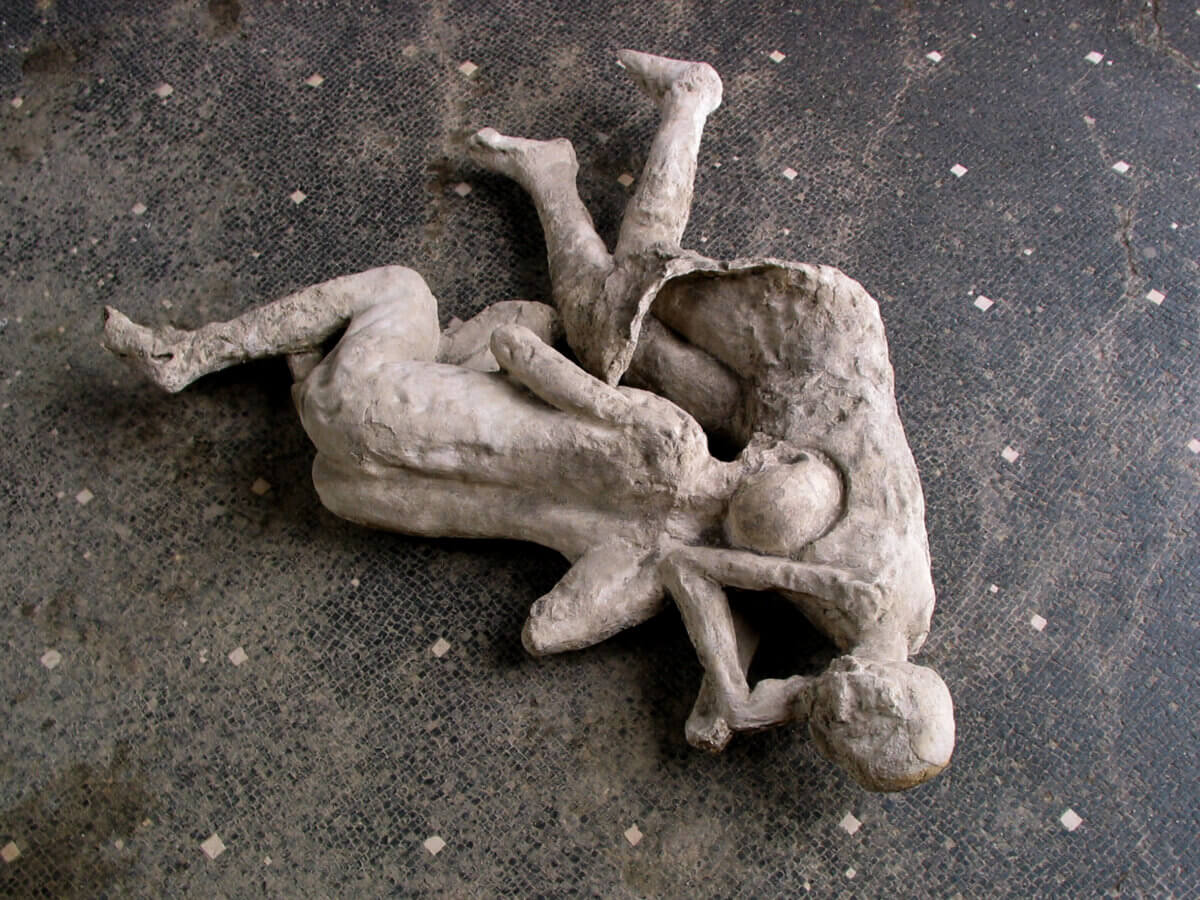
The study, led by a team of archaeologists and geneticists from Italy, the United States, and Germany, focused on 14 different plaster casts representing victims from three key locations in Pompeii: the House of the Golden Bracelet, the House of the Cryptoporticus, and the Villa of the Mysteries. By extracting and analyzing ancient DNA from the skeletal remains preserved within the casts, the researchers were able to determine the biological sex and genetic ancestry of these long-dead individuals.
One of the most surprising revelations came from the House of the Golden Bracelet, where the bodies of four victims – two adults and two children – were found in close proximity. Previous interpretations had suggested this was a family group, with the adult female victim wearing an elaborate golden bracelet being the mother. However, the genetic analysis showed that all four individuals were actually biologically male, undermining the idea of a related family unit.
Similarly, at the House of the Cryptoporticus, the remains of two individuals who had been thought to be female, possibly sisters or a mother and daughter, were also determined to be male based on their DNA.
“Our findings have significant implications for the interpretation of archaeological data and the understanding of ancient societies,” says study team member Alissa Mittnik, also from Harvard University. “They highlight the importance of integrating genetic data with archaeological and historical information to avoid misinterpretations based on modern assumptions. This study also underscores the diverse and cosmopolitan nature of Pompeii’s population, reflecting broader patterns of mobility and cultural exchange in the Roman Empire.”
The genetic data also provided insights into the ancestry and geographic origins of the Pompeii victims. The analysis revealed that the individuals had diverse ancestral backgrounds, with origins ranging from the Levant (modern-day Syria and Lebanon) to North Africa and Anatolia (modern-day Turkey). This reflects the cosmopolitan nature of the Roman Empire at the time, with Pompeii serving as a thriving port city that attracted people from across the Mediterranean world.
“Besides emphasizing the cosmopolitanism and mobility that shaped urban Roman Imperial populations, this study illustrates how unreliable narratives based on limited evidence can be, often reflecting the worldview of the researchers at the time,” the researchers write in the journal Current Biology.
Paper Summary
Methodology
To conduct the genetic analysis, the researchers took samples of bone fragments mixed with plaster from 14 different plaster casts representing Pompeii victims. They then used advanced techniques to extract and analyze ancient DNA from these samples, including quantifying the concentration and degradation of the DNA, as well as using a hybridization-based approach to enrich mitochondrial DNA and over 1 million target regions in the nuclear genome.
Based on the genetic data, the researchers were able to determine the biological sex of five individuals, all of whom were found to be genetically male. They also analyzed the individuals’ ancestry, finding that they had diverse origins in the eastern Mediterranean and North Africa. Additionally, the researchers found no evidence that any of the individuals were closely related to one another, despite previous interpretations suggesting family connections.
Key Results
At the House of the Golden Bracelet, the four individuals previously thought to be a family group – two adults and two children – were all found to be biologically male, contradicting the idea of a related family unit.
At the House of the Cryptoporticus, the two individuals believed to be female, possibly sisters or a mother and daughter, were also determined to be male based on their DNA.
The genetic data revealed diverse ancestral backgrounds among the Pompeii victims, with origins ranging from the Levant to North Africa and Anatolia, reflecting the cosmopolitan nature of the Roman Empire at the time.
None of the individuals analyzed showed evidence of being closely related to one another, despite previous interpretations suggesting family connections.
Study Limitations
The researchers note that their sample size was relatively small, with genetic data obtained from only 5 of the 14 plaster casts they examined. Additionally, the highly fragmented nature of the skeletal remains and the presence of plaster material made the DNA extraction and analysis challenging.
Discussion & Takeaways
The findings from this study challenge long-held assumptions about the identities and relationships of the Pompeii victims, forcing scholars to reconsider their understanding of gender roles and family structures in ancient Roman society. By integrating genetic data with archaeological evidence, the researchers were able to provide a more nuanced and accurate picture of the lives and backgrounds of these individuals.
The study also highlights the importance of using modern scientific techniques, such as ancient DNA analysis, to reexamine and reinterpret historical narratives that may have been shaped by the biases and assumptions of earlier researchers. As the authors note, “this study illustrates how unreliable narratives based on limited evidence can be, often reflecting the worldview of the researchers at the time.”
Funding & Disclosures
This research was funded by several sources, including grants from the Italian Ministry of Research, the National Institutes of Health, the John Templeton Foundation, and the Allen Discovery Center program. The authors declare no competing interests.


