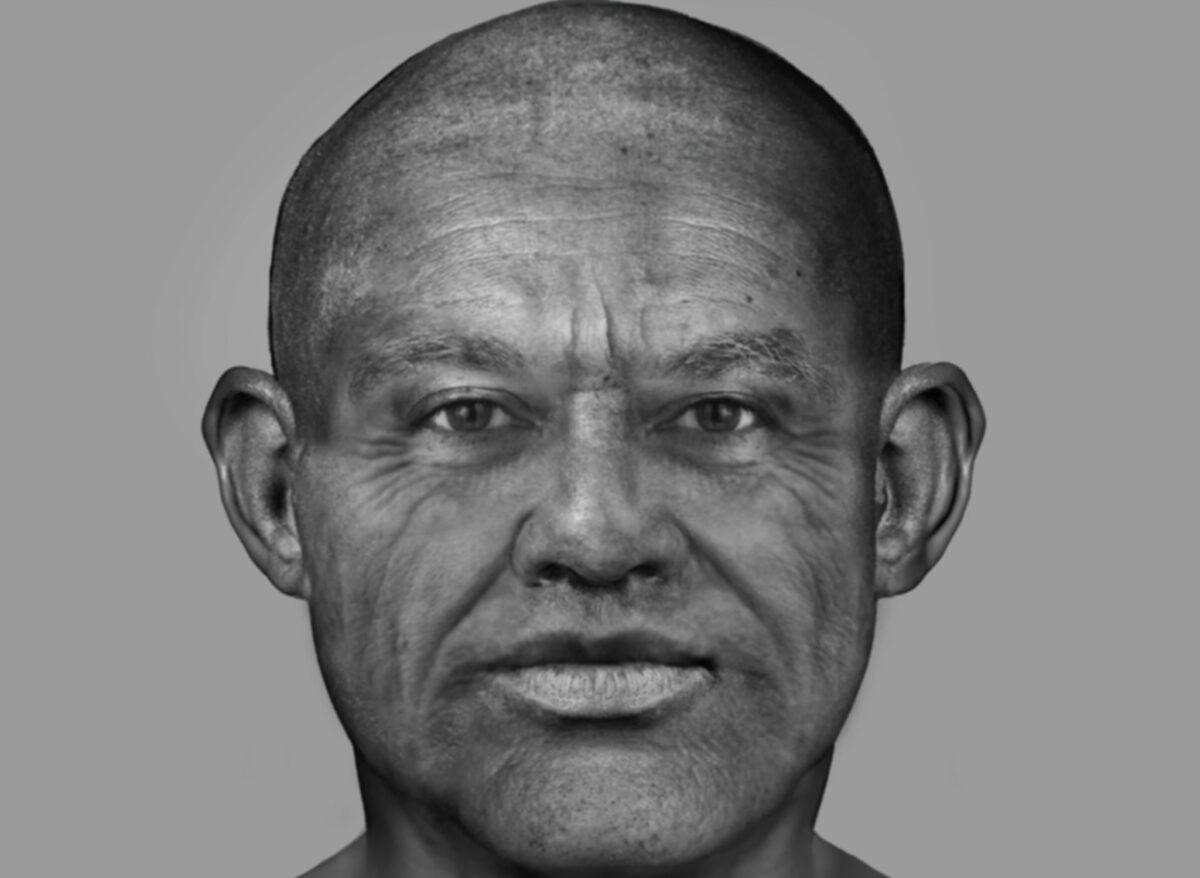
Final facial depiction of the Nuwayrat individual. (Credit: Jacobs et al / Nature)
In a Nutshell
- The first complete ancient Egyptian genome shows this 4,800-year-old individual had mostly North African ancestry with a significant Neolithic Mesopotamian component.
- It provides rare direct genetic evidence supporting the idea that cultural links between Egypt and Mesopotamia included actual migration, not just trade.
- The findings are based on a single high-status burial and may not represent the entire ancient Egyptian population.
LONDON — For the first time, scientists have successfully decoded the complete genome of an ancient Egyptian who lived nearly 5,000 years ago. The results from this single individual challenge assumptions about early Egyptian ancestry, showing that this pyramid-era man carried genetic material from both North African and Middle Eastern populations.
The study, published in Nature, provides rare direct genetic evidence supporting the possibility that cultural exchanges also involved actual human migration.
How Scientists Decoded the First Ancient Egyptian Genome
Researchers from Francis Crick Institute and Liverpool John Moores University extracted DNA from a man buried in a ceramic pot near Beni Hasan, 265 kilometers south of Cairo. Radiocarbon dating placed his death between 2855 and 2570 BCE, making him a contemporary of the Great Pyramid’s construction. His burial method — interment in pottery within a rock-cut tomb — was typically reserved for higher-status individuals.
Getting usable DNA from ancient Egyptian remains has historically proven nearly impossible due to Egypt’s harsh climate. Previous attempts yielded only limited genetic data from much later periods, thousands of years after the height of ancient Egyptian civilization. The ceramic pot burial may have created conditions that helped preserve DNA molecules.
The genetic analysis revealed that most of the man’s ancestry traced back to populations represented by Middle Neolithic Morocco. The remainder came from populations most closely related to Neolithic Mesopotamia, the region encompassing ancient Iraq and surrounding areas.
What This Pyramid-Era Egyptian Looked Like
“Piecing together all the clues from this individual’s DNA, bones and teeth have allowed us to build a comprehensive picture,” says first author Adeline Morez Jacobs, Visiting Research Fellow and former PhD student at Liverpool John Moores University, in a statement. “We hope that future DNA samples from ancient Egypt can expand on when precisely this movement from West Asia started.”
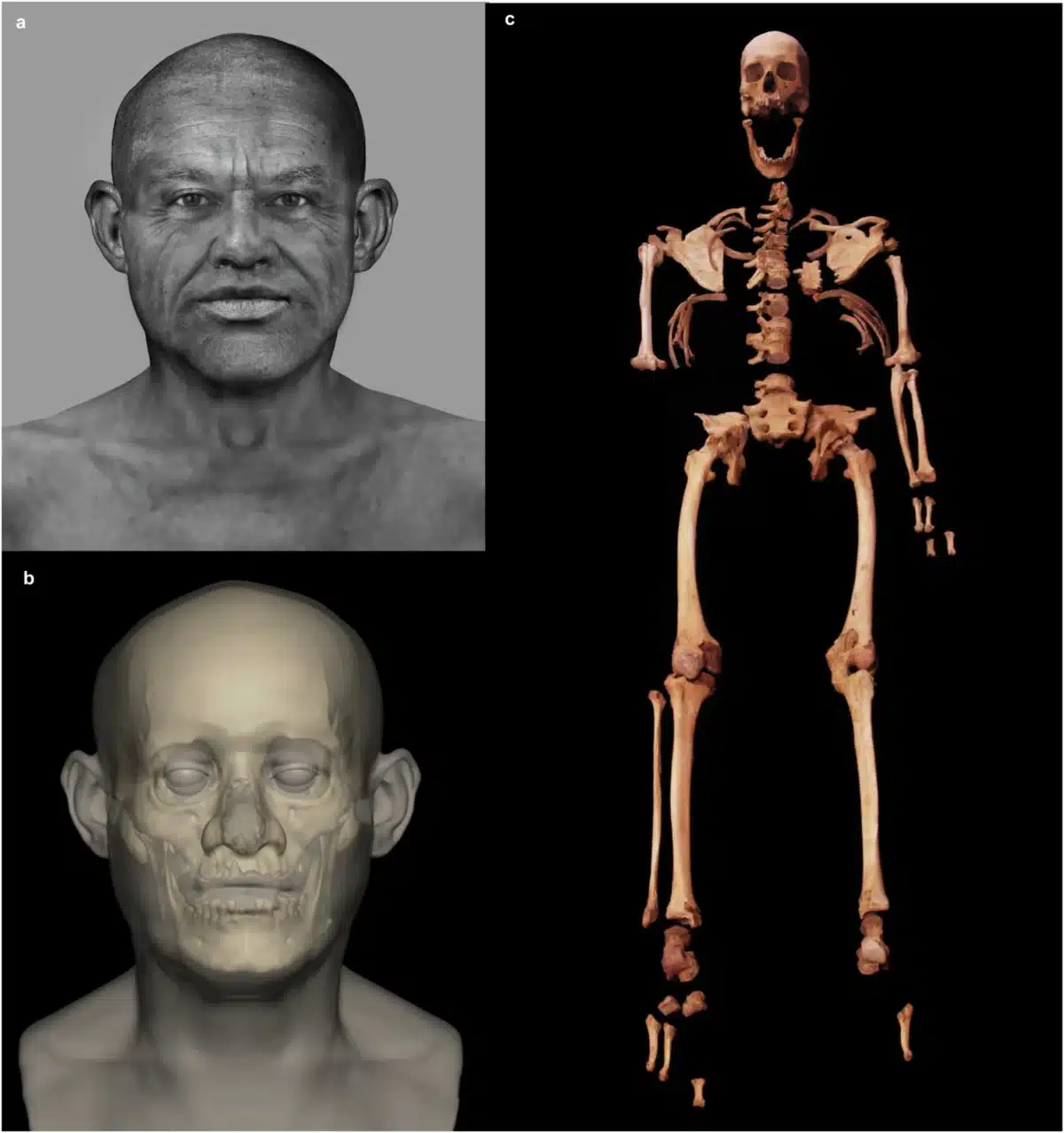
Standing approximately 157-160 centimeters tall (about 5 feet 2 inches to 5 feet 3 inches), he lived to an advanced age for his time, likely between 44 and 64 years old. Genetic analysis predicted he had brown eyes, brown hair, and dark skin pigmentation.
His heavily worn teeth and severe arthritis throughout his joints and spine indicated “an extended period of physical labour,” according to the researchers. This creates an intriguing contrast with his high-status burial. The bone wear patterns suggested activities that some researchers believe could indicate he worked as a potter.
Chemical analysis of his teeth confirmed he grew up in the Nile Valley’s hot, dry climate and consumed what the paper describes as “an omnivorous diet based on terrestrial animal protein and plants, such as wheat and barley.”
DNA Proves Migration Between Ancient Egypt and Mesopotamia
The presence of Middle Eastern ancestry provides rare direct genetic evidence that connections between early Egypt and Mesopotamia might have involved population movement, not just cultural exchange. As the researchers note: “This genetic affinity is similar to the ancestry appearing in Anatolia and the Levant during the Neolithic and Bronze Age.”
Archaeological evidence shows trade networks and cultural similarities between Egypt and Mesopotamia dating back to at least 6000 BCE, including shared technologies, domesticated species, and early writing systems. However, the genetic data transforms understanding of these connections from primarily economic and cultural exchanges to potentially include human migration.
“This individual has been on an extraordinary journey. He lived and died during a critical period of change in ancient Egypt, and his skeleton was excavated in 1902 and donated to World Museum Liverpool, where it then survived bombings during the Blitz that destroyed most of the human remains in their collection,” said co-senior author Linus Girdland Flink, a lecturer in ancient biomolecules at the University of Aberdeen. “We’ve now been able to tell part of the individual’s story, finding that some of his ancestry came from the Fertile Crescent, highlighting mixture between groups at this time.”
Why This Egyptian DNA Study Needs More Research
The study’s authors acknowledge their work had notable limitations: “Although our analyses are limited to a single Egyptian individual who, on the basis of his relatively high-status burial, may not be representative of the general population, our results revealed ancestry links to earlier North African groups and populations of the eastern Fertile Crescent.”
The challenging DNA preservation conditions in Egypt have prevented similar analyses from other individuals and time periods. Regional variations across ancient Egypt remain unexplored due to the lack of additional ancient DNA samples.
The research also examined later Egyptian populations, finding that individuals from Egypt’s Third Intermediate Period (approximately 1000–700 BCE) showed increased Levantine ancestry. Modern Egyptian populations display even more genetic diversity, with ancestry components from this ancient individual, Middle Eastern groups, and more recent East and West African contributions.
This single ancient genome demonstrates that at least some early Egyptians carried ancestry from distant regions, supporting archaeological evidence of long-distance connections. However, much more research is needed to understand the full picture of ancient Egyptian population genetics and how representative this individual was of his contemporaries.
Paper Summary
Methodology
Researchers extracted DNA from seven teeth of an adult male Egyptian individual discovered at Nuwayrat, near Beni Hasan, Egypt. The remains were radiocarbon dated to 2855–2570 BCE, placing them in the Early Dynastic to Old Kingdom periods. DNA was extracted using specialized ancient DNA techniques and sequenced to 2× genome coverage. The team used principal component analysis, ADMIXTURE clustering, and qpAdm modeling to determine genetic ancestry components. They compared the ancient genome with 3,233 present-day individuals and 805 ancient individuals from various global populations.
Results
The analysis revealed that approximately 77.6% of the individual’s ancestry derived from populations similar to Middle Neolithic Moroccans, representing North African lineages, while 22.4% traced to Neolithic Mesopotamian populations. The individual was genetically male, predicted to have brown eyes, brown hair, and dark skin pigmentation. Isotope analysis confirmed he grew up in the Nile Valley consuming a typical ancient Egyptian diet. Comparison with later Egyptian populations showed increased Levantine ancestry over time, while modern Egyptians display additional East and West African genetic components.
Limitations
The study’s conclusions are based on a single individual’s genome, limiting broader population-level inferences. The individual’s high-status burial may not represent the general ancient Egyptian population. The challenging DNA preservation conditions in Egypt have prevented similar analyses from other individuals and time periods. Regional variations across ancient Egypt remain unexplored due to the lack of additional ancient DNA samples.
Funding and Disclosures
The study was supported by the European Research Council (grant no. 852558 to P.S.), a Sir Henry Wellcome Fellowship (220457/Z/20/Z to L.S.), the European Molecular Biology Organization, the Vallee Foundation, the Wellcome Trust (217223/Z/19/Z), and The Francis Crick Institute core funding from Cancer Research UK, the UK Medical Research Council, and the Wellcome Trust. The authors declared no competing interests.
Publication Information
This research was published in Nature on July 2, 2025. The paper is titled “Whole-genome ancestry of an Old Kingdom Egyptian” and was authored by Adeline Morez Jacobs and colleagues from multiple institutions including Liverpool John Moores University, The Francis Crick Institute, and the University of Aberdeen. The research is available as open access under DOI: 10.1038/s41586-025-09195-5.


