
How do freezing temperatures persist even though the world is warming? (© Masque - stock.adobe.com)
DURHAM, N.C. — Long before humans walked the Earth, when dinosaurs roamed supercontinent Pangea and greenhouse gas levels soared far beyond today’s measurements, a powerful climate pattern was already influencing global weather systems. New research reveals that El Niño, the periodic warming of the tropical Pacific Ocean that can trigger worldwide weather disruptions, has been actively shaping Earth’s climate for at least 250 million years – and it was often more intense than what we experience today.
In a study published in the Proceedings of the National Academy of Sciences, an international team of researchers used sophisticated climate modeling to peer deep into Earth’s past. They discovered that the El Niño-Southern Oscillation (ENSO) has remained Earth’s dominant mode of year-to-year climate variability throughout this vast period. This finding challenges previous uncertainties about the longevity and stability of this crucial climate pattern and provides new insights into how it might behave in our warming world.
The study reveals that El Niño-Southern Oscillation strength varied significantly over time, with some periods showing oscillations twice as strong as those we observe today. Surprisingly, these variations weren’t directly linked to global average temperatures or even to the temperature difference between the eastern and western Pacific – factors that scientists had previously thought might control ENSO’s intensity.
To understand ENSO’s importance, imagine the tropical Pacific Ocean as a giant bathtub of warm water. Usually, trade winds blow from east to west, pushing warm water toward Asia and allowing cooler deep water to well up near South America. During an El Niño event, these winds weaken, allowing warm water to spread eastward across the Pacific. This creates a massive patch of unusually warm water that can alter weather patterns globally – drying out the U.S. Northwest while drenching the Southwest with unusual rains.
Its counterpart, La Niña, occurs when the waters become unusually cool, pushing the jet stream northward and potentially triggering droughts in the southwestern United States and East Africa while intensifying South Asian monsoons.
Using the same climate modeling tool employed by the Intergovernmental Panel on Climate Change (IPCC), the researchers conducted what amounts to a virtual time machine experiment. However, instead of projecting into the future, they looked backward, examining Earth’s climate at 26 different time points, each separated by 10 million years, spanning back 250 million years.
“To our knowledge, there were no other studies systematically investigating the geological history of ENSO, due to the lack of geological evidence in the deep past,” study lead author Dr. Xiang Li, from Duke University’s Nicholas School of the Environment, tells StudyFinds. “The most exciting point is that the ENSO is persistently active as far back as 250 million years ago in our simulations. In addition, it is surprising to see the amplitude of ENSO varies greatly in the geological past.”
Li and co-author Shineng Hu found nearly all their models of the El Niño Southern Oscillation were more intense than what we see today. Some were “way stronger, some slightly stronger.”
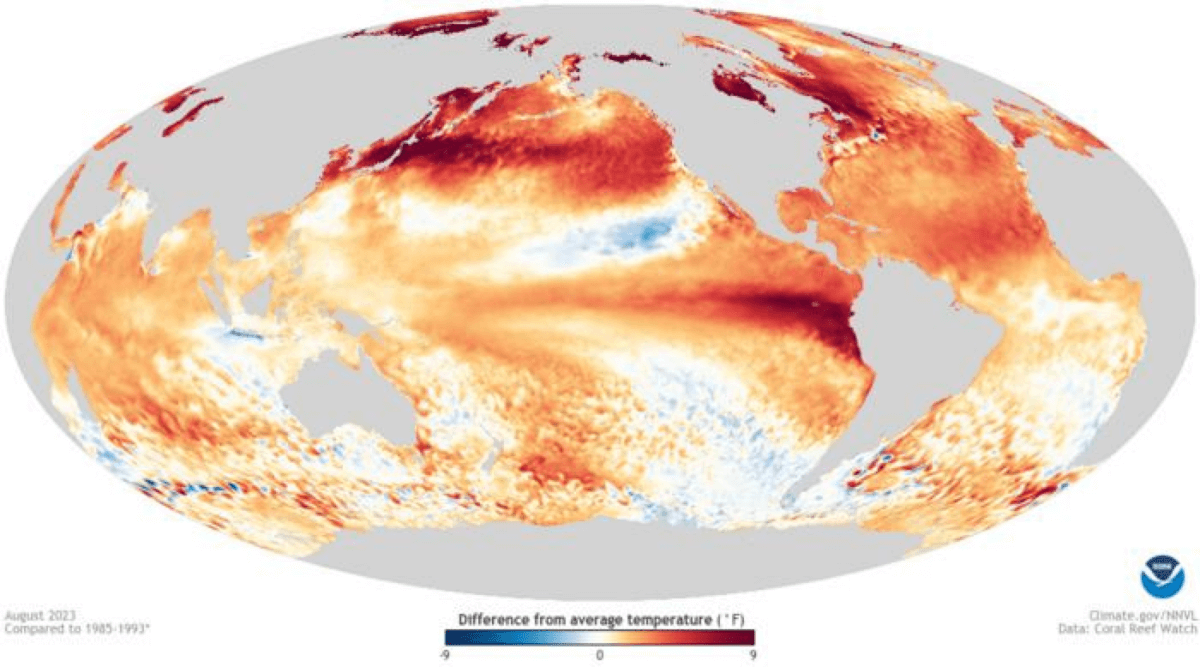
“In modern climate, ENSO is the dominant mode of climate variability on year-to-year timescales and affects global climate and extreme weather events through air-sea interactions and teleconnections. Thus, knowing that ancient El Nino events were more intense may provide valuable hints for us in understanding significant climate transitions,” Li tells StudyFinds. “For example, some mass extinction events were shown to be closely related to climate change, on which ENSO may play an indispensable role and further efforts should be made.”
The simulations revealed two key factors controlling ENSO’s strength throughout history: the depth of the thermocline (the boundary between warm surface waters and cold deep waters) in the western Pacific Ocean and variations in wind patterns over the tropical Pacific. Together, these factors explained about 76% of ENSO’s amplitude variations over time.
The authors liken the oscillation to a pendulum, with atmospheric winds acting as random kicks that can influence its swing.
“The pendulum describes an alternation between warm phase El Niño and cold phase La Niña events,” Li explains. “During El Niño, anomalous sea surface temperature warming appears in the central and eastern equatorial Pacific, while anomalously cool sea surface temperatures are found there during La Niña events. Such dynamical changes have important climatic impacts.
“For example, during El Niño events, the eastward shift of convection promotes drought and forest fires in southeast Asia bordering the western Pacific, but severe rainfall and floods in the regions of the eastern equatorial Pacific,” he continues. “Roughly opposite impacts are observed during La Niña. Therefore, the alternation of ENSO events has influential climatic, economic, and societal impacts which strongly affects the future of our planet.”
The research team had to overcome significant computational challenges. The simulations were so complex that they couldn’t model each year continuously from 250 million years ago. Instead, they created detailed climate snapshots at 10-million-year intervals. Each simulation required months to complete and ran for thousands of model years to ensure reliable results.
These simulations had to account for dramatically different conditions than those we see today. During the Mesozoic period, 250 million years ago, the continents were merged into the supercontinent Pangea, with South America located in its center. The ENSO pattern occurred in the vast Panthalassic Ocean to the west. Solar radiation reaching Earth was about 2% lower than today, but atmospheric CO2 levels were much higher, resulting in significantly warmer oceans and atmosphere than we have today.
“If we want to have a more reliable future projection, we need to understand past climates first,” notes Hu.
The study’s findings have important implications for understanding how ENSO might behave as Earth continues to warm due to greenhouse gas emissions. While previous research has focused primarily on ocean temperatures, this study suggests that scientists should pay equal attention to wind patterns when trying to predict future ENSO behavior.
This historical perspective provides crucial context for understanding how this vital climate pattern might respond to future warming scenarios. Moving forward, Hu and his team plan to continue studying ENSO events and how they might impact the planet in years ahead.
“We are going to investigate more on different characteristics of El Niño and La Niña events in the past. For example, we noticed that there were multi-year El Niño and La Niña events in our simulations for the past climates,” Li explains. “On the other hand, climate scientists have pointed out long La Niña events could rise in frequency as our planet warms. Therefore, further efforts are going to be made for a better understanding of the duration of ENSO events and how it would change in a warmer climate, to provide implications for future ENSO and climate projections.”
Paper Summary
Methodology
The researchers used the Community Earth System Model, a sophisticated climate simulation tool, to recreate Earth’s climate at 26 different points in time. For each time slice, they input known or estimated data about continental positions, ocean depths, atmospheric CO2 levels, and solar radiation. Each simulation ran for over 4,000 model years to ensure stable results. The model had to account for vastly different conditions, including alternative continental arrangements, varying CO2 levels, and different amounts of solar radiation reaching Earth.
Key Results
The study found that ENSO remained active throughout the entire 250-million-year period, with its strength varying by a factor of two between peak and minimum periods. The strongest activity occurred around 150 million years ago, while the weakest occurred during the pre-industrial period. The research identified two primary controlling factors: thermocline depth and atmospheric wind variations, which together explained about 76% of ENSO’s amplitude variations through time.
Study Limitations
The study relies on computer models that must make certain assumptions about past conditions. The accuracy depends on input data quality regarding ancient geography, CO2 levels, and other factors, which become less certain further back in time. The model’s relatively coarse resolution (3.75° × 3.75° grid) could affect some results’ precision. Additionally, the researchers could only examine discrete time points rather than creating a continuous simulation due to computational limitations.
Discussion & Takeaways
The research demonstrates ENSO’s remarkable resilience as a fundamental feature of Earth’s climate system, persisting through dramatic changes in global temperature and geography. The identification of thermocline depth and atmospheric noise as key controlling factors provides new focus areas for predicting future ENSO behavior. While the study suggests ENSO will likely persist in a warming world, its strength may change based on how these key factors evolve.
Funding & Disclosures
The research was supported by the National Natural Science Foundation of China (grant 42488201) and the Swedish Research Council Vetenskapsrådet (2022-03617). Simulations were conducted at the High-performance Computing Platform of Peking University. The authors declared no competing interests. The study represented a collaborative effort involving researchers from multiple institutions, including Peking University, Duke University, Ocean University of China, Xiamen University, Chinese Academy of Sciences, and Lund University.


