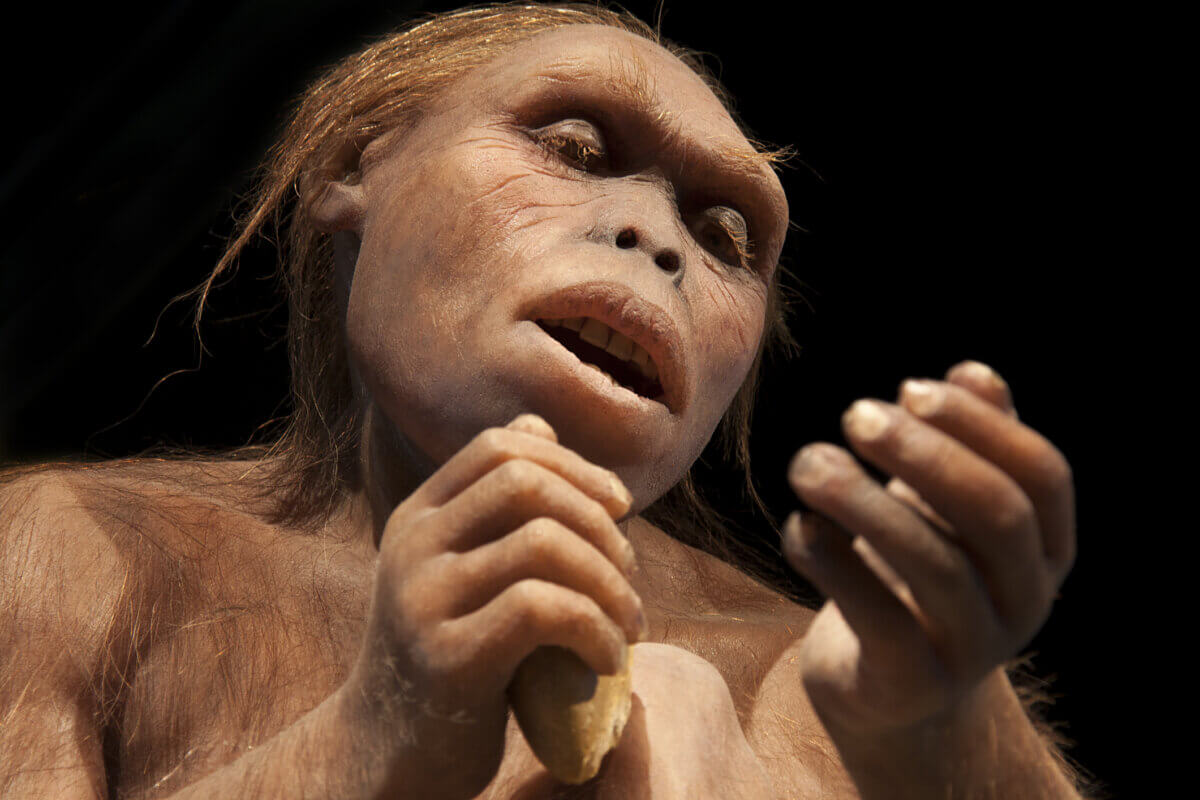
Model depicting Australopithecus afarensis. (Credit: © Procyab | Dreamstime.com)
JOHANNESBURG — Breaking new ground in our understanding of early human diet and evolution, scientists have discovered that our ancient relatives may not have been the avid meat-eaters previously believed. Research reveals that Australopithecus, one of humanity’s earliest ancestors who lived in South Africa between 3.7 and 3.3 million years ago, primarily maintained a plant-based diet rather than regularly consuming meat.
Scientists have long debated when our ancestors began regularly consuming meat, as this dietary shift has been linked to several crucial evolutionary developments, including increased brain size and reduced gut size. Many researchers believed meat-eating began with early human ancestors like Australopithecus, partly because stone tools and cut marks on animal bones have been found dating back to this period.
“Tooth enamel is the hardest tissue of the mammalian body and can preserve the isotopic fingerprint of an animal’s diet for millions of years,” says geochemist Tina Lüdecke, the study’s lead author, in a statement. As head of the Emmy-Noether Junior Research Group for Hominin Meat Consumption at the Max Planck Institute for Chemistry and Honorary Research Fellow at the University of the Witwatersrand, Lüdecke regularly travels to Africa to collect fossilized teeth samples for analysis.
When living things digest food and process nutrients, they create a kind of chemical signature involving different forms of nitrogen. Think of it like leaving footprints in sand. Herbivores leave one type of print, while meat-eaters leave another. By examining these ancient chemical footprints preserved in tooth enamel, scientists can determine what kinds of foods an animal ate. Meat-eaters consistently show higher levels of a specific form of nitrogen compared to plant-eaters.
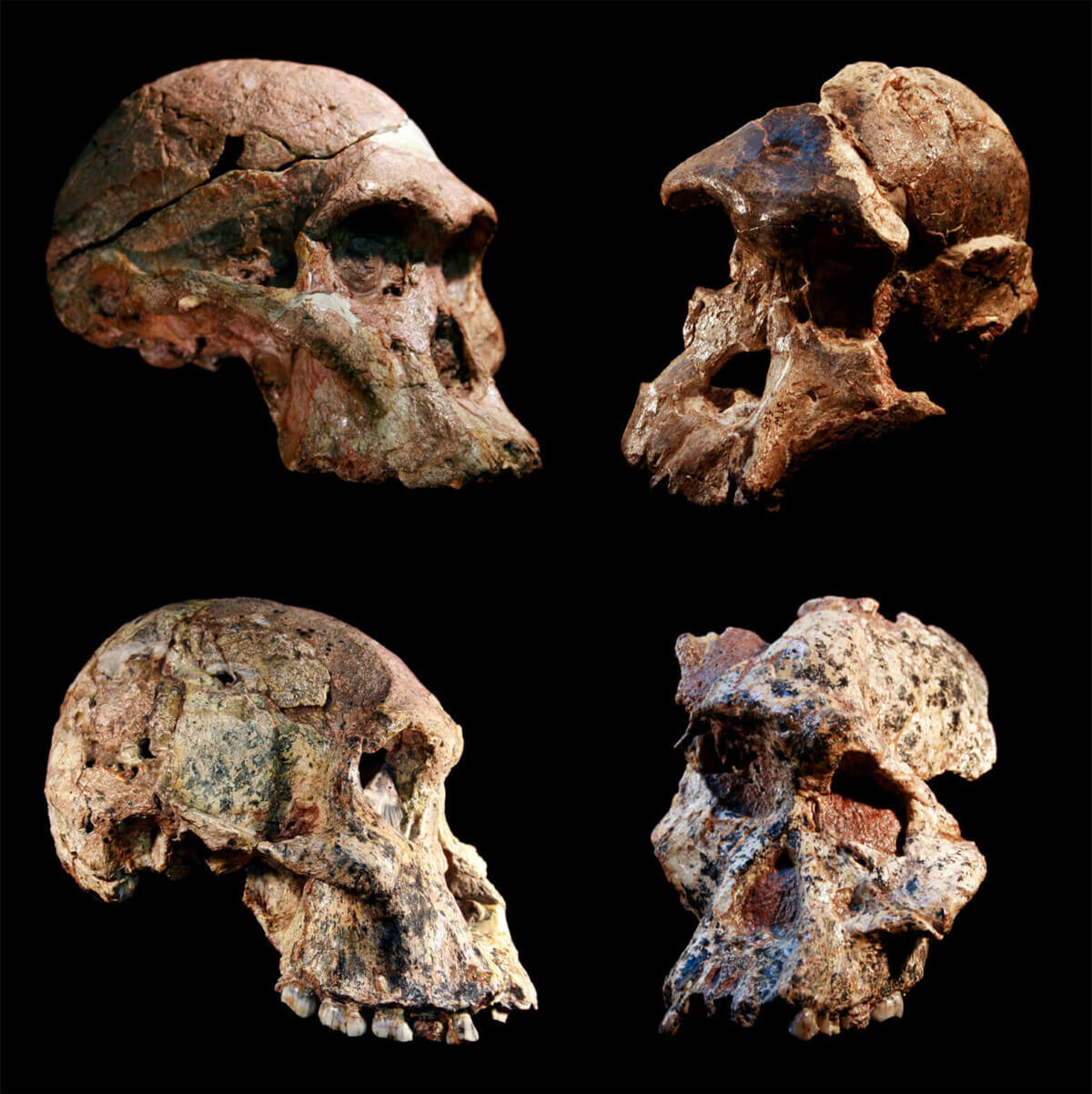
The research, published in Science, focused on specimens from the Sterkfontein cave near Johannesburg, part of South Africa’s “Cradle of Humankind,” an area renowned for its abundant early hominin fossils. Using innovative chemical analysis techniques, researchers examined fossilized teeth from seven Australopithecus specimens, comparing them with teeth from other animals that lived alongside them, including ancient relatives of antelopes, cats, dogs, and hyenas.
The findings challenge long-held assumptions about early human diet. The Australopithecus specimens showed nitrogen levels similar to plant-eaters and significantly lower than meat-eaters from the same period. However, they demonstrated remarkable dietary flexibility. The seven specimens showed more variation in their chemical signatures than any other species studied, suggesting they could adapt their diet based on what foods were available.
“This method opens up exciting possibilities for understanding human evolution, and it has the potential to answer crucial questions, for example, when did our ancestors begin to incorporate meat in their diet? And was the onset of meat consumption linked to an increase in brain volume?” says Alfredo Martínez-García from the Max Planck Institute for Chemistry.
The study also revealed that these early humans mainly ate C3 plants — trees, shrubs, and herbs — rather than grasses. Although the occasional consumption of small animals or insects cannot be ruled out, the study does not provide direct evidence of this behavior. Instead, the findings indicate that Australopithecus primarily relied on plant-based foods, potentially including energy-rich sources such as tubers, corms, or legumes.
Looking ahead, the research team plans to expand their investigation by collecting data from different early human species and time periods across eastern and southern Africa, as well as southeast Asia. This broader perspective could help pinpoint when regular meat consumption began and whether it provided evolutionary advantages.
“This work represents a huge step in extending our ability to better understand diets and trophic level of all animals back into the scale of millions of years,” notes Professor Dominic Stratford, Director of Research at the Sterkfontein Caves and study co-author.
This research not only changes our understanding of early human diet but also raises fascinating questions about human evolution. If Australopithecus thrived on a primarily plant-based diet, researchers must now investigate what other factors – beyond meat consumption – contributed to the development of larger brains and other distinctly human characteristics.
Paper Summary
Methodology
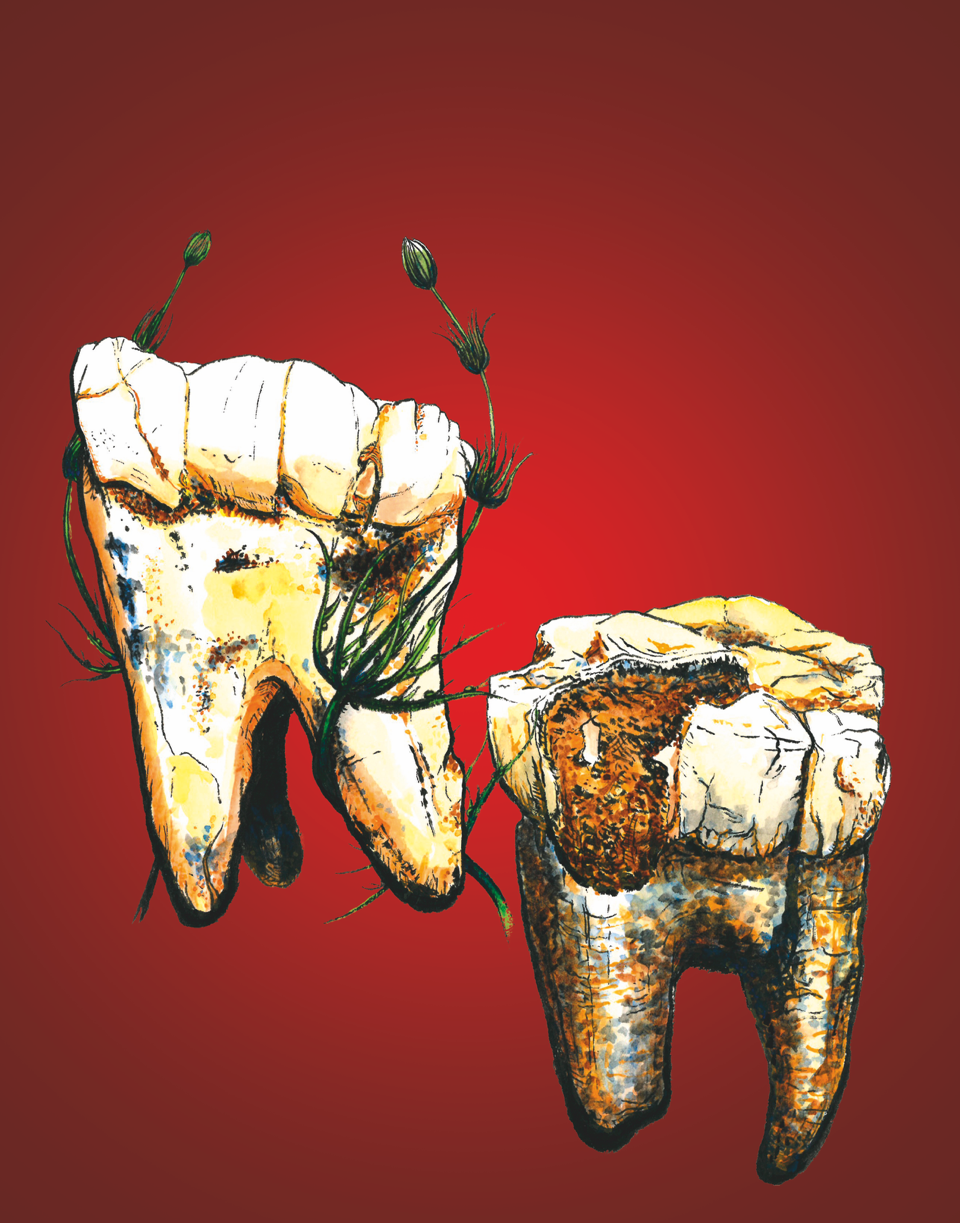
The researchers used a novel technique analyzing nitrogen isotopes preserved in tooth enamel, which survives far longer than other biological materials like collagen. They examined 43 fossil specimens from Sterkfontein Member 4 deposits, including seven Australopithecus teeth, comparing their isotope ratios with those of known herbivores and carnivores from the same period. This established a baseline for understanding different dietary patterns.
Results
The study found that Australopithecus specimens had nitrogen isotope values similar to herbivores and significantly lower than carnivores, indicating a primarily plant-based diet. The specimens showed the highest dietary variability of any species studied, with a range of 6.7‰ in nitrogen isotope values. Carbon isotope analysis revealed they mainly consumed C3 plants with some C4 plant matter.
Limitations
The sample size of seven Australopithecus specimens is relatively small. Two of the specimens were first molars, which form before weaning and could show elevated nitrogen values due to nursing rather than diet. The findings also only represent one geographic location and time period, so they may not reflect the dietary patterns of all Australopithecus populations.
Discussion and Takeaways
This research challenges previous assumptions about early hominin meat consumption and suggests that regular meat-eating emerged later in human evolution than previously thought. The high dietary variability observed in Australopithecus suggests they were adaptable opportunistic feeders, which may have contributed to their evolutionary success.
Funding and Disclosures
The study was funded by the Max Planck Society, the German Research Foundation Emmy Noether Fellowship, the Human Frontiers Science Program, and the Scott Fund of Princeton University’s Department of Geosciences. The authors declared no competing interests.
Publication Information
Published in Science (Volume 387, pages 309-314) on January 17, 2025, under the title “Australopithecus at Sterkfontein did not consume substantial mammalian meat” by Tina Lüdecke and colleagues.


The Homo species whose brains grew 25 times faster and that now are the only animals that can speak, started on that journey about 2.5 million years ago, from Australopithecus. Some human groups are 100% vegetarian and some ape-brained hominids seem to have hunted (Flores hobbits) and made advanced tools. So its hard to see how meat eating can have driven human brain expansion. This Substack argues that Australopithecus and their ancestors made and used wooden spears that were seldom preserved with their fossils, to gain access to savanna resources.
https://jayjay4547.substack.com/p/using-ai-to-reconstruct-australopithecus
lol…early modern humans (H. Sapiens) began to exist 300K years ago. Australopithecus and Homo erectus are hominids (great apes).
Some primates with the Australopithecus body plan survived until nearly modern times on the Indonesian island of Flores, while more fossils have been found who shared a 25 times more rapid brain growth
I
Total BS.
Australopithicus was basically a Monkey, so they probably ate anything they could get their hands on, plant or animal.
F
I study this. Broadly, not in one area. This is very disingenuous. Broadly, they did not. regionally some did. More people ate meat in more areas
Really? We already knew this. We have known that the Australopithenes were plant eaters by their body form. They existed at the same time as the Early Homo species, that we ALREADY knew ate meat. The early homo species had a larger brain housing than the Australopithecenes which were approximately the same size in stature. In addition Australopithecus had a much larger digestive cavity than did the early homo species. Brain size and gut size are all indications of plant vs meat diet. They cannot find any evidence that Australopithecus continued to evolve. It hit an evolutionary dead end while the meat-eating variety continued on the path of evolutionary development. So, basically, barring a testing of enamel, NO NEW INFORMATION HAS TRANSPIRED.
This information has been covered several times over the years in several papers and has even been covered in documentaries. The series “Miracle Planet” from 2003 also covered this then.
I have heard that Human’s were NOT on the planet until AFTER Pollen was found (ice core studies in the Arctic/Antarctic).
All lies.
Looks like you can’t handle the truth.????????
Lies? About what?