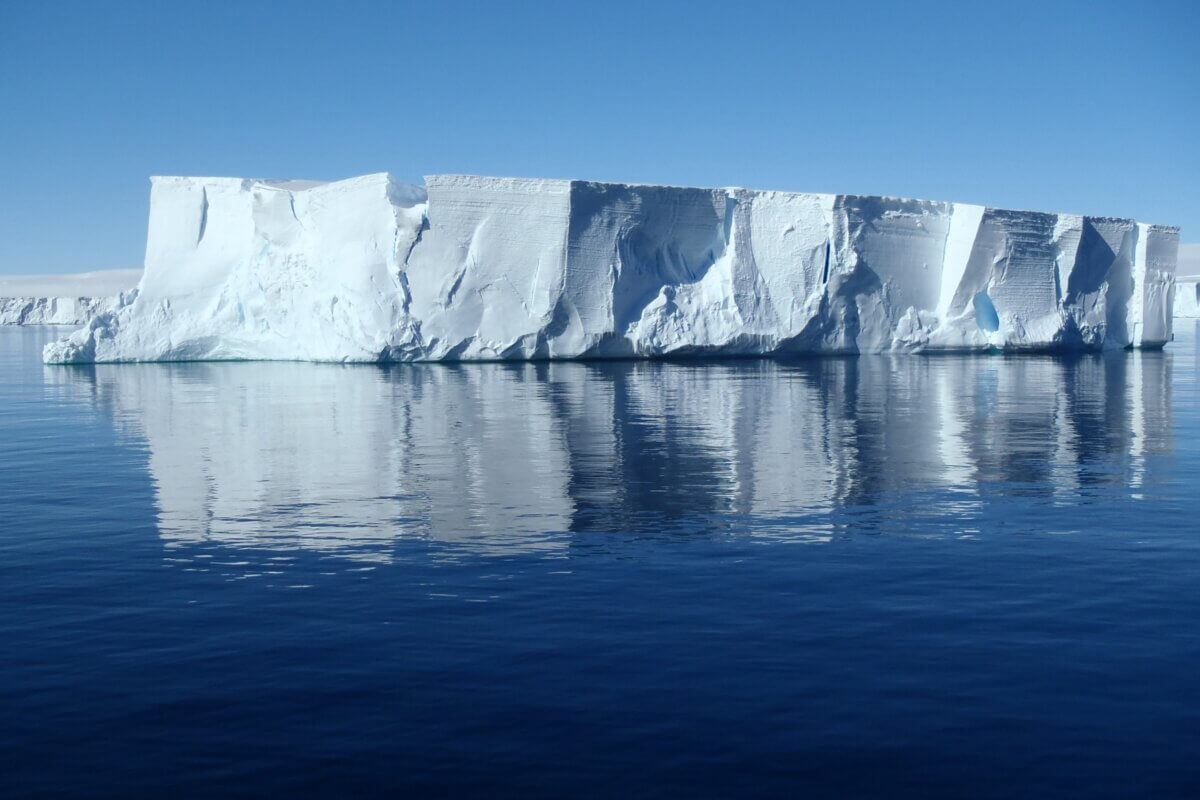
Icebergs near Bear Peninsula in West Antarctica are being studied as part of the International Thwaites Glacier Collaboration. (Photo by Amy Chiuchiolo, National Science Foundation, licensed under CC BY 4.0 - cropped from original)
HANOVER, N.H. — The melting of ice sheets in Antarctica has long been a major concern for scientists studying climate change and sea level rise. Previous research suggested that parts of the West Antarctic Ice Sheet could collapse rapidly due to a process called marine ice cliff instability (MICI). However, a new study published in Science Advances challenges this idea, suggesting that the ice sheet may be more stable than previously thought, at least for the next century.
The study, led by researchers from Dartmouth College and several other institutions, focused on the Thwaites Glacier in West Antarctica. This massive glacier has been nicknamed the “Doomsday Glacier” because its collapse could significantly raise global sea levels. The researchers used advanced computer models to simulate what would happen if the ice shelf – the floating part of the glacier that extends over the ocean – were to suddenly disappear.
The results? Even in worst-case scenarios, the Thwaites Glacier is unlikely to trigger the catastrophic collapse that MICI predicts, at least not in this century.
Mathieu Morlighem, a Dartmouth professor of earth sciences and the study’s lead author, emphasizes the real-world implications of these findings.
“These projections are actually changing people’s lives,” Morlighem says in a university release. “Policymakers and planners rely on these models, and they’re frequently looking at the high-end risk. They don’t want to design solutions and then the threat turns out to be even worse than they thought.”
However, Morlighem and his colleagues stress that their findings don’t mean we can breathe easily about sea level rise.
“We’re not reporting that the Antarctic is safe and that sea-level rise isn’t going to continue—all of our projections show a rapid retreat of the ice sheet,” Morlighem clarifies.
The study simply suggests that the most extreme scenarios are less likely than previously thought.
Understanding Ice Sheets and Cliffs
To grasp the significance of this study, it’s helpful to understand a few key concepts. An ice sheet is a large mass of glacial ice covering a land area. In coastal areas, these ice sheets often extend out over the ocean, forming floating ice shelves. These shelves play a crucial role in holding back the land-based ice, like a cork in a bottle.
The marine ice cliff instability hypothesis suggests that if these ice shelves collapse, it could expose tall ice cliffs at the edge of the remaining ice sheet. If these cliffs are tall enough, they might become unstable and collapse, leading to rapid retreat of the ice sheet.
Previous studies estimated that cliffs taller than about 300 feet (90 meters) above sea level would be unstable and prone to collapse. This led to dire predictions about rapid sea level rise if large parts of the Antarctic ice sheets were to disintegrate.
New Findings Challenge Previous Assumptions
The new study takes a fresh look at this process using more sophisticated models and updated data. The researchers simulated what would happen if the entire ice shelf of the Thwaites Glacier suddenly disappeared. Surprisingly, they found that even in this extreme scenario, the exposed ice cliffs did not immediately collapse and trigger runaway ice loss.
There are several reasons for this unexpected stability:
- The exposed cliffs were not as tall as previously thought, with most areas below the critical threshold for instability.
- The ice near the front of the glacier sped up dramatically after the ice shelf was removed. This rapid flow helped to quickly thin the ice, reducing the height of the cliffs.
- The rapid thinning also meant that even if some ice did break off, the cliff behind it was not necessarily taller, contradicting a key assumption of the MICI hypothesis.
The researchers then ran another simulation where they forced the glacier to retreat further inland, exposing even taller cliffs. Even in this scenario, they did not observe the runaway collapse predicted by the MICI hypothesis.
“Everyone agrees that cliff failure is real—a cliff will collapse if it’s too tall. The question is how fast that will happen,” says Morlighem. “But we found that the rate of retreat is nowhere near as high as what was assumed in these initial simulations. When we use a rate that is better constrained by physics, we see that ice cliff instability never kicks in.”
Implications for Sea Level Rise Predictions
These findings have important implications for predictions of future sea level rise. Some previous estimates suggested that Antarctica alone could contribute up to three feet (1 meter) of sea level rise by 2100 if MICI occurred. The new study suggests that such extreme scenarios are less likely, at least in the short term.
However, the researchers caution that this doesn’t mean the West Antarctic Ice Sheet is safe from melting. Other processes, such as warm ocean water melting the ice from below, could still lead to significant ice loss and sea level rise over longer time scales.
The study highlights the complexity of ice sheet dynamics and the need for continued research to improve our understanding of these critical systems. While the immediate threat of catastrophic collapse may be lower than previously thought, the long-term risks associated with melting ice sheets remain a serious concern for coastal communities worldwide.
Paper Summary
Methodology
The researchers used three different ice sheet models to simulate the behavior of the Thwaites Glacier. These models are complex computer programs that incorporate various physical processes to predict how ice sheets will change over time.
The team ran two main sets of simulations:
- They simulated an immediate and complete collapse of the Thwaites ice shelf, removing all floating ice instantly. This is an extreme scenario that is unlikely to happen in reality but helps to test the limits of the system.
- They ran the models forward for 50 years, forcing the grounding line (where the ice begins to float) to retreat inland at a rate of about 0.6 miles (1 kilometer) per year. Then they again removed all floating ice and ran the models for another 20 years.
In both cases, they used a new method for calculating how quickly ice would break off from the exposed cliffs. This method was based on recent research that looked at the physics of ice cliff failure in detail.
Key Results
After simulating the collapse of the current ice shelf, none of the models showed significant further retreat of the ice front over the next 100 years. Even when they forced the glacier to retreat into deeper areas, exposing taller cliffs, they did not observe runaway collapse as predicted by the marine ice cliff instability hypothesis.
The ice near the front of the glacier sped up dramatically after ice shelf removal, reaching speeds of up to 1.9 miles (3 kilometers) per year. This acceleration led to rapid thinning of the ice, with some areas losing more than 490 feet (150 meters) of thickness per year.
Study Limitations
The simulations focus on a single glacier, and the results may not apply equally to all parts of Antarctica. The models don’t include all possible processes that could affect ice loss, such as the potential for ice shelves to regrow or the effects of sea ice and icebergs on calving rates.
The study looks at relatively short time scales (100 years or less). Over longer periods, other processes could lead to significant ice loss. The models rely on certain assumptions and simplifications, which may not capture all the complexities of real-world ice sheet behavior.
Discussion & Takeaways
This study challenges previous ideas about how vulnerable the West Antarctic Ice Sheet is to rapid collapse. It suggests that the process of marine ice cliff instability may not be as dangerous as once thought, at least in the near term.
However, the researchers stress that this doesn’t mean Antarctica is safe from melting. Other processes, particularly the melting of ice from below by warm ocean water, could still lead to significant ice loss over time.
The study highlights the importance of using multiple models and incorporating the latest physical understanding when making predictions about complex systems like ice sheets. It also underscores the need for continued research to refine our understanding of these critical components of the Earth’s climate system.
Funding & Disclosures
This research was part of the PROPHET project, which is a component of the International Thwaites Glacier Collaboration. It received support from the National Science Foundation in the United States and the Natural Environment Research Council in the United Kingdom. The authors declared no competing interests.


