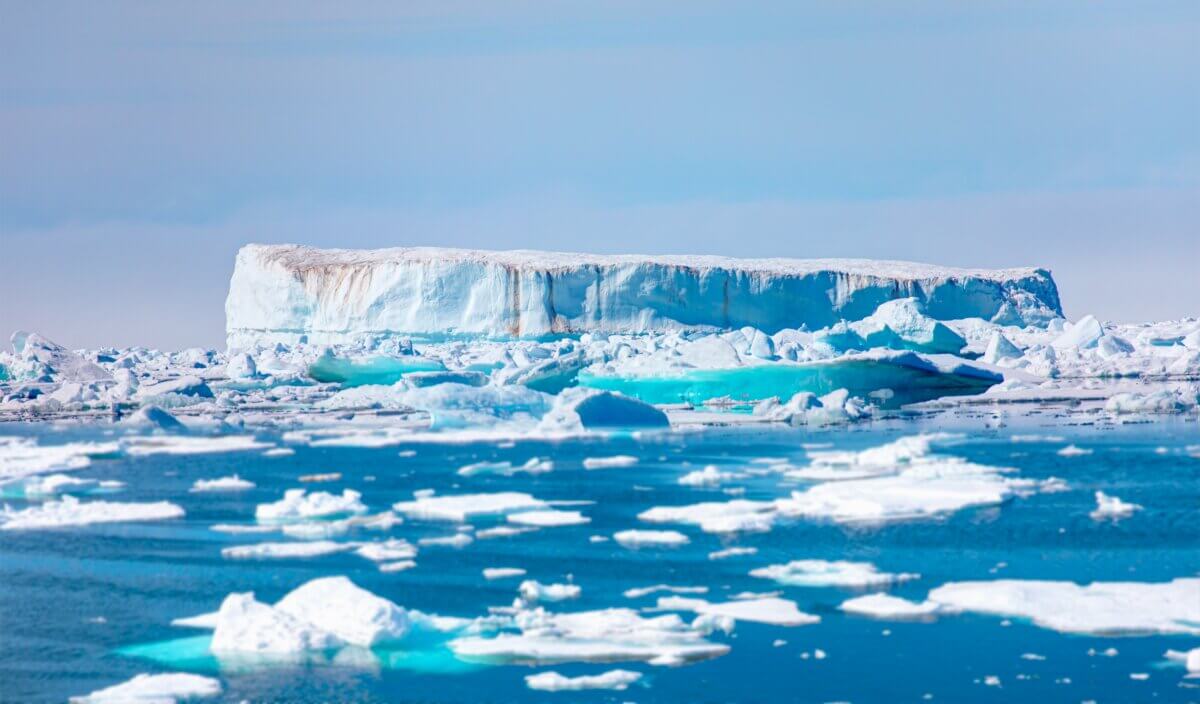
Melting icebergs by the coast of Greenland. (Photo by muratart on Shutterstock)
BOULDER, Colo. — The Arctic Ocean’s pristine white ice cap, a defining feature of our planet visible even from space, could undergo a historic transformation in the next few years. A new study reveals that while most projections show the first ice-free day occurring within nine to 20 years after 2023, there’s an unlikely but significant possibility this milestone could arrive as soon as 2026-2027.
While scientists have long studied when the Arctic might become ice-free during September (typically when sea ice reaches its annual minimum), this is the first research to examine when we might see the very first day without significant ice cover. The distinction is crucial – like the difference between a lake being ice-free for an entire month versus experiencing its first ice-free day during an unusually warm spell.
The study, led by researchers Céline Heuzé from the University of Gothenburg and Alexandra Jahn from the University of Colorado Boulder, defines “ice-free” as less than one million square kilometers of sea ice remaining. For perspective, that’s about four times the size of the United Kingdom – a small fraction of the Arctic Ocean’s typical ice coverage. It mainly accounts for ice that tends to persist along northern coastlines even during extensive melting.
“The first ice-free day in the Arctic won’t change things dramatically,” says Jahn, an associate professor in the Department of Atmospheric and Oceanic Sciences and a fellow at CU Boulder’s Institute of Arctic and Alpine Research, in a statement. “But it will show that we’ve fundamentally altered one of the defining characteristics of the natural environment in the Arctic Ocean, which is that it is covered by sea ice and snow year-round, through greenhouse gas emissions.”
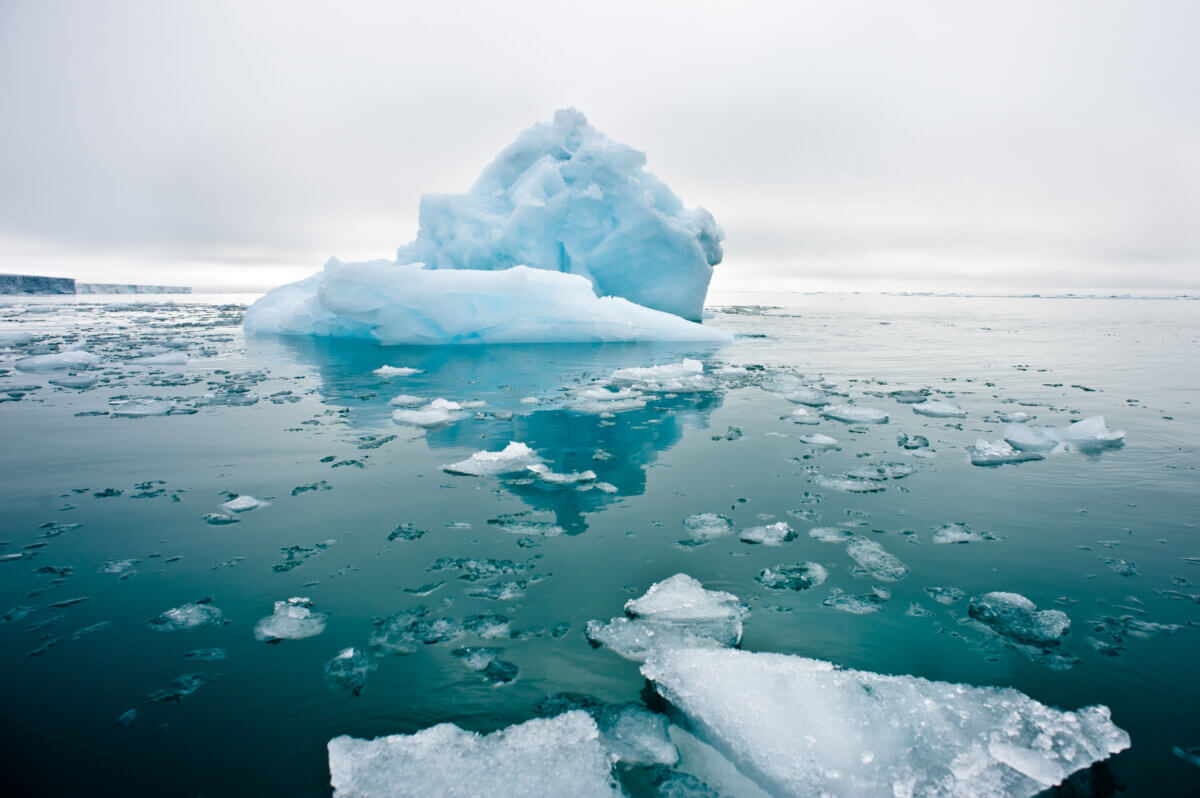
This transformation is already well underway. The National Snow and Ice Data Center reported that September 2023’s sea ice minimum – 4.28 million square kilometers – was one of the lowest measurements since satellite monitoring began in 1978. While this figure exceeded the record low set in September 2012, it represents a dramatic decline from the 1979-1992 average of 6.85 million square kilometers. Scientists have observed Arctic ice disappearing at an unprecedented rate of more than 12% each decade.
While researchers have long focused on predicting when the Arctic might become ice-free for an entire month (typically September, when sea ice reaches its annual minimum), this study breaks new ground by examining when we might see the very first day without significant ice cover. The distinction is crucial – like the difference between a lake being ice-free for an entire month versus experiencing its first ice-free day during an unusually warm spell.
“Because the first ice-free day is likely to happen earlier than the first ice-free month, we want to be prepared,” says Heuzé. “It’s also important to know what events could lead to the melting of all sea ice in the Arctic Ocean.”
To understand when this threshold might be crossed, the researchers analyzed 366 simulations from 11 carefully selected climate models. These models were chosen based on their accuracy in reproducing historical Arctic conditions and seasonal patterns. The simulations explored various future scenarios, from optimistic cases with reduced emissions (SSP1-1.9) to pessimistic ones with continued high emissions (SSP5-8.5). Nine of these simulations suggested the possibility of an ice-free day occurring within just three to six years – an extreme but plausible scenario.
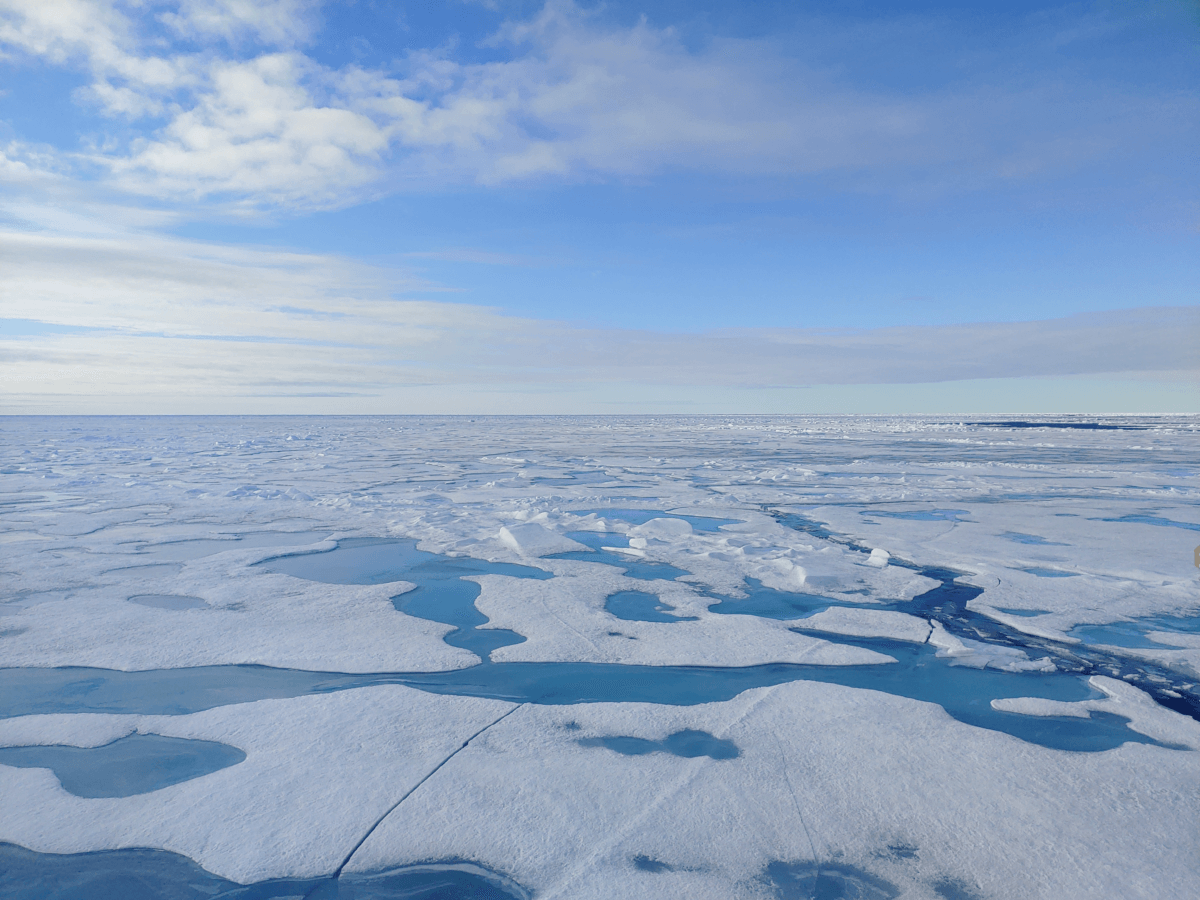
Recent events demonstrate how quickly Arctic conditions can change. In March 2022, parts of the Arctic experienced temperatures 50°F above average, with areas around the North Pole approaching melting point – an unprecedented warm spell that hints at the kind of extreme events that could accelerate ice loss. The researchers found that such warming events, particularly when they occur in sequence, could trigger rapid ice decline.
These rapid transitions typically follow a pattern: an unusually warm fall weakens the ice, followed by a warm winter and spring that prevent normal ice formation. When these conditions persist for three or more years, they create the perfect environment for an ice-free day to occur in late summer. As climate change progresses, these warm spells are expected to become more frequent and intense.
The loss of Arctic sea ice creates a troubling feedback loop. Ice and snow reflect most incoming sunlight back to space, while dark ocean water absorbs it. As more ice melts, more solar energy is absorbed, further warming the region and potentially accelerating ice loss. This process could have far-reaching effects on global weather patterns and ecosystems.
However, the research, published in Nature Communications, also offers hope. All the scenarios showing rapid transition to ice-free conditions occurred in simulations where global warming exceeded 1.5°C above pre-industrial levels – the target limit set by the Paris Climate Agreement. The study found that under the lowest emission scenario (SSP1-1.9), the earliest ice-free day occurred 18 years after 2023-equivalent conditions, suggesting that keeping warming below this threshold could help prevent, or at least delay, the Arctic’s first ice-free day.
One particularly striking finding was that in the year when ice-free conditions occurred, the ice extent typically fell below current levels (as measured in 2023) by late July – about six weeks earlier than usual. This could serve as an early warning signal: if future summer ice levels drop dramatically by July, it might indicate an increased risk of ice-free conditions later that season.
“Any reductions in emissions would help preserve sea ice,” says Jahn.
The transformation of the Arctic from white to blue would mark a profound change in Earth’s appearance from space – a visible reminder of humanity’s impact on the climate. Whether this change arrives in the next few years or decades from now may depend on our collective action to address climate change. Like the proverbial canary in the coal mine, the Arctic’s first ice-free day would signal a fundamental shift in our planet’s climate system – only this time, the warning sign encompasses an entire ocean.
Paper Summary
Methodology
The researchers analyzed daily sea ice data from 11 different climate models, selected based on their accuracy in simulating historical Arctic conditions. They focused on models that could accurately predict both the timing and extent of minimum sea ice coverage when compared to satellite observations. The study considered various future scenarios, from aggressive emission reductions to business-as-usual cases. They defined the starting point as conditions equivalent to 2023’s minimum ice extent (3.39 million square kilometers) and tracked how quickly each simulation reached “ice-free” conditions (less than 1 million square kilometers).
Key Results
The analysis revealed that the first ice-free day could occur between 3 and 70+ years after reaching 2023-equivalent conditions. Nine simulations showed a particularly rapid transition (within 3-6 years), all featuring specific atmospheric patterns: warm winters, early spring warming, and disruptive summer storms. The initial ice-free period lasted between 11 and 53 days, with an average of 27 days. The timing wasn’t strongly tied to emission scenarios but rather to natural climate variability.
Study Limitations
The research relies on climate models, which, while sophisticated, can’t perfectly predict future conditions. The models may not capture all potential feedback mechanisms or unexpected climate system interactions. The study also focuses on daily ice extent rather than ice volume or quality, which could provide additional insights into Arctic changes.
Discussion & Takeaways
The study highlights the possibility of abrupt changes in Arctic sea ice, even under moderate emission scenarios. The identification of specific weather patterns associated with rapid ice loss could help improve monitoring and prediction efforts. The research suggests that keeping global warming below 1.5°C could help prevent early ice-free conditions, underlining the importance of climate action.
Funding & Disclosures
The research was funded by the Swedish National Research Council, the Swedish National Space Agency, and the NSF-CAREER award. The authors declared no competing interests. The study benefited from international collaboration and computing resources provided by various research institutions.


Lol!!