
An illustration of a star that collapsed, forming a black hole. The black hole is at the center, unseen. Surrounding it is a dust shell moving away from the black hole and gas being pulled toward it. (Credit: Keith Miller, Caltech/IPAC - SELab)
In A Nutshell
- A massive star in the Andromeda Galaxy faded by more than 10,000 times over a decade and vanished from view, likely collapsing into a black hole without exploding as a supernova
- Astronomers tracked the “failed supernova” using telescopes including Hubble, watching as the star’s outer layers fell back onto the collapsing core instead of blowing apart
- Only a small fraction of the star’s material was ejected, forming a dusty shell that glowed in infrared light while the rest collapsed to form a 5-solar-mass black hole
- This is only the second time astronomers have observed such an event, suggesting some massive stars quietly disappear rather than going out in the blaze of a supernova explosion
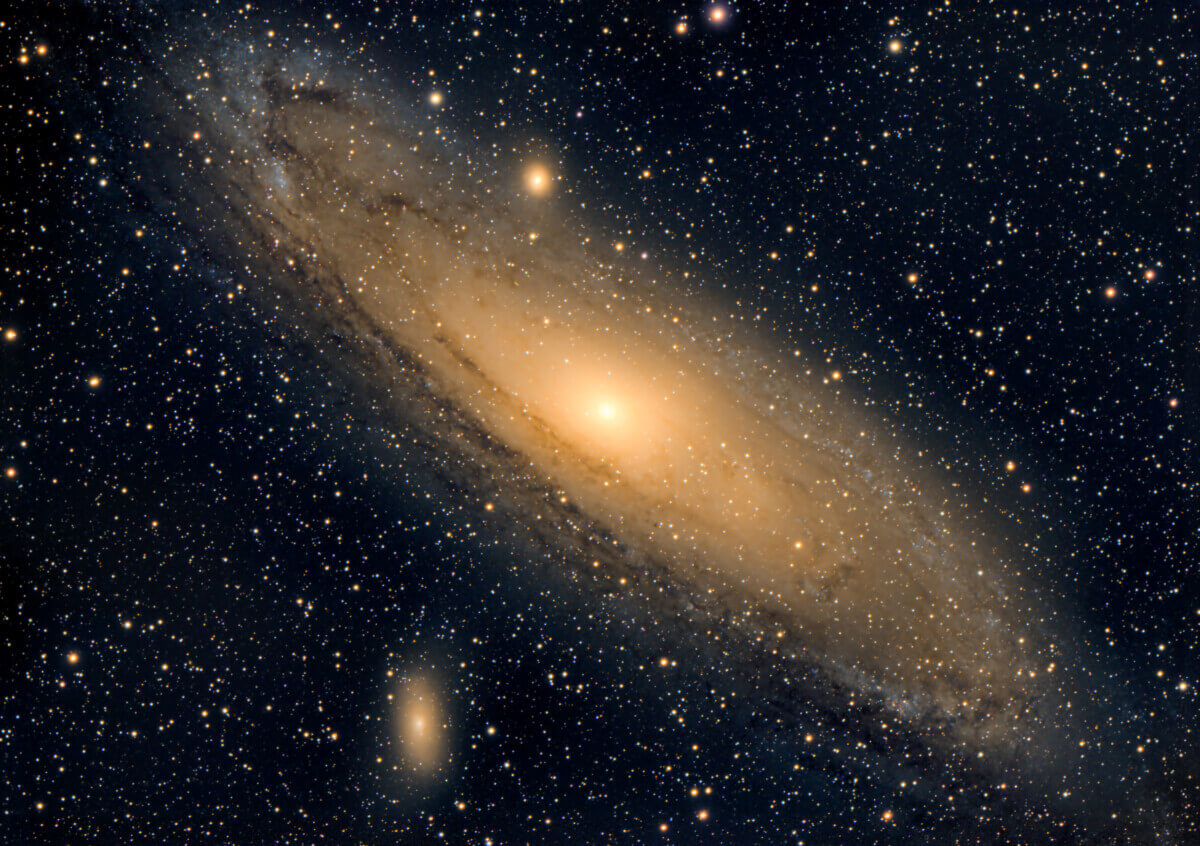
A massive star in the Andromeda Galaxy has vanished. Over nearly a decade, astronomers watched as the brilliant supergiant faded from view until it became completely invisible. The star didn’t explode in a supernova as expected. Instead, it simply disappeared, collapsing into a black hole in what scientists call a “failed supernova.”
The star, designated M31-2014-DS1, once burned about 100,000 times brighter than our sun. Between 2016 and 2019, it faded dramatically in visible light. By 2023, when astronomers checked again, the star had essentially vanished.
Watching A Star Disappear In Real Time
Kishalay De from Columbia University led the team that tracked this stellar disappearance using data from the Hubble Space Telescope and NASA’s infrared space survey. What they documented in the journal Science represents something rarely observed: a massive star collapsing into a black hole without the usual fireworks.
Typically, when massive stars reach the end of their lives, their cores collapse and send shockwaves through the star’s outer layers. Those shockwaves blow the star apart in a brilliant supernova explosion visible across vast cosmic distances. But sometimes those shocks aren’t strong enough. The outer layers fall back onto the collapsing core instead of flying outward, and the star simply winks out of existence.
M31-2014-DS1 showed exactly this behavior. The research team dug through archival observations dating back to 2005 and found the star had been acting strange for years. It was surrounded by a thick cloud of dust from shedding enormous amounts of material, a sign something was going very wrong inside.
In 2014, the star started brightening in infrared light, the kind our eyes can’t see but specialized telescopes can detect. The infrared glow peaked and then faded over the next few years as the star continued its slow disappearance. The team interprets this as hot dust forming from material puffed out during the early stages of collapse.

Why This Star Took So Long To Vanish
The long, slow fade is what makes this event special. If the star were simply falling in on itself under gravity alone, it would have disappeared within about seven months. Instead, it took more than three years to fade away. That extended timeline tells astronomers that energy released during the core collapse was holding up the outer layers temporarily, delaying their inevitable fall inward.
The team’s calculations suggest the star started its life weighing about 13 times as much as our sun but had shed most of that mass over millions of years. By the time it collapsed, only about 5 solar masses remained. When the core gave way, it released tremendous energy, but not nearly enough to blow the star apart like a normal supernova.
The weak shock managed to blow off only a small amount of material (about one-tenth the mass of our sun) at modest speeds. That ejected gas cooled and formed dust grains, creating the infrared glow astronomers detected. Meanwhile, the vast majority of the star’s mass fell back onto itself, creating a black hole.
For the next few years, leftover material continued falling into the newly formed black hole. Initially, so much material was falling in that the black hole couldn’t swallow it all efficiently. During this phase, the system stayed relatively bright. But as the infall rate dropped, the brightness faded in lockstep until almost nothing remained visible.
What’s Left Behind
When Hubble looked at the location in 2022, it detected no visible light at all. In infrared wavelengths, though, astronomers spotted a faint remnant: a dusty ember more than 10,000 times dimmer than the original star. Follow-up observations in 2023 from ground-based telescopes in Hawaii confirmed this faint glow. It’s the leftover dust shell surrounding what little remains visible of the system.
This isn’t the first time astronomers have caught a star vanishing. Another case from 2015, in a galaxy called NGC 6946, showed remarkably similar behavior: a bright outburst, followed by a dusty envelope, then fading to a fraction of its original brightness over several years. Analyzing both events together reveals a pattern of how certain massive stars meet their end not with a bang, but with a whimper.
The Failed Supernova
What determines whether a massive star explodes or quietly collapses may come down to how much weight it loses before the end. M31-2014-DS1 had shed most of its outer hydrogen envelope through powerful stellar winds or by transferring material to a companion star. The earlier case NGC 6946-BH1 retained more of its hydrogen layers. Despite these differences, both underwent failed supernovae, suggesting multiple pathways can lead to this quiet collapse. The thickness of the remaining hydrogen envelope appears to affect the duration of the process; NGC 6946-BH1’s thicker envelope produced a longer initial outburst before fading.
No X-rays have been detected from either vanishing star, which might seem odd since material falling into a black hole typically produces high-energy radiation. But the same dusty gas creating the infrared glow also blocks X-rays from escaping, hiding the black hole’s presence from certain types of telescopes.
The odds of finding even one of these events were low, somewhere between 1 and 20 percent, based on previous estimates of how often massive stars fail to explode. Finding two suggests astronomers might discover more as surveys improve. Or it could mean the relationship between a star’s birth mass and its final fate is more complicated than simple cutoffs.
For stars born weighing more than about 12 times the sun’s mass, the difference between explosion and disappearance may hinge on subtle factors during their evolution that remain difficult to predict. Some become supernovae. Others, like M31-2014-DS1, simply fade away.
The decade-long observations required to track M31-2014-DS1 from its first signs of trouble through its final disappearance show why these vanishing stars have been so hard to find. Catching one requires watching millions of individual stars for years, hoping to be looking at the right one at the right moment. As astronomical surveys get better at this kind of long-term monitoring, astronomers expect to find more stars that defy the explosive death we’ve come to expect from giants like these.
Paper Notes
Limitations
The exact timing of the core collapse cannot be precisely determined from the available data, though the observations constrain it to within a few years. The photometric cadence was insufficient to capture a potential brief optical outburst that may have occurred between observation epochs. The stellar evolution models rely on assumptions about mass-loss mechanisms that remain incompletely understood. Uncertainties exist in the dust formation process and the velocity distribution of ejected material. The accretion modeling assumes specific angular momentum distributions that may vary in reality.
Funding and Disclosures
K.D. received support from NASA through a NASA Hubble Fellowship grant HST-HF2-51477.001 awarded by the Space Telescope Science Institute, and through a Keck PI Data Award administered by the NASA Exoplanet Science Institute and ADAP grant 80NSSC24K0663. M. MacLeod was supported by a Clay postdoctoral fellowship at the Smithsonian Astrophysical Observatory. A. Antoni was supported by the Simons Foundation through a Flatiron Research Fellowship. E. Quataert’s work benefited from interactions at workshops funded by the Gordon and Betty Moore Foundation through grant GBMF5076. The authors declare no competing interests.
Publication Details
Authors: Kishalay De (Department of Astronomy and Columbia Astrophysics Laboratory, Columbia University; Center for Computational Astrophysics, Flatiron Institute), Morgan MacLeod (Center for Astrophysics, Harvard University & Smithsonian), Jacob E. Jencson (IPAC, California Institute of Technology), Elizabeth Lovegrove (US Naval Observatory), Andrea Antoni (Center for Computational Astrophysics, Flatiron Institute), Erin Kara (Kavli Institute for Astrophysics and Space Research, Massachusetts Institute of Technology), Mansi M. Kasliwal (Cahill Center for Astrophysics, California Institute of Technology), Ryan M. Lau (National Optical-Infrared Astronomy Research Laboratory, National Science Foundation), Abraham Loeb (Center for Astrophysics, Harvard University & Smithsonian; Black Hole Initiative, Harvard University), Megan Masterson (Kavli Institute for Astrophysics and Space Research, Massachusetts Institute of Technology), Aaron M. Meisner (National Optical-Infrared Astronomy Research Laboratory, National Science Foundation), Christos Panagiotou (Kavli Institute for Astrophysics and Space Research, Massachusetts Institute of Technology), Eliot Quataert (Department of Astrophysical Sciences, Princeton University), Robert Simcoe (Kavli Institute for Astrophysics and Space Research, Massachusetts Institute of Technology).
Journal: Science, Volume 391, Issue 6786, pages 689-693 | DOI: 10.1126/science.adt4853 | Published: February 12, 2026
Data and code availability: Compiled photometric data, image subtraction code, theoretical stellar evolution models, and failed supernova calculations available at https://github.com/dekishalay/M31-2014-DS1 and archived on Zenodo at https://doi.org/10.5281/zenodo.17774115


