
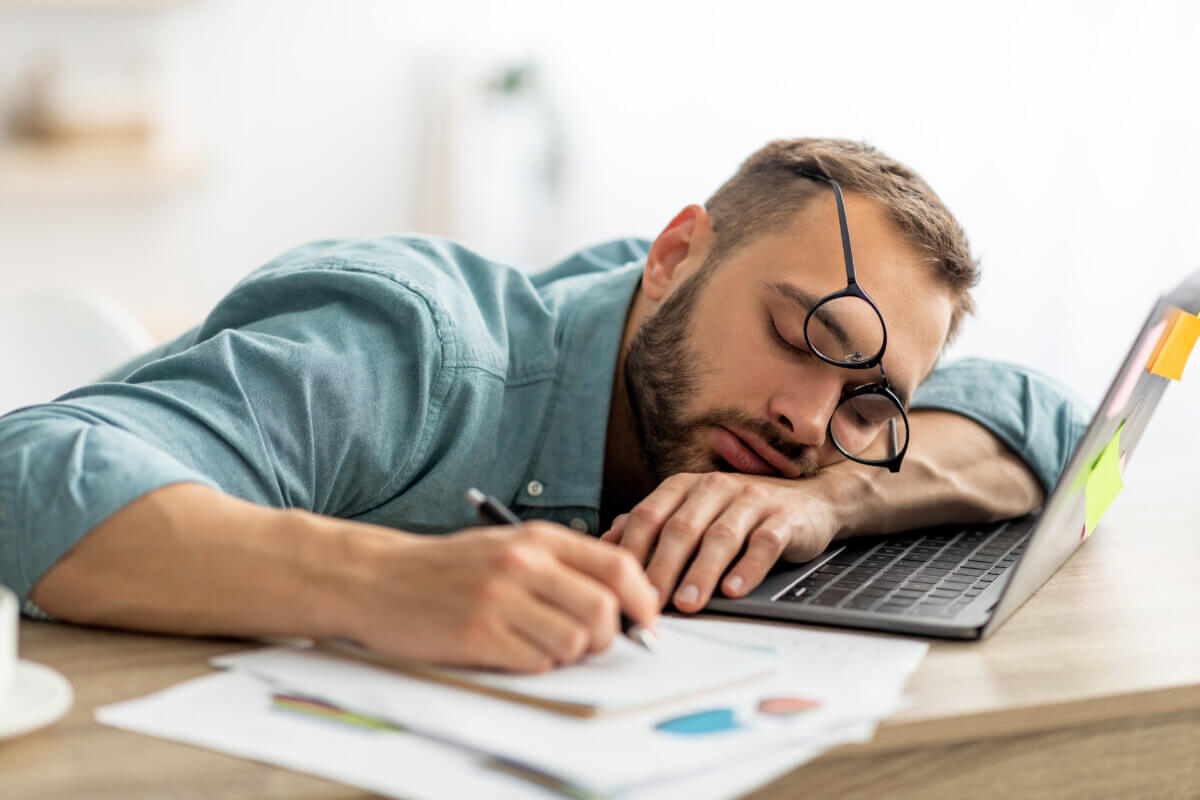
Work fatigue can increase work stress. (Photo by Pranithan Chorruangsak on Shutterstock)
In A Nutshell
People crave connection, not productivity: Given unlimited energy, 18% would spend more time with family and friends, topping the list of energy fantasies.
The post-lunch crash is real: Survey respondents identified early afternoon as their daily energy low point, with most saying they’d need double their current energy levels just to keep up with daily demands.
Fatigue costs money and happiness: 74% of Americans believe higher energy would boost their earnings, while 71% said more energy would make them happier.
Exercise is the first casualty: When energy runs low, working out suffers most; 44% said they can’t exercise as often as they’d like. Social activities (34%), outdoor time (31%), and home cooking (29%) also take hits.
The afternoon slump has a clear time stamp. According to new survey data from 2,000 Americans, respondents said their energy levels tend to bottom out around 2:06 p.m., a finding that puts a number on what workers and students have long suspected about those drowsy post-lunch hours. On average, respondents said they’d need to double their current energy levels just to feel capable of keeping up with daily demands.
Three-quarters of survey respondents said they think they’d earn more if they had higher energy levels, and 71% said they’d be happier with more energy to get through the day. The survey, conducted by Talker Research on behalf of Zipfizz, reveals a practical problem with real-world consequences for both personal well-being and professional success. When asked how energy levels have changed over time, 44% said they have declined with age.
When given the hypothetical gift of unlimited energy, the top answer by 18% of respondents was spending more time with friends or family. People prioritized connection over achievement when they imagined life without fatigue.
Low Energy Levels Stop Americans From Exercising and Socializing
Nearly half of respondents (44%) said they don’t have enough energy to exercise as often as they would like, making physical activity the most common casualty of fatigue. Social connection also suffers, with 34% reporting that low energy prevents them from spending time with their social circles. Close behind were outdoor activities (31%) and home-cooked meals (29%).
For many Americans, this fatigue has become routine rather than occasional. Nearly half (45%) said they feel too drained to do things they enjoy, while 56% said a lack of energy impacts their ability to get things done. A quarter of respondents said they are left exhausted after a full day of work.
The guilt around energy depletion appears nearly as draining as the fatigue itself. One-third of respondents (32%) said they feel most guilty about neglecting exercise or physical activity. Others pointed to falling behind on home organization (26%), self-care (25%), and time spent with loved ones (21%).
Given More Energy, Americans Would Prioritize Family Time Over Work
If they could control when to receive an energy boost, people were divided between wanting it on Monday (24%), Friday (22%), and Saturday (22%). “During the winter months, especially, energy dips can affect everything from motivation to connection,” said Marcela Kanalos, a spokesperson for Zipfizz. “What stands out is that, given more energy, people would prioritize time with loved ones, not just getting more done.”
Spending more time with friends or family topped the list at 18% when people imagined what they would do with unlimited energy. The responses point toward relationships and connection rather than professional accomplishments. “Lack of energy doesn’t just mean feeling tired; it can lead to guilt, missed opportunities and less time for the people and activities that matter most,” Kanalos added.
Energy Levels Decline With Age, Affecting Happiness
More than seven in 10 respondents (71%) said they’d be happier if they had more energy to get through the day. When asked about how energy levels change with age, 44% said they have declined.
The 2:06 p.m. slump represents the point when many Americans feel the day’s demands outpace their ability to meet them. For many Americans, this energy deficit has become a defining feature of daily life, with consequences that ripple through health, happiness, and human connection. The guilt reveals that Americans know they should be exercising and taking care of themselves, but the fantasy of unlimited energy points toward relationships and the people who matter most.
Survey Methodology
Talker Research surveyed 2,000 Americans who have access to the internet. The survey was commissioned by Zipfizz and administered and conducted online by Talker Research between December 2-5, 2025.


