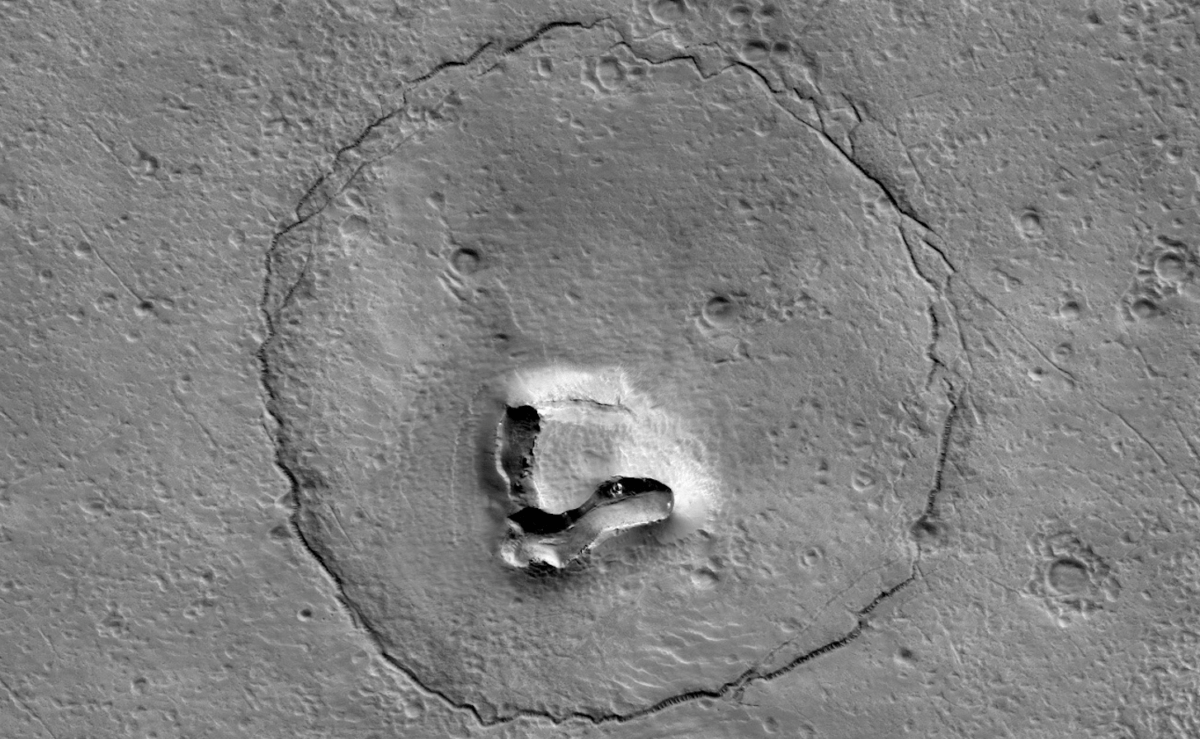
Look closely and you may notice the raised terrain in this photo looks like a bear's snout beneath two circular eyes. (Credit: NASA/JPL-Caltech/UArizona)
TUCSON, Ariz. — Even space may need a teddy bear to snuggle up to in all that darkness. Turns out there’s one hiding right on the surface of Mars, well, sort of. Scientists at NASA have spotted what they say looks like the face of an adorable grizzly on the Red Planet.
The marvelous image of the bear was taken in December by the Mars Reconnaissance Orbiter from a height of 251 kilometers, or 155 miles.
The spacecraft used its HiRISE (High Resolution Imaging Science Experiment) camera — the most powerful ever sent to another planet. In a brief post, the agency writes: “A Bear on Mars? This feature looks a bit like a bear’s face. What is it really?”
You can see for yourself in the image below (click to enlarge):

Still can’t see the bear on Mars?
“There’s a hill with a V-shaped collapse structure (the nose), two craters (the eyes), and a circular fracture pattern (the head). The circular fracture pattern might be due to the settling of a deposit over a buried impact crater,” their post notes. “Maybe the nose is a volcanic or mud vent and the deposit could be lava or mud flows? Maybe just grin and bear it.”
Based in Tucson, Arizona, the HiRISE Operations Center oversees the spectacular camera’s mission on Mars. With an unparalleled ability to snap images at up to 30 centimeters per pixel, the camera arrived on the Red Planet in 2006. Its findings and data will help astronomers continue to learn important insights about the Red Planet, particularly for facilitating human and robotic exploration.
HiPOD: A Bear on Mars?
This feature looks a bit like a bear’s face. What is it really?
More: https://t.co/MpLQBg38ur
NASA/JPL-Caltech/UArizona#Mars #science #NASA https://t.co/2WUNquTUZH pic.twitter.com/1k2ZnLcJ5o
— HiRISE: Beautiful Mars (NASA) (@HiRISE) January 25, 2023


