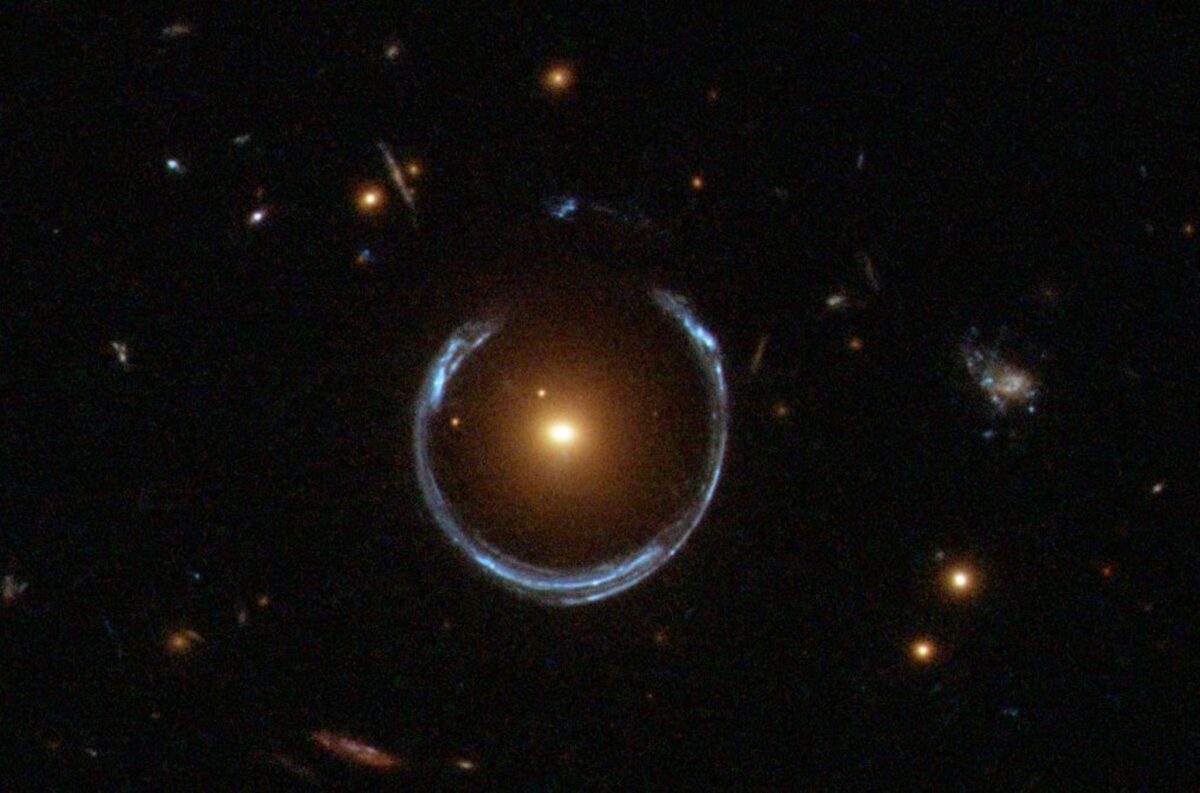
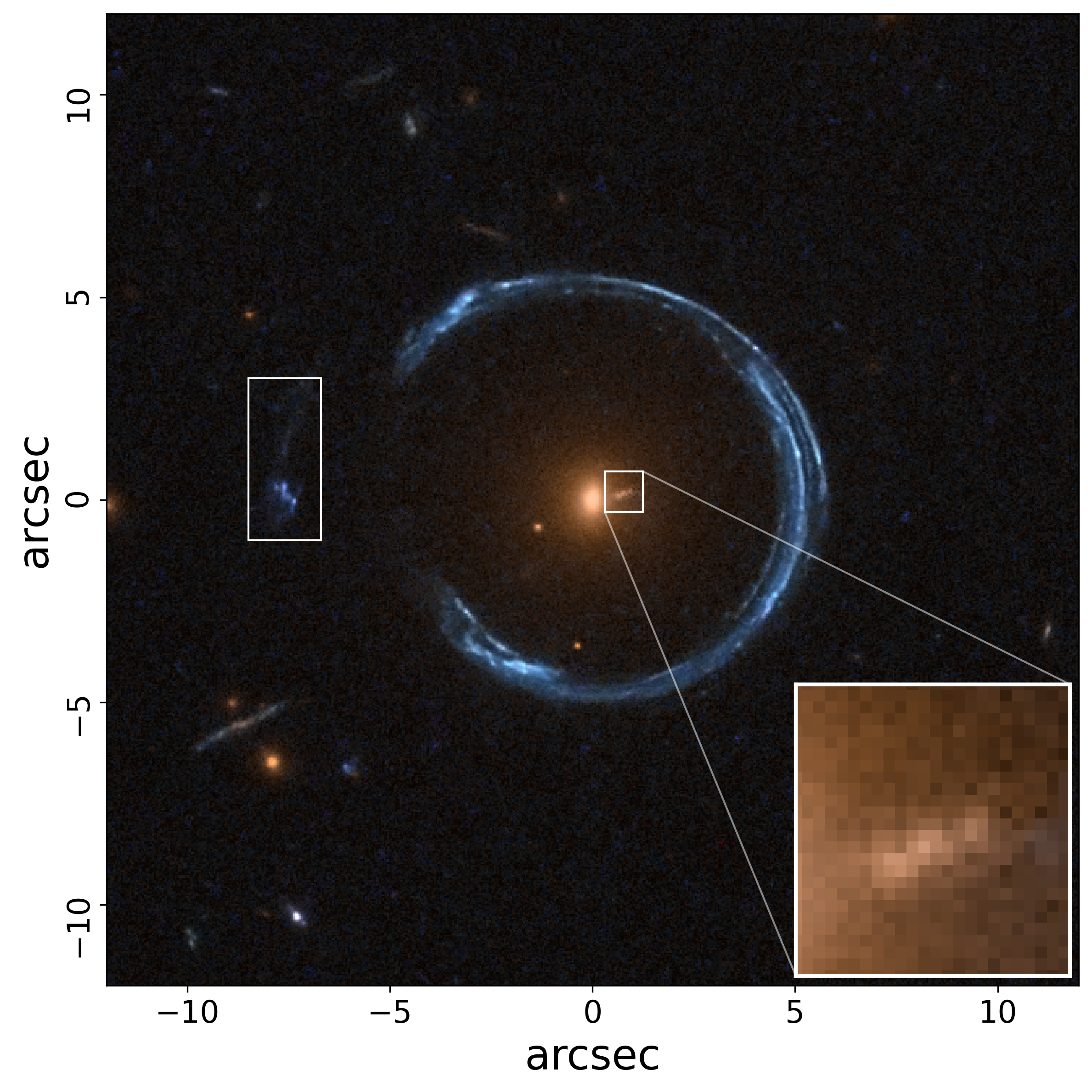
The Cosmic Horseshoe gravitational lens. The newly discovered ultramassive blackhole lies at the center of the orange galaxy. Far behind it is a blue galaxy that is being warped into the horseshoe shaped ring by distortions in spacetime created by the immense mass of the foreground orange galaxy. (Credit: NASA/ESA)
In a nutshell
- Scientists discovered a monster black hole weighing 36 billion times more than our Sun, making it one of the heaviest ever found
- They used Einstein’s theory of gravity bending light combined with tracking star movements to “weigh” the invisible giant
- The black hole is significantly bigger than scientists expected for a galaxy of this size, breaking the usual rules
- This technique could help astronomers find thousands more hidden monster black holes as new telescopes come online
PORTO ALEGRE, Brazil — Astronomers have found one of the heaviest black holes ever measured, sitting in the heart of a distant galaxy and coming in well above what scientists would normally expect for a galaxy of its size.
An international team discovered this “ultramassive” black hole, weighing as much as 36 billion Suns, by combining two powerful techniques — one that measures how gravity bends light, and another that tracks the motion of stars. Together, these gave the researchers a clear, direct way to “weigh” the black hole, even though it’s far too far away to see directly.
The results, published in the Monthly Notices of the Royal Astronomical Society, place the object in a category of black holes so rare and extreme that our own Milky Way’s central black hole — at a mere 4 million solar masses — looks small by comparison.
“This is amongst the top 10 most massive black holes ever discovered, and quite possibly the most massive,” said study co-author Thomas Collett, a professor at the University of Portsmouth, in a statement. “Most of the other black hole mass measurements are indirect and have quite large uncertainties, so we really don’t know for sure which is biggest. However, we’ve got much more certainty about the mass of this black hole thanks to our new method.”
A Cosmic Heavyweight: How Scientists Measured the Black Hole’s Mass
The black hole lives inside what astronomers call the “Cosmic Horseshoe,” a galaxy whose huge mass bends light from even more distant galaxies behind it. This warping of space, predicted by Einstein’s theory of general relativity, acts like a cosmic magnifying glass, stretching background galaxies into distinctive arcs and rings, similar to the rare “Einstein ring” recently captured in stunning telescope images.
Lead researcher Carlos Melo of the Universidade Federal do Rio Grande do Sul in Brazil explained that the discovery was made for a “‘dormant’ black hole – one that isn’t actively accreting material at the time of observation. Its detection relied purely on its immense gravitational pull and the effect it has on its surroundings.”
Because gravitational lensing depends only on mass, and not whether the black hole is “feeding” and glowing, it works for otherwise invisible objects. Researchers realized they could pair this technique with measurements of how stars inside the galaxy move to estimate the black hole’s mass. “Our approach, combining strong lensing with stellar dynamics, offers a more direct and robust measurement, even for these distant systems,” Melo said.
Two Techniques, One Big Discovery
The researchers combined stellar kinematics (the study of how stars move inside a galaxy) with gravitational lensing, where a massive object bends the path of light traveling past it.
“Stellar kinematics is the gold standard for measuring black hole masses, but doesn’t really work outside of the very nearby universe because galaxies appear too small on the sky to resolve the region where a supermassive or ultramassive black hole lies,” Collett explained. “Adding in gravitational lensing helped the team push much further out into the universe.”
They used images from the Hubble Space Telescope and detailed light measurements from the European Southern Observatory’s Very Large Telescope in Chile. By studying how quickly stars orbit near the galaxy’s center, they could figure out how much mass is pulling on them. The faster the stars move, the heavier the central object must be.
They then modeled both the bending of background light and the stars’ motions together. All told, they tested 15 different versions of their model to make sure their results held up. Every approach pointed to the same conclusion: the galaxy hosts an ultramassive black hole with a mass of about 36 billion Suns. The researchers are extremely confident in their result, describing it as a “5-sigma detection” — scientific language for being more than 99.99% certain.
Why This Black Hole Is Bigger Than It ‘Should’ Be
Most galaxies follow a rough rule: the bigger the central “bulge” of stars, the bigger the black hole at its core. But at the very top end, some galaxies seem to sit above that trend — and this is one of them. The Cosmic Horseshoe’s black hole is significantly more massive than scientists would normally expect for a galaxy of this size, hinting that the connection between galaxy size and black hole mass changes for the universe’s largest galaxies.
One possible explanation is that the galaxy went through major mergers in the distant past, combining not just the stars but also the central black holes of each galaxy into one super-heavy remnant. Another is that powerful outflows from an actively feeding black hole may have reshaped the galaxy’s central regions over time, affecting how its size is measured today.
The Cosmic Horseshoe appears to be part of what astronomers call a “fossil group.” This is the leftover core of an ancient galaxy cluster that merged into a single dominant galaxy billions of years ago.
What the Next Generation of Telescopes Could Reveal
The researchers believe their approach can find more hidden giants, especially as new observatories come online. The European Space Agency’s Euclid mission, for example, is expected to find hundreds of thousands of gravitational lenses over the next few years, greatly expanding the number of galaxies suitable for this kind of analysis, building on space missions like NASA’s James Webb Space Telescope, which spotted the oldest galaxy ever observed.
Every new discovery adds to our understanding of how these cosmic heavyweights form and grow. In the case of the Cosmic Horseshoe, the sheer size of its black hole offers a rare look at the extreme end of galaxy evolution, and a reminder that the universe still has surprises in store.
Paper Summary
Methodology
Researchers studied the Cosmic Horseshoe gravitational lens system (at redshift z = 0.44) by combining high-resolution Hubble images with spectroscopic data from the MUSE instrument on the Very Large Telescope. They modeled how the galaxy’s gravity bends light from background sources and measured the speeds of stars in the galaxy itself. By running 15 different versions of their model, they tested the robustness of their result.
Results
They found an ultramassive black hole weighing about 36 billion times the Sun’s mass — one of the heaviest ever measured. The detection is at the 5-sigma level, meaning the team is extremely confident in the result. The galaxy’s central stellar velocity dispersion is about 366 km/s, and the black hole’s mass sits roughly 1.5 standard deviations above the typical galaxy–black hole relation. The system likely belongs to a fossil group.
Limitations
The technique depends on very high-quality images and spectra, limiting it to relatively bright lens systems. Some assumptions about dark matter distribution and stellar populations could affect the result, though the team tested these thoroughly.
Funding and Disclosures
Work was supported by Brazilian agencies CNPq, CAPES, and FAPERGS, plus the European Research Council. The authors report no conflicts of interest.
Publication Details
Title: Unveiling a 36-Billion-Solar-Mass Black Hole at the Centre of the Cosmic Horseshoe
Authors: Carlos R. Melo-Carneiro, et al.
Journal: Monthly Notices of the Royal Astronomical Society (August 7, 2025)


