
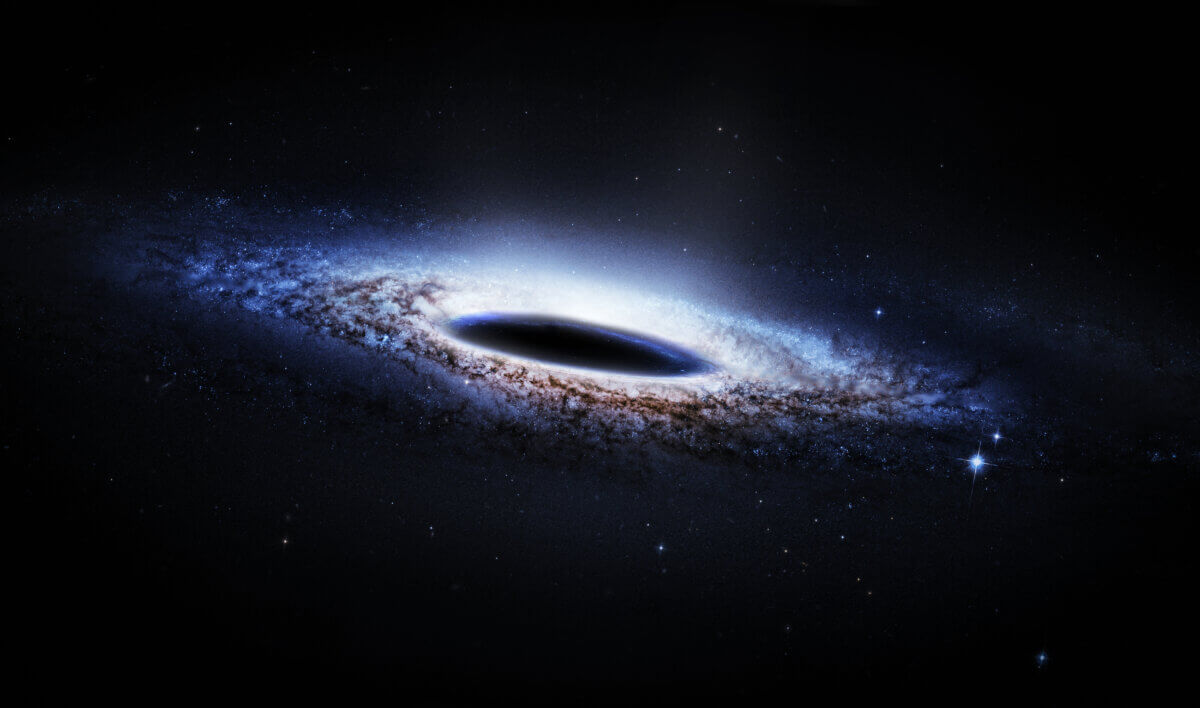
A black hole at the center of a galaxy. (Credit: Dima Zel/Shutterstock)
CAMBRIDGE, United Kingdom — What do parasites and black holes have in common? According to astronomers, they both like to drain their host of vital resources. The James Webb Space Telescope recently observed a supermassive black hole starving its own galaxy to death. This black hole leached off so much energy from its host galaxy until it could no longer create new stars, essentially turning it into a giant “dead” mass in the universe.
Astronomers believe most large galaxies have a supermassive black hole at the center. In this case, the galaxy known as GS-10578 or “Pablo’s Galaxy” was the size of the Milky Way in the early universe, about two billion years after the Big Bang. Its total mass is about 200 billion times the Sun’s mass, with most stars made between 11.5 and 12.5 billion years ago. With a mass this large in the early universe, researchers were surprised to see star formation had already halted, suggesting something extraordinary took place.
In a study published in Nature Astronomy, researchers found the central black hole was the cause for the galaxy’s inability to make new stars — an oddity for a galaxy of this size.
“Based on earlier observations, we knew this galaxy was in a quenched state: it’s not forming many stars given its size, and we expect there is a link between the black hole and the end of star formation,” says Dr. Francesco D’Eugenio, a researcher at the Cambridge’s Kavli Institute for Cosmology and a co-lead author of the study, in a media release. “However, until Webb, we haven’t been able to study this galaxy in enough detail to confirm that link, and we haven’t known whether this quenched state is temporary or permanent.”
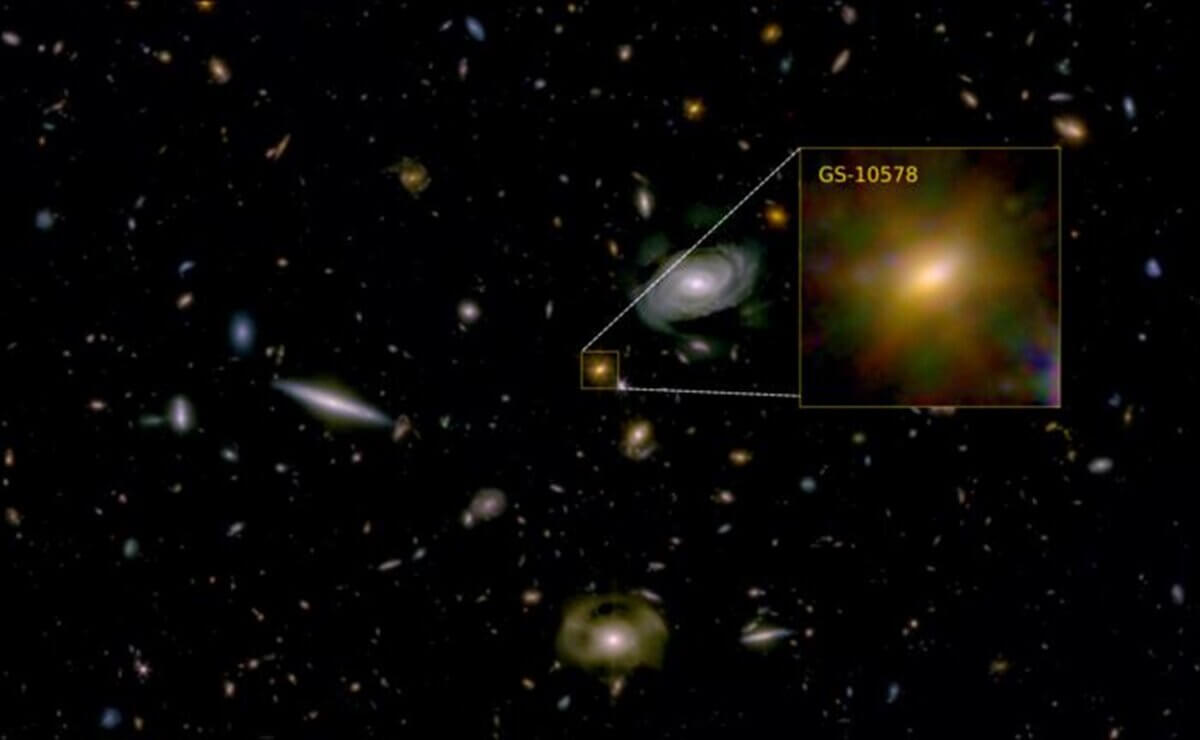
Galaxies with black holes, like Pablo’s Galaxy, typically contain fast winds of hot gas. These hot gas clouds are thin with little mass. However, the James Webb telescope found a new undetectable wind with earlier telescope models — cold, dense gases that do not release light. These dark gas clouds block the light from their host galaxy.
Webb found the black hole in Pablo’s Galaxy pushing large amounts of wind out of the galaxy at about 1,000 kilometers per second. This quick speed is enough to evade the galaxy’s gravitational pulls. The rate of gas mass being expelled from the galaxy is more than what the galaxy needs to continue creating stars.
“We found the culprit,” D’Eugenio explains. “The black hole is killing this galaxy and keeping it dormant, by cutting off the source of ‘food’ the galaxy needs to form new stars.”
Astronomers have long theorized that black holes can drain a galaxy of its resources, but before the James Webb Space Telescope, it was challenging to observe this effect on early universes.
Another interesting observation the team made was how galaxies act without their stars. Earlier models suggested the ability to create stars would wreck the shape of galaxies. However, the observations from Pablo’s Galaxy suggest this is not always the case as it kept its disc shape, and the stars still in there continue to move in an orderly way.
“We knew that black holes have a massive impact on galaxies, and perhaps it’s common that they stop star formation, but until Webb, we weren’t able to directly confirm this,” says Roberto Maiolino, a professor from the Kavli Institute of Cosmology. “It’s yet another way that Webb is such a giant leap forward in terms of our ability to study the early universe and how it evolved.”
Paper Summary
Methodology
The researchers used a powerful space telescope, the James Webb Space Telescope (JWST), to observe a galaxy called GS-10578, located about 11.7 billion years away from Earth. They employed a technique called “integral-field spectroscopy” using an instrument called NIRSpec. This allowed them to capture detailed images and spectra (the breakdown of light into its colors) of the galaxy and its surroundings.
By analyzing the light, they could determine the galaxy’s age, mass, star formation rate, and other key properties. They focused on specific wavelengths of light that show how stars are forming and how gas is moving, especially detecting signs of gas being pushed out of the galaxy by a supermassive black hole (SMBH) at its center. This combination of methods helped them map the structure and behavior of GS-10578 in great detail.
Key Results
The study found that GS-10578 is a huge galaxy that has almost stopped forming new stars. Most of its stars were created a long time ago, but now its star formation rate is very low. The reason this galaxy isn’t making more stars is because the supermassive black hole at its center is pushing gas out of the galaxy.
Without gas, stars can’t form. The galaxy is also spinning rapidly, and its structure shows that it used to be more active in forming stars, but now it’s becoming quiet. This makes it an example of how massive galaxies stop making stars over time.
Study Limitations
One of the key limitations of this study is that it focuses on a single galaxy, GS-10578, so the findings might not apply to all galaxies in the universe. Also, the researchers had to make certain assumptions about the geometry and velocity of gas outflows, which could affect the precision of their results.
There are also uncertainties in how the data from JWST is calibrated, and more observations might be needed to confirm all the findings. Finally, the study doesn’t fully address how the supermassive black hole interacts with all types of gas in the galaxy, leaving some open questions for future research.
Discussion & Takeaways
This study provides clear evidence that supermassive black holes can push out gas from galaxies, stopping them from forming stars. The galaxy GS-10578 is a perfect example of this process, where powerful winds driven by the black hole are removing the gas needed to create new stars.
The researchers showed that even though the galaxy has stopped making stars, it still retains a spinning structure, suggesting that the process of shutting down star formation doesn’t necessarily destroy the galaxy’s shape. This study helps us understand how massive galaxies evolve and why many of them become “quiescent” (quiet) over time.
Funding & Disclosures
The research was part of a larger program called the GA-NIFS survey, which is supported by guaranteed time observations (GTO) on the JWST. The authors also acknowledged the Cosmic Assembly Near-infrared Deep Extragalactic Legacy Survey (CANDELS) and various other programs that provided data. Additionally, there were no clear personal disclosures provided by the researchers, though they did mention that the data processing was performed with public tools available through JWST’s pipeline.


