(Photo by Gorodenkoff on Shutterstock)
In A Nutshell
- Alpha brain waves cycling at 8-13 times per second determine how wide your “temporal binding window,” or the time gap your brain tolerates between seeing and feeling a touch while still perceiving them as simultaneous
- People with faster alpha frequencies (closer to 13 Hz) have narrower integration windows and greater sensitivity to timing mismatches, while those with slower frequencies (closer to 8 Hz) integrate sensory signals across wider time spans
- Scientists used electrical brain stimulation to speed up or slow down participants’ alpha waves, which directly widened or narrowed their temporal binding windows. This proved alpha frequency causally shapes body ownership perception
- The findings explain individual differences in the famous rubber hand illusion and may help understand why people with schizophrenia experience altered body perception
Brain waves cycling at specific speeds in your skull might be shaping one of the most fundamental aspects of human experience: your sense that your body belongs to you. Neuroscientists have discovered that alpha oscillations (rhythmic electrical patterns pulsing through the brain about 8 to 13 times per second) directly influence whether people perceive their limbs as their own.
The finding emerged from experiments using the famous rubber hand illusion, where people can be tricked into feeling that a prosthetic hand is part of their body. Researchers at the Karolinska Institutet found that individual differences in alpha wave frequency predict how much timing mismatch people can tolerate between seeing a touch and feeling it before the illusion breaks down.
The team demonstrated in their paper, published in Nature Communications, that alpha frequency shapes body ownership by modulating how the brain integrates signals from different senses over time.
Brain Wave Speed Varies Among People
Brain wave speed varied among the 46 participants tested. Some showed alpha oscillations cycling at 9.2 times per second, while others reached 12.3 cycles per second after accounting for background brain noise. This modest-seeming difference produced surprisingly large effects on body perception.
Alpha waves act as a sampling rate, similar to frames per second in a movie. People with faster alpha rhythms (more frames per second) can detect even tiny timing differences between what they see and feel. Their brains essentially have higher temporal resolution. Those with slower rhythms sample sensory information less frequently, so nearby events blur together. For them, touches separated by several hundred milliseconds might still feel simultaneous.
The researchers tested this relationship through three separate experiments combining psychophysics, brain recordings, and electrical stimulation.
Testing the Rubber Hand Illusion
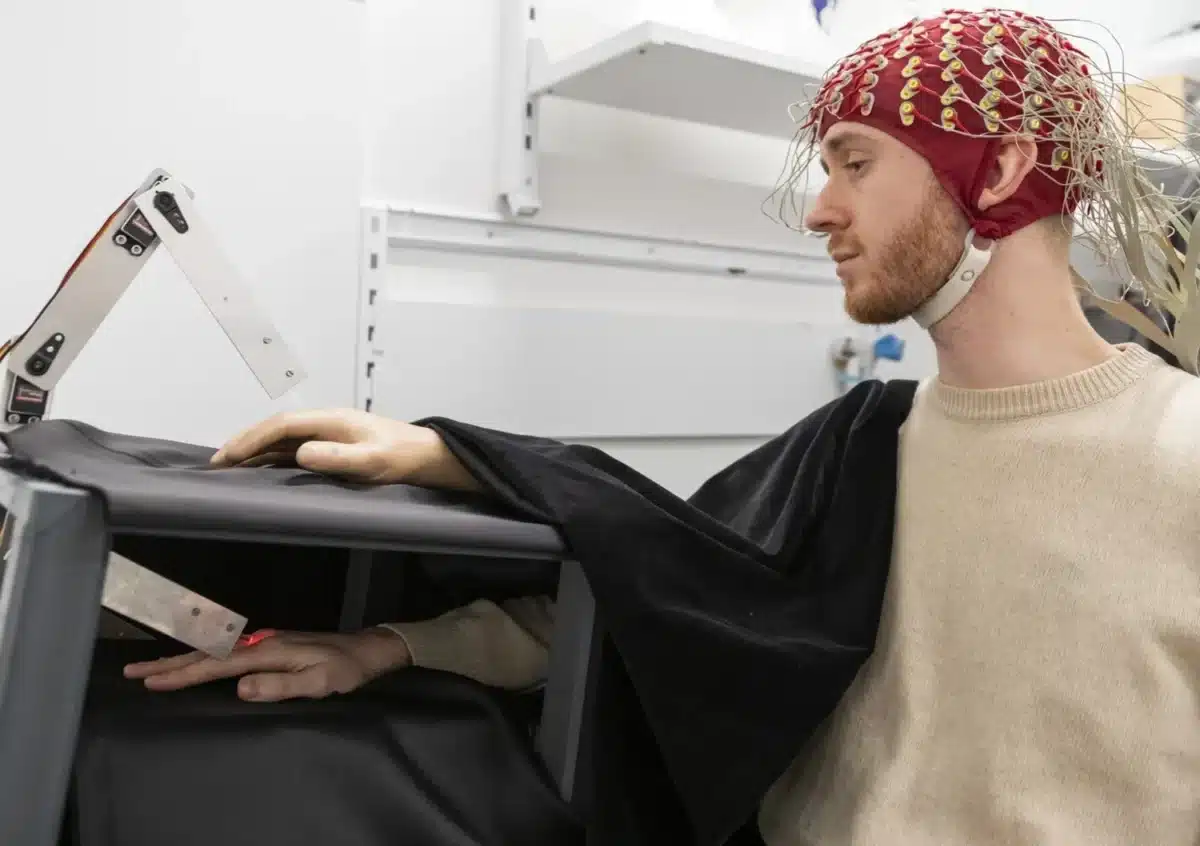
In the first experiment, 30 volunteers judged whether a rubber prosthetic hand felt like their own after robots tapped both the fake hand and their real hidden hand. Timing between these touches varied from perfect synchronization to delays up to 500 milliseconds.
Participants who tolerated larger time gaps while still experiencing the illusion also tolerated larger gaps when simply judging whether two stimuli occurred simultaneously, suggesting both tasks tap into a common temporal processing mechanism.
Recording Brain Activity During Body Illusions
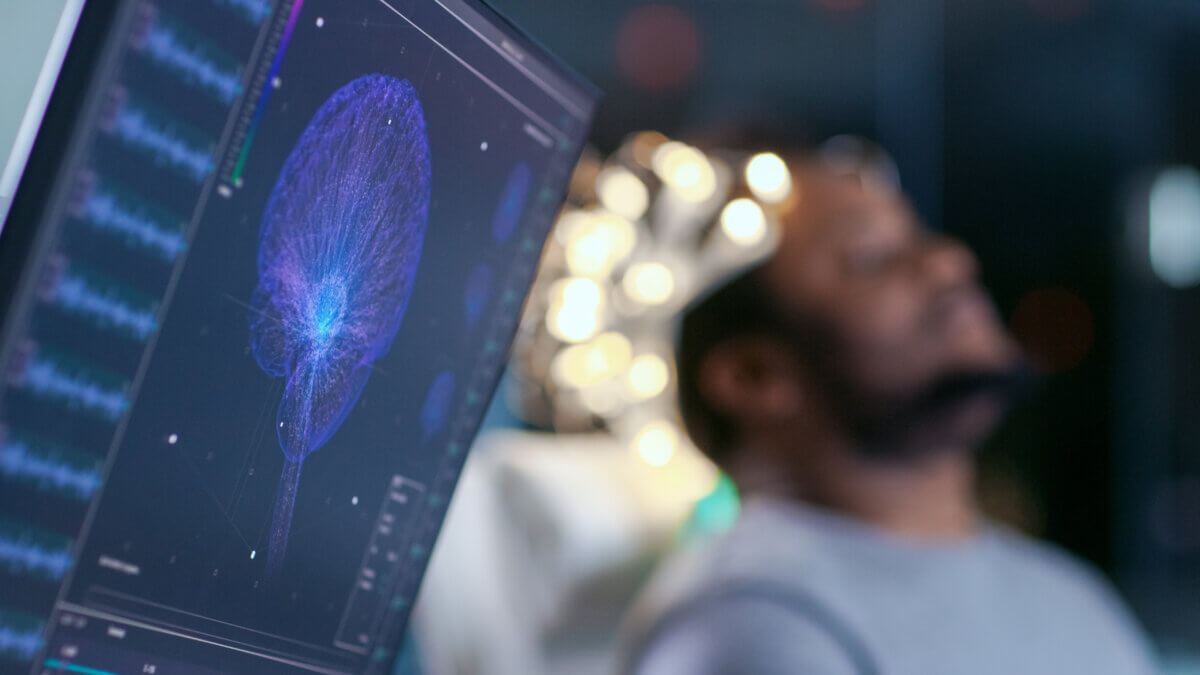
The second experiment added brain recordings via EEG caps measuring electrical activity across participants’ scalps. Forty-six people performed identical tasks while researchers monitored alpha oscillations over brain regions where sensory information from vision, touch, and body position converge.
Individual alpha frequency predicted both how wide someone’s temporal binding window was and how sensitively they detected timing differences. The correlations were remarkably strong in the parietal cortex, a brain region linked to multisensory integration. Participants with alpha cycling closer to 13 Hz showed narrower integration windows and greater sensitivity to timing mismatches. Those with slower rhythms near 8 Hz demonstrated the opposite pattern.
The correlations held whether alpha frequency was measured during the tasks or while participants simply rested with eyes open.
Manipulating Brain Waves Altered Temporal Integration
To establish causation, the team conducted a third experiment using transcranial alternating current stimulation. This technique applies weak electrical currents through electrodes on the scalp, nudging brain oscillations faster or slower.
Thirty participants completed the rubber hand illusion and simultaneity tasks on three separate days while receiving different stimulation: low alpha at 8 Hz, high alpha at 13 Hz, or sham stimulation with no actual current.
The results confirmed the causal relationship. Low-frequency stimulation at 8 Hz widened temporal binding windows from about 165 milliseconds to 208 milliseconds for body ownership judgments. High-frequency stimulation at 13 Hz narrowed the windows to approximately 138 milliseconds. Simultaneity judgments showed similar patterns, with low-frequency stimulation expanding windows and high-frequency stimulation compressing them.
Participants whose simultaneity windows shifted most with brain stimulation also showed the largest changes in their body ownership windows, reinforcing that a single mechanism governs both phenomena.
Understanding the Computational Process
The researchers used mathematical modeling to understand what drives these effects. The brain appears to decide whether to integrate or segregate sensory signals by weighing uncertainty about timing against prior expectations.
Model fitting revealed that individual alpha frequency correlated specifically with sensory uncertainty. Faster alpha frequencies corresponded to less uncertain information about whether touches were synchronous, while slower frequencies indicated greater uncertainty. The brain stimulation data supported this: changes in temporal windows were better explained by altered sensory uncertainty than by changed prior beliefs.
Someone with 9 Hz alpha has a sampling period of approximately 110 milliseconds per cycle, while another person with 11 Hz alpha samples every 90 milliseconds. This difference in sampling rate affects how readily the brain can detect timing mismatches in sensory signals.
Clinical Connections and Future Implications
Previous brain imaging studies have shown specific brain regions activate when people experience illusory ownership of rubber hands. The current findings reveal how neural oscillations within these areas determine the rules governing whether the brain integrates or segregates bodily signals.
Additional exploratory analysis examined the premotor cortex, another brain region involved in body ownership. Alpha frequency there also correlated with body ownership but showed weaker links to simultaneity judgments, suggesting a more specialized role in ownership perception.
People with schizophrenia show slower alpha frequencies in posterior brain regions, according to previous studies. The authors suggest this might contribute to altered body perception and unusual sensory experiences through increased uncertainty in temporal sensory signals. This could explain why some patients report feeling disconnected from their bodies. However, this connection remains speculative and was not tested in the current study.
Addressing Scientific Questions About Alpha Waves
The findings help clarify a recent debate in neuroscience. A 2022 study in Nature Human Behaviour found no evidence linking alpha frequency to temporal perception, contradicting earlier research and raising questions about whether the proposed mechanism had merit.
The current research addresses those concerns through multiple methodological improvements. The team measured perceptual performance using sophisticated techniques separating true sensitivity from cognitive biases. They estimated alpha frequency using two analytical approaches, including one removing background brain noise that can obscure oscillatory peaks. Moreover, the brain stimulation experiment provided direct causal evidence beyond correlational findings.
What’s now clear is that brain oscillations play a crucial role in one of the most basic aspects of human experience: knowing that your body is your own. Alpha frequency doesn’t just affect how we perceive external events. It fundamentally shapes how we distinguish ourselves from the external world by determining which sensory signals get bound together as “mine” and which get treated as separate.
The research demonstrates that individual differences in brain rhythms translate directly into individual differences in perception. People aren’t just better or worse at timing judgments. Their brains are literally operating at different sampling rates, creating fundamentally different perceptual experiences of the same physical events.
Paper Notes
Study Limitations
The research examined healthy adults with normal sensory processing abilities. Findings may not generalize to clinical populations with altered sensory integration. Brain stimulation protocols applied to both hemispheres at once rather than testing lateralized effects. Stimulation frequencies were standardized across participants rather than individually customized to each person’s alpha peak. The study did not directly measure whether stimulation successfully entrained neural oscillations, relying instead on behavioral outcomes. Individual variability in stimulation responsiveness was considerable, with some participants showing minimal behavioral changes.
Funding and Disclosures
The research received support from the European Research Council 2020 research and innovation program (SELF-UNITY grant 787386), Göran Gustafsson’s foundation, and a Swedish Research Council Distinguished Professor grant (2017-03135). Additional funding came from Sweden’s Innovation Agency VINNOVA (2022-01441), Swedish Research Council grants (2024-00839), Strategic Research Area Neuroscience fellowship, and French government France 2030 investment plan through Aix-Marseille Université. The authors declared no competing interests.
Publication Information
The study “Parietal alpha frequency shapes own-body perception by modulating the temporal integration of bodily signals” was authored by Mariano D’Angelo, Renzo C. Lanfranco, Marie Chancel, and H. Henrik Ehrsson from the Department of Neuroscience at Karolinska Institutet in Stockholm, Sweden (with additional affiliations listed). Published in Nature Communications on January 12, 2026, volume 17, article number 53. DOI: 10.1038/s41467-025-67657-w.


