
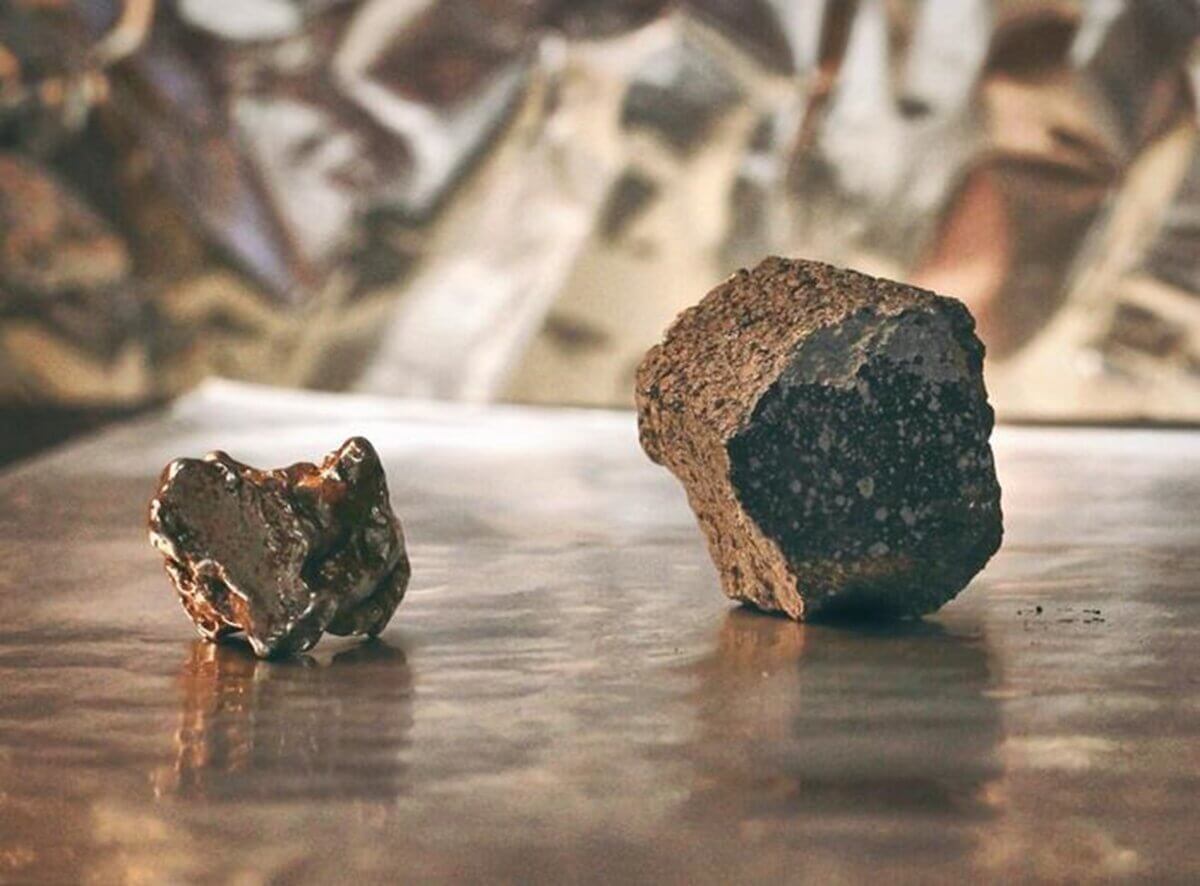
An iron meteorite from the core of a melted planetesimal (left) and a chondrite meteorite, derived from a ‘primitive’, unmelted planetesimal (right). (Credit: Rayssa Martins/Ross Findlay)
CAMBRIDGE, United Kingdom — Everything has a beginning, and a new study finds that the start of life on Earth arrived in the form of melted asteroids. The new research from the United Kingdom traced the chemical fingerprints of zinc in meteorites to find the first volatile elements found on Earth. Without these asteroids colliding on Earth, the authors suggest there would not have been enough chemical building blocks here for life to begin.
Volatiles are elements or compounds that turn into vapor at low temperatures. Along with water, volatiles make up six of the most common elements in living organisms. According to the study published in Science Advances, zinc found in meteorites provides a unique opportunity to explore life’s origins since it contains a unique profile with various volatile elements.
Previous research shows Earth’s zinc comes from all over the solar system. About half may have come from Jupiter, while the other half likely come from celestial bodies closer to Earth.
“One of the most fundamental questions on the origin of life is where the materials we need for life to evolve came from,” says lead study author Rayssa Martins, a researcher from the University of Cambridge’s Department of Earth Sciences, in a media release. “If we can understand how these materials came to be on Earth, it might give us clues to how life originated here, and how it might emerge elsewhere.”
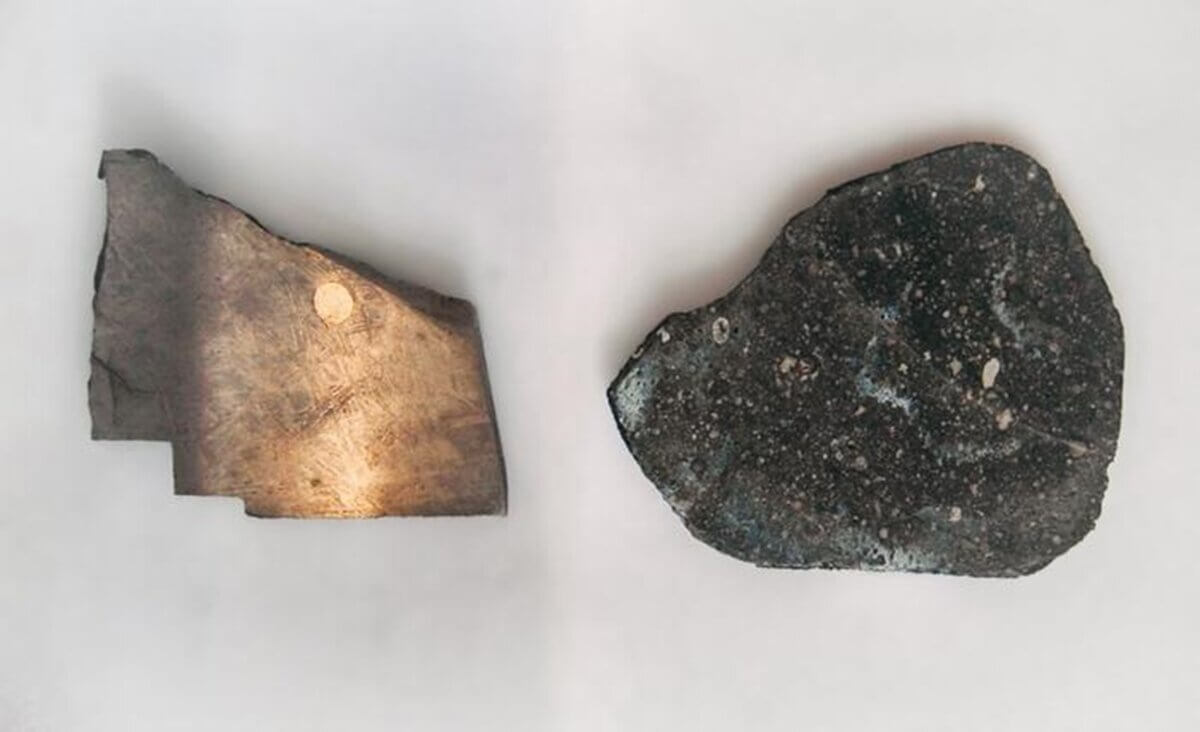
The new study suggests that some of Earth’s building blocks came from other planetesimals. These are the major building blocks for rocky planets like Earth. They come together through a process called accretion, where particles around a young star clump together and form larger bodies.
Not all planetesimals are the same. The earliest ones in the solar system were exposed to high radioactivity levels, which caused melting and loss of volatiles. Meanwhile, planetesimals formed after the radioactivity went extinct did not melt, allowing them to retain volatile elements.
The new study examined different forms of zinc that came to Earth through a large sample of meteorites. These meteorites came from different planetesimals. The researchers used the data to trace back the period of Earth’s accretion — taking tens of millions of years — to model when zinc arrived on Earth.
Modeling results showed melted planetesimals helped form 70% of Earth’s mass. However, they only provided about 10% of the planet’s zinc supply. Instead, Earth’s zinc came from thawed-out materials that did not lose their volatile elements.
“We know that the distance between a planet and its star is a determining a factor in establishing the necessary conditions for that planet to sustain liquid water on its surface,” Martins says. “But our results show that there’s no guarantee that planets incorporate the right materials to have enough water and other volatiles in the first place—regardless of their physical state.”
Tracing the origins of elements needed to start life provides a glimpse of the past and helps to search for life elsewhere in space.
“Similar conditions and processes are also likely in other young planetary systems,” Martins concludes. “The roles these different materials play in supplying volatiles is something we should keep in mind when looking for habitable planets elsewhere.”
Paper Summary
Methodology
The study involved analyzing zinc (Zn) isotopes in various meteorites to understand the sources of Earth’s volatile elements like zinc. Meteorites sampled included those from differentiated and non-differentiated planetesimals—objects that never melted and, therefore, preserved their original solar system composition better.
Researchers used complex mixing models to simulate the various contributions of different meteorite types to Earth’s zinc content. The isotopic analysis was carried out using a sophisticated mass spectrometer which measures the abundance of different Zn isotopes to trace their origin back to different types of solar system materials.
Key Results
The results revealed that differentiated planetesimals (those that had melted and lost some volatiles) contributed only about 10% of Earth’s zinc, despite providing around 70% of Earth’s mass. The rest came from primitive, non-melted materials. This implies that primitive materials are essential in contributing volatiles to terrestrial planets.
The study also used statistical methods (Monte Carlo simulations) to support the findings, showing that the data aligns well with other isotopic measurements and underpins the theory that Earth’s building blocks came from both melted and non-melted original solar material.
Study Limitations
This study’s limitations include the complexity of analyzing zinc isotopes, which requires highly specialized equipment and expertise. The data from differentiated bodies like achondrites was limited, which could skew understanding of their full contribution to Earth’s zinc inventory. Additionally, the simulations used had to make several assumptions about the behavior of isotopes during planetary formation, which may not completely capture the complexities of these processes.
Discussion & Takeaways
The findings emphasize the importance of primitive, non-differentiated asteroids in delivering volatiles necessary for life, such as zinc, to the terrestrial planets. These materials likely played a crucial role during the early stages of Earth’s formation by supplying essential volatiles that differentiated materials had lost. The study also suggests that the inner solar system, where Earth resides, did not lose all its volatile materials despite the high temperatures and conditions conducive to their loss.
Funding & Disclosures
The research received funding from Imperial College London, the European Research Council, and UK Research and Innovation (UKRI). The lead researchers have disclosed that there are no competing interests, indicating that the results presented are based solely on scientific findings without bias from external influences.


It’s amazing that the one element needed for conception is not present in abundance until then. Serendipitous.
Really ? Yet another title ” scientists discover where the building blocks of life come from ” A statement of fact ….yet in the article it’s all words like ” may have ” or ” are likely” or “suggests” nothing in the article confirms the same statement at what the title of the article states. I see this all the time . All it is is a trick to pull the reader into believing something that’s not true . NOBODY knows where the building blocks of life come from .
From my perspective, modern scientists speak in absolutes way too often. This may be a promising hypothesis, but not a proven fact. This is built upon other unproven theories.
Until someone makes evovable life from inanimate objects, this just sounds possible. The headline is misleading. This would be like a scientist, 1k years from now, finding a garage from 2024 with iron ore and plastic bottles. Then proclaiming that they can prove the existence of jumbo jets.
Yeah, but… no.
Close, but no cigar.