
Why are some cats more talkative than others? (Alones/Shutterstock)
In a nutshell
- Cats with a specific gene variant, shorter repeats in the androgen receptor (AR) gene, are significantly more likely to purr and vocalize toward humans.
- This “chatty cat” gene is more common in mixed-breed and stray cats, suggesting vocal behavior may have offered an evolutionary advantage in gaining human care.
- The study is the first to link AR gene variations to feline behavior and could help improve pet adoption, animal welfare, and conservation efforts through genetic insights.
KYOTO, Japan — Some cats are genetically programmed to be chatterboxes. Japanese researchers have discovered that the difference between a silent house panther and a feline motormouth might be written in their DNA, and it all traces back to which cats’ ancestors were better at sweet-talking humans for their supper.
A new study published in PLOS One has discovered that cats carrying certain genetic variations are significantly more likely to purr and vocalize with their human companions. The research, conducted by scientists at Kyoto University in Japan, analyzed the DNA of 280 mixed-breed cats and found that those with shorter versions of a specific gene sequence scored higher on measures of purring and directed vocalizations toward humans.
“When we called for participants, we were moved to receive responses from 265 cat owners from across Japan in just a single day and received kind messages. This reminded us of the strong public interest in cat research,” says first author Yume Okamoto from Kyoto University, in a statement.
These “chatty cat” gene variants appear to be more common in mixed-breed cats, the scrappy survivors who often start life as strays, compared to their purebred cousins. The researchers believe this genetic difference might actually be an evolutionary survival strategy, where cats who could better communicate with humans had a leg up in securing food, shelter, and care.

The study represents the first scientific evidence linking these specific genetic variations to behavioral traits in cats. The gene in question is called the androgen receptor gene, and variations in its structure have been linked to behavioral differences across multiple animal species, from dogs to camels.
Decoding Cat Communication
To understand what makes some cats more talkative, the research team focused on this specific gene, which sits on the X chromosome and helps regulate how the body responds to hormones like testosterone. Within this gene is a region that contains repeating sequences of genetic code, kind of like a biological stutter. Cats can have anywhere from 15 to 22 of these repeats, and the researchers discovered that the number matters for behavior.
Using cheek swabs from 280 neutered cats across Japan, the scientists analyzed each cat’s genetic makeup and compared it to detailed behavioral assessments completed by their owners. The behavioral questionnaire, called the Feline Behavioral Assessment and Research Questionnaire (Fe-BARQ), asked owners to rate their cats on 23 different behavioral categories, including how often they purr, make directed calls or vocalizations toward humans, and show aggression toward strangers.
The researchers divided the cats into two groups based on their genetic patterns: those with “short” gene variants (18 or fewer repeats) and those with “long” variants (19 or more repeats). What they found was that cats with the shorter variants consistently scored higher on vocal behaviors.
The Chatty Gene in Action
Both male and female cats carrying the short gene variants showed significantly higher purring scores than their long-variant counterparts. But the differences didn’t stop there. Male cats with short variants were also more likely to make directed calls and vocalizations toward humans, similar to cats who seem to have full conversations with their owners, complete with different meows for different requests.
Female cats with short variants showed they were more likely to display stranger-directed aggression. This might not seem connected to vocal behavior at first, but researchers suggest both could be signs of the same thing—a stronger reaction to new or unfamiliar situations.
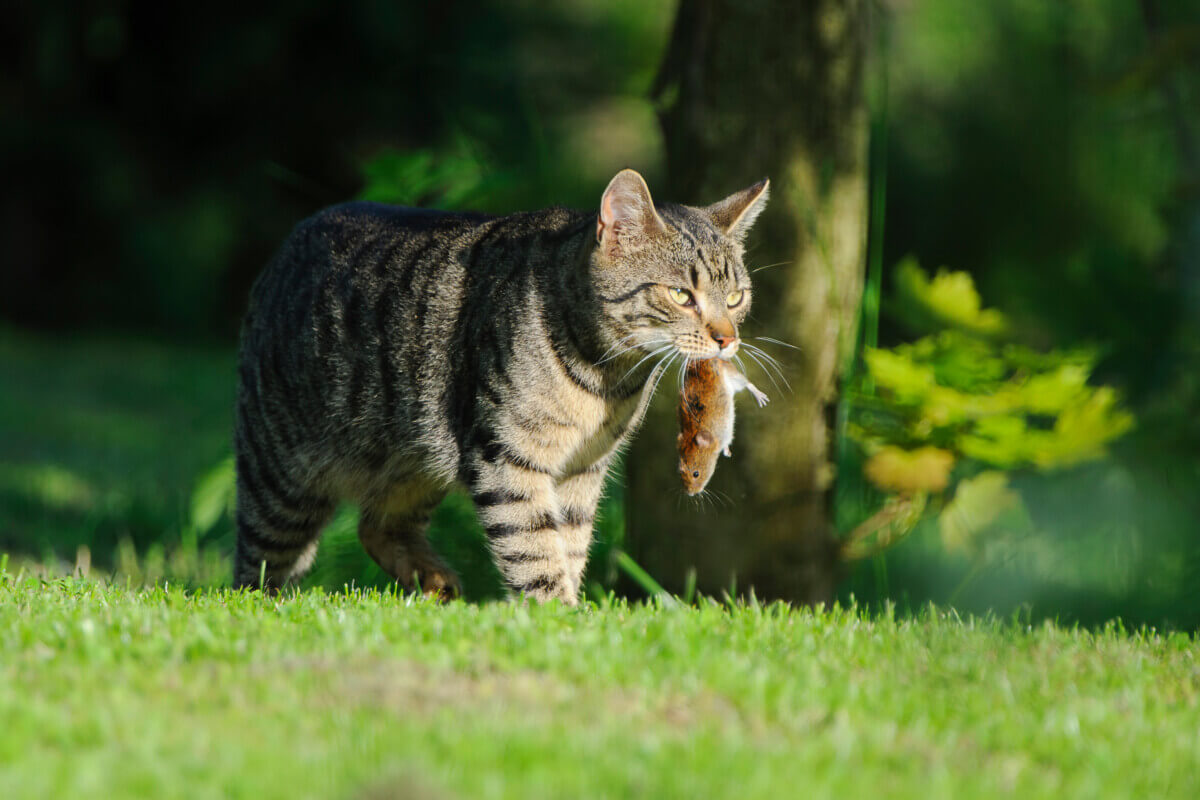
These findings make sense from an evolutionary perspective. Cats who could effectively communicate their needs to humans would have had significant survival advantages, especially in situations where they depended on human care for food and shelter. A cat who could purr appealingly or “ask” for food with the right meow would be more likely to survive and reproduce.
Pure Breeds vs. Street Smarts
Next, scientists compared the genetic patterns of domestic cats to their wild relatives including leopard cats, lynx, cheetahs, and lions. Longer gene variants (20-22 repeats) were found exclusively in domestic cats. Wild felids typically had shorter variants, suggesting that the longer versions evolved specifically during the domestication process. Even more intriguingly, previous research has shown that these longer variants are significantly more common in purebred cats than in mixed breeds.
Mixed-breed cats, many of whom started as strays or feral cats, needed to be vocal to survive. They had to communicate effectively with humans to secure resources. The researchers found that 79% of the mixed-breed cats in their study were rescued former strays. Purebred cats, on the other hand, were often bred in controlled environments where human care was guaranteed, reducing the evolutionary pressure for vocal communication.
With this research, shelters might eventually be able to predict which cats are likely to be more vocal or social based on genetic testing, helping match pets with families who want either chatty companions or quieter housemates.
Since the same genetic patterns exist across wild felid species, scientists could potentially use genetic information to better understand and predict the behavior of wild cats, which could be crucial for conservation programs and wildlife management.
“Through our research, we hope to deepen our understanding of cats and contribute to building happier relationships between cats and humans,” says Okamoto.
Our feline companions aren’t just randomly vocal or quiet. They’re carrying genetic instructions written by ancestors who figured out that the right meow at the right moment could secure a lifetime of warmth, food, and belly rubs. Evolution at its finest.
Paper Summary
Methodology
Researchers collected DNA samples from 280 neutered mixed-breed cats in Japan using cheek swabs. Cat owners completed detailed behavioral questionnaires rating their pets on 23 behavioral categories. The scientists analyzed a specific gene called the androgen receptor gene, focusing on repeating genetic sequences that varied from 15-22 repeats. Cats were divided into “short” (≤18 repeats) and “long” (≥19 repeats) groups for comparison. The study used statistical models to analyze relationships between genetic variants and behaviors while controlling for factors like age.
Results
Cats with shorter genetic variants showed significantly higher scores for purring behavior in both males and females. Male cats with short variants also displayed more directed calls and vocalizations toward humans, while female cats with short variants showed higher stranger-directed aggression scores. Comparison with wild felid species revealed that the longest genetic variants (20-22 repeats) were unique to domestic cats, with wild relatives typically having shorter variants.
Limitations
The study was limited to mixed-breed cats in Japan, which may not represent all cat populations globally. Behavioral assessments relied on owner-reported questionnaires, which could include subjective bias since owners tend to view their pets favorably. The research didn’t include purebred cats, which previous studies suggest have different genetic patterns. Comparison with wild felid species was constrained by limited database samples and species representation.
Funding and Disclosures
The study was funded by grants from the Japan Society for the Promotion of Environmental Restoration and Conservation Agency, the Japan Society for the Promotion of Science, and the Japan Science and Technology Agency. Individual researchers received scholarships from various Japanese scientific organizations. The authors declared no competing interests.
Publication Information
The paper “Association between androgen receptor gene and behavioral traits in cats (Felis catus)” was authored by Yume Okamoto, Madoka Hattori, and Miho Inoue-Murayama. It was published in PLOS One on May 28, 2025. The research was conducted at the Wildlife Research Center at Kyoto University in Japan.


