Photo by qimono from Pixabay
BERKELEY, Calif. — What will happen to Earth when our Sun burns out? A newly discovered planetary system 4,000 light-years away might hold the answer, showing an Earth-like world orbiting the remnant of a star like our Sun.
Imagine Earth not as the vibrant, life-sustaining oasis we know but as a frozen, desolate world orbiting the faint ember of what was once a star like our Sun. This is the scene set by the newly discovered system, where an Earth-mass planet circles a white dwarf at a distance roughly twice that of Earth’s current orbit around the Sun. It’s a cosmic déjà vu, a preview of one possible fate awaiting our planet in the distant future.
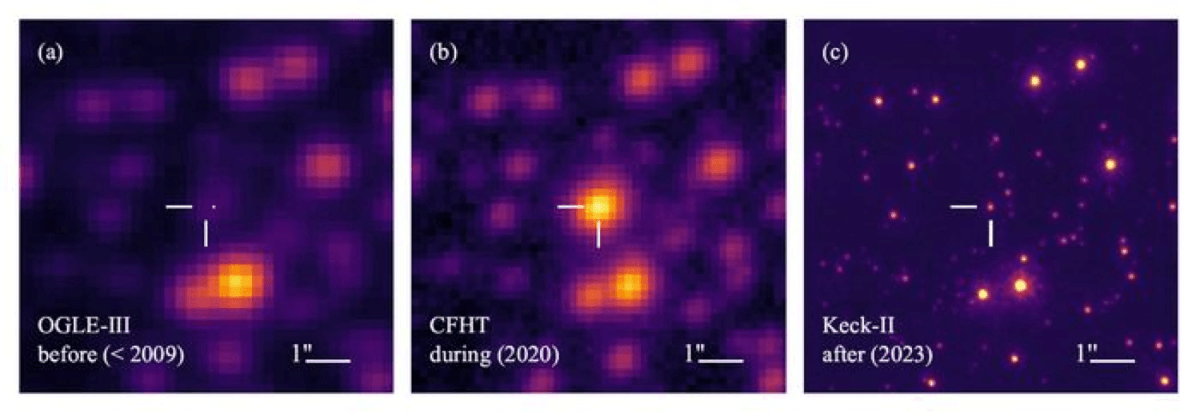
The story of this remarkable find begins with a celestial magic trick known as gravitational microlensing. In 2020, astronomers detected a brief brightening of a distant star, magnified a thousandfold by the gravity of an intervening planetary system. This cosmic lens, dubbed KMT-2020-BLG-0414, revealed not just one but three bodies: a star about half the mass of our Sun, an Earth-sized planet, and a much larger object about 17 times the mass of Jupiter — likely a brown dwarf (a failed star).
However, the true nature of this system remained shrouded in mystery until Keming Zhang, a former doctoral student at the University of California-Berkeley, and his colleagues took a closer look using the powerful Keck II telescope in Hawaii. What they found—or rather, didn’t find—was the key to unlocking the system’s secrets. Their findings are published in the journal Nature Astronomy.
“Our conclusions are based on ruling out the alternative scenarios, since a normal star would have been easily seen,” Zhang explains in a media release. “Because the lens is both dark and low mass, we concluded that it can only be a white dwarf.”
This absence of light told a compelling story: the star at the heart of this system had already lived out its main sequence life, ballooned into a red giant, and finally settled into its current state as a white dwarf — a dense, Earth-sized stellar remnant.
The implications of this discovery ripple far beyond the boundaries of astronomy. It offers a cosmic crystal ball, showing one possible outcome for Earth as our own Sun ages. In about a billion years, our star will begin to swell, potentially engulfing the inner planets and forcing the outer ones, including Earth if it survives, into wider orbits.
“We do not currently have a consensus whether Earth could avoid being engulfed by the red giant sun in 6 billion years,” Zhang notes. “In any case, planet Earth will only be habitable for around another billion years, at which point Earth’s oceans would be vaporized by runaway greenhouse effect — long before the risk of getting swallowed by the red giant.”
While the fate of our planet remains uncertain, the KMT-2020-BLG-0414 system provides evidence that Earth-like worlds can indeed survive their stars’ tumultuous final acts. It’s a testament to the resilience of planets and a reminder of the vast timescales on which cosmic dramas unfold.
This discovery is more than just a scientific curiosity — it’s a profound reflection on our place in the universe and the ultimate fate of our cosmic home. As we gaze at the night sky, we’re not just seeing distant stars and planets; we’re seeing possible futures, cosmic postcards from billions of years hence.
As humanity contemplates its long-term future, Zhang offers a glimmer of hope, albeit a distant one. Even if Earth doesn’t survive the Sun’s red giant phase, the outer solar system might become a surprising haven.
“As the sun becomes a red giant, the habitable zone will move to around Jupiter and Saturn’s orbit, and many of these moons will become ocean planets,” he concludes. “I think, in that case, humanity could migrate out there.”
Paper Summary
Methodology
The researchers employed a two-step process to uncover the nature of the KMT-2020-BLG-0414 system. First, they analyzed data from the initial microlensing event detected by the Korea Microlensing Telescope Network in 2020. This event, which lasted about two months, provided information about the masses and relative positions of the objects in the system. To determine the type of star at the center of the system, the team then used the Keck II telescope in Hawaii in 2023, equipped with adaptive optics for sharp imaging. The absence of visible light from the central star, combined with its calculated low mass, led to the conclusion that it must be a white dwarf.
Key Results
The analysis revealed a system consisting of a white dwarf star with about half the mass of our Sun, an Earth-mass planet orbiting at about twice the distance of Earth from the Sun, and a brown dwarf companion about 17 times the mass of Jupiter in a much wider orbit. The Earth-mass planet is estimated to be between 1 and 2 astronomical units from its host star.
Study Limitations
While microlensing provides a powerful tool for detecting distant planetary systems, it typically offers only a brief window of observation. This makes it challenging to gather detailed information about the planets’ atmospheres or potential habitability. Additionally, the rarity of such events means that building a comprehensive statistical sample of similar systems is difficult. The interpretation of the system’s evolutionary history also relies on models of stellar evolution, which carry their own uncertainties.
Discussion & Takeaways
This discovery provides observational evidence that Earth-sized planets can survive the turbulent late stages of stellar evolution and end up in stable orbits around white dwarfs. It offers a potential preview of the long-term fate of our own solar system and raises intriguing questions about the possibility of life persisting or emerging in such systems. The study also highlights the importance of follow-up observations in resolving ambiguities in microlensing data and the potential of this method for discovering exotic planetary systems that are difficult to detect through other means.
Funding & Disclosures
The research was supported by various institutions and funding bodies, including the Eric and Wendy Schmidt AI in Science Postdoctoral Fellowship and the National Science Foundation. The study used data from the Korea Microlensing Telescope Network and observations from the Keck Observatory. The authors declared no competing interests.


The earth’s core will cool and eliminate life long before the sun gives out.
I thought the sun would become a red giant and incinerate the earth