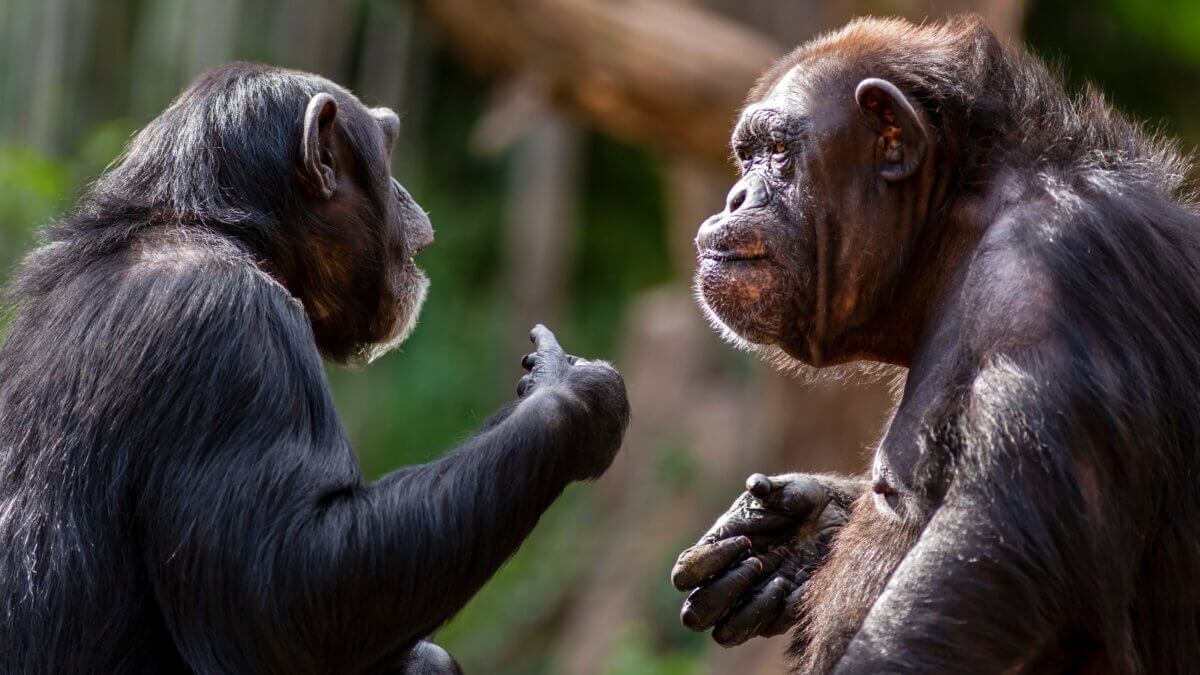
Studied chimps were capable of differentiating between genuinely new information and redundant details (Patrick Rolands/Shutterstock)
In A Nutshell: They may not be able to vocally speak like us, but chimpanzees demonstrate remarkable gestural communication with one another comparable to human conversation, new research shows. This discovery challenges our understanding of language evolution and suggests that the foundations of human communication may be more ancient than previously thought.
ST. ANDREWS, Scotland — When we think of conversation, we often picture two people exchanging words back and forth. But what if our closest animal relatives engage in similar exchanges, just without spoken language? That’s exactly what a team of international researchers found when they studied the gestural communication of wild chimpanzees across five communities in East Africa.
Chimpanzees, like humans, use a variety of gestures to communicate with each other. These can include hand movements, body postures, and facial expressions. What’s fascinating is that these apes don’t just make random gestures – they engage in structured back-and-forth exchanges that mirror the timing of human conversations.
“While human languages are incredibly diverse, a hallmark we all share is that our conversations are structured with fast-paced turns of just 200 milliseconds on average. But it was an open question whether this was uniquely human, or if other animals share this structure,” says study co-author Catherine Hobaiter from the University of St Andrews, in a statement.
The study found that chimpanzees follow a similar rapid-fire pattern in their gestural exchanges. “We found that the timing of chimpanzee gesture and human conversational turn-taking is similar and very fast, which suggests that similar evolutionary mechanisms are driving these social, communicative interactions,” says Gal Badihi, the study’s first author.
Imagine you’re chatting with a friend. There’s a natural rhythm to your conversation, with each person taking turns to speak and respond. Typically, there’s only a brief pause between one person finishing their sentence and the other beginning to reply. Surprisingly, chimpanzees show a similar pattern in their gestural exchanges. When one chimp makes a gesture, the other often responds with its own gesture after a similar short delay.
The study found that about 14% of chimpanzee communicative interactions involved these gesture exchanges. While this might seem low compared to how often humans engage in conversation, it’s important to remember that chimps use gestures primarily for immediate, practical purposes – like requesting food or play – rather than the wide range of topics humans discuss.
Most of these chimp “conversations” involved just two turns – one gesture from each participant. However, some exchanges extended up to seven turns, showing that chimps can engage in more complex communication when needed.
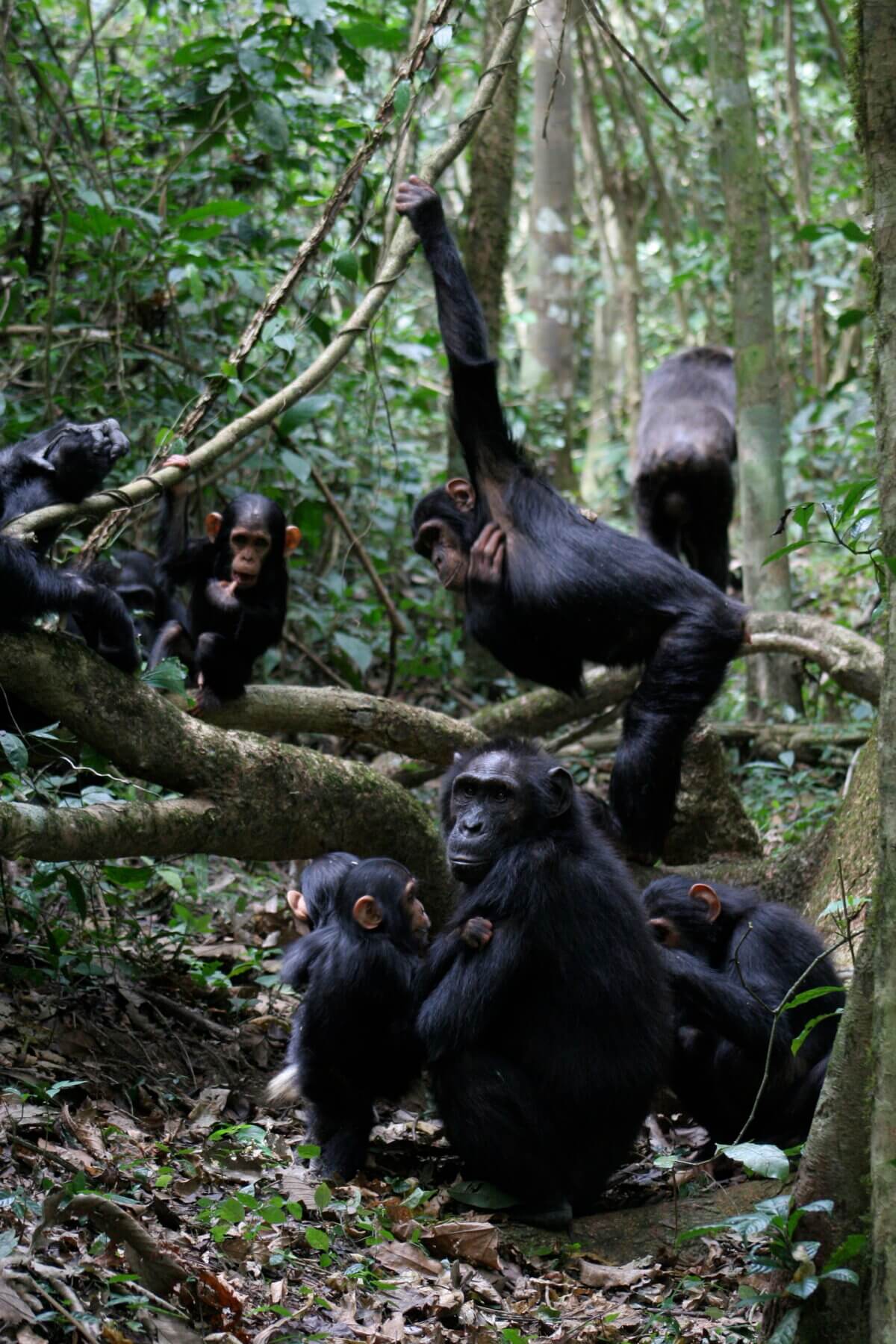
What’s particularly intriguing is the consistency of this behavior across different chimpanzee communities. Just as human conversations follow similar timing patterns regardless of the language being spoken, chimps from different groups showed remarkably similar timing in their gestural exchanges. However, there were subtle differences, as Badihi notes: “We did see a little variation among different chimp communities, which again matches what we see in people where there are slight cultural variations in conversation pace: some cultures have slower or faster talkers.”
Hobaiter adds an interesting cultural comparison: “Fascinatingly, they seem to share both our universal timing, and subtle cultural differences. In humans, it is the Danish who are ‘slower’ responders, and in Eastern chimpanzees that’s the Sonso community in Uganda.”
The findings suggests that the basic structure of turn-taking in communication – a cornerstone of human language – may have evolved long before humans split from other great apes. This doesn’t mean that chimps have language as we understand it, but it does indicate that some of the fundamental building blocks of language may be present in our closest animal relatives.
“It shows that other social species don’t need language to engage in close-range communicative exchanges with quick response time,” says Badihi. “Human conversations may share similar evolutionary history or trajectories to the communication systems of other species suggesting that this type of communication is not unique to humans but more widespread in social animals.”
Paper Summary
Methodology
The researchers observed and recorded gestural interactions among 252 wild chimpanzees across five communities in East Africa. They analyzed over 8,500 instances of gesture use, focusing on the timing between gestures in exchanges and between gestures and behavioral responses. They measured the timing of turn-taking and conversational patterns, comparing them to known patterns in human conversation.
Results
The study found that 14% of chimpanzee communicative interactions included gesture exchanges. Most exchanges involved two turns, but some extended up to seven turns. The average delay between one chimp’s gesture and another’s response was about 120 milliseconds, similar to the 200-millisecond average seen in human speech. These gestural exchanges were significantly faster than when a chimp responded to a gesture with a non-communicative behavior.
Limitations
The study focused on East African chimpanzees, so it’s unclear if these findings apply to all chimpanzee populations or other great ape species. The researchers also noted that their data came from a wider range of contexts than typical human conversation studies, which could account for some of the variation in timing they observed. Additionally, the study didn’t explore the content or meaning of the gestural exchanges, focusing primarily on their timing and structure.
Discussion and Takeaways
The similarities in timing between chimpanzee gestural exchanges and human conversations suggest a shared underlying mechanism for communication. This could be the result of a common evolutionary origin or convergent evolution due to similar social pressures. The study highlights the potential importance of face-to-face communication in the evolution of complex social interactions. It also raises questions about the development of more elaborate forms of communication, like human language, from these basic turn-taking structures. As Hobaiter points out, “We still don’t know when these conversational structures evolved, or why! To get at that question we need to explore communication in more distantly related species—so that we can work out if these are an ape-characteristic, or ones that we share with other highly social species, such as elephants or ravens.”
Funding and Disclosures
The study involved researchers from multiple institutions across several countries. While specific funding sources weren’t detailed in the provided excerpt, research of this nature typically involves support from universities, research institutions, and conservation organizations. The authors declared no competing interests, indicating that their findings weren’t influenced by any financial or personal considerations that could bias their results.


