(Credit: Shutterstock)
No side is entirely free of bias.
In A Nutshell
- Conservatives show higher belief in conspiracy theories and are more willing to spread science misinformation, even after accounting for analytical thinking and education
- Both liberals and conservatives engage in motivated reasoning equally when evaluating political arguments, accepting flawed logic that supports their views and rejecting sound logic that challenges them
- Analytical thinking helps people spot logical fallacies across the political spectrum but doesn’t protect against conspiracy beliefs or misinformation sharing
- Believing truth is subjective rather than objective predicts greater susceptibility to conspiracy theories and pseudo-profound nonsense, regardless of political orientation
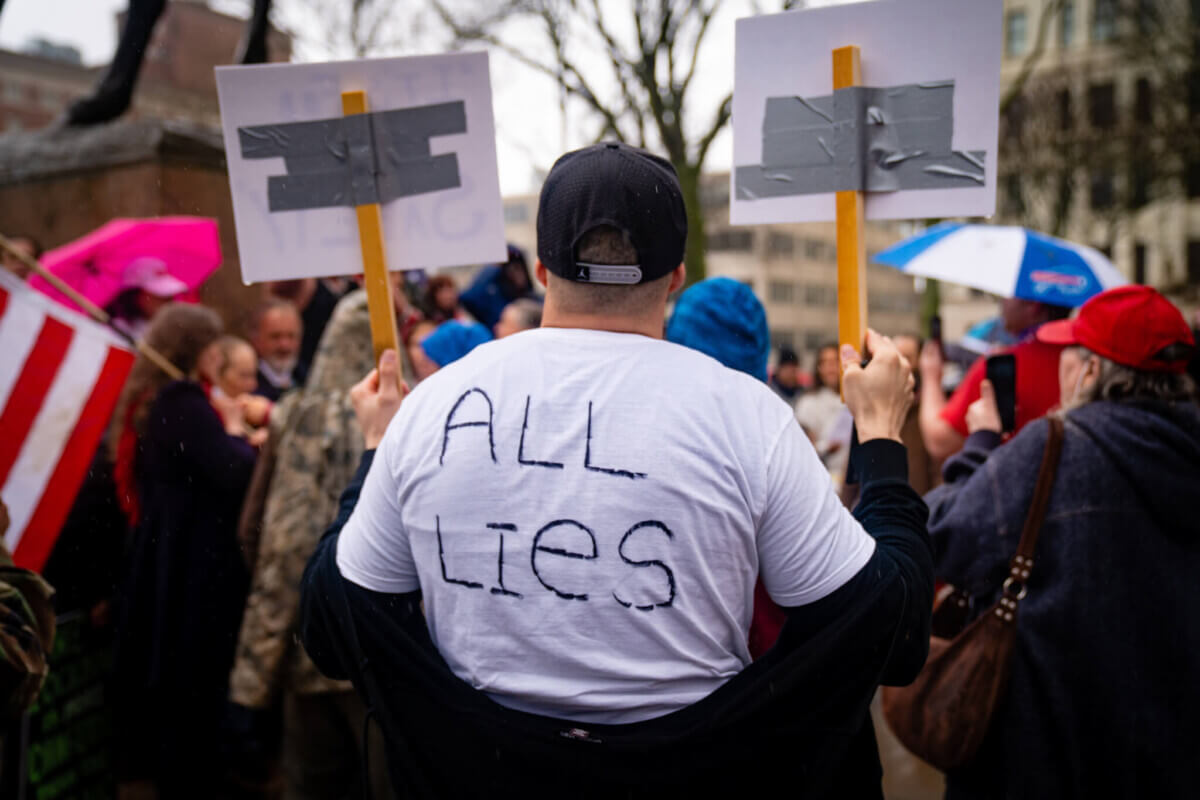
Conservatives are more likely than liberals to believe conspiracy theories and share fake science news. But when it comes to bending the truth to support their political team, both sides do it equally.
That’s the key finding from a large Swedish study that tracked how people across the political spectrum responded to different types of misinformation. Across three studies with samples of 1,005 (Sweden), 417 (U.K.), and 1,008 (Sweden) — with one Swedish sample analyzed in two separate papers — the research offers a more nuanced picture than the usual “one side is worse” narrative that dominates debates about fake news.
Author Julia Aspernäs, from the Department of Behavioural Sciences and Learning at Linköping University in Sweden, found evidence of both symmetries and asymmetries in misinformation susceptibility. It all depends on what type of misinformation you’re looking at.
The Conspiracy Theory Gap
When researchers asked people about conspiracy theories, like whether the science behind global warming has been invented or distorted, or whether experiments with new drugs are routinely carried out on the public without their knowledge or consent, conservatives consistently believed them more often than liberals. This pattern held up even after accounting for other factors like education level and thinking styles.
The gap extended to sharing behavior too. When participants encountered scientific results in a fictional social media scenario covering controversial topics like gender differences, organized crime, and unemployment, conservatives reported higher willingness to post misleading summaries that twisted the research to match their views.

When Both Sides Play the Same Game
Aspernäs also tested whether people could spot flawed logic in political arguments. They created puzzles where participants had to figure out if a conclusion actually followed from the evidence presented—like a detective checking if the clues really point to the suspect.
Some arguments had conservative conclusions. Others had liberal ones. The trick was that participants were told to ignore whether they agreed with the content and just check if the logic worked.
Both liberals and conservatives failed this test in the same way. When an argument supported their political views, they’d often accept it even when the logic was broken. When an argument opposed their views, they’d reject it even when the reasoning was sound.
A conservative might nod along to a logically flawed argument for tax cuts. A liberal might do the same for a poorly reasoned argument about wealth inequality. Neither side was better at catching their own bias.
This matters because it suggests that when people have skin in the game politically, they bend facts at similar rates regardless of ideology.
The Thinking Style That Helps
One trait did protect people from some types of misinformation: taking time to think things through rather than going with gut instinct.
Aspernäs tested this with trick questions. Here’s an example: “A bat and a ball cost 110 kronor total. The bat costs 100 kronor more than the ball. How much does the ball cost?”
Most people immediately think “10 kronor.” But if you pause and work it out, the answer is actually 5 kronor.
People who caught these tricks were better at spotting logical flaws in political arguments, whether conservative or liberal. Slowing down and double-checking your instincts appeared to help people resist at least some forms of bias.
But analytical thinking wasn’t a cure-all. It helped with logic puzzles but didn’t stop people from believing conspiracy theories or sharing misleading science posts. Something else was going on there.
The ‘Your Truth’ Problem
Aspernäs uncovered another factor that has been almost completely neglected in misinformation research: what people believe about truth itself.
Some people lean toward thinking truth is objective: either the earth is round or it isn’t, regardless of anyone’s opinion. Others lean toward thinking truth is personal or subjective. Someone with strong subjectivist beliefs might agree that “truth is nothing more than a person’s subjective experience of the world.”
People with stronger subjectivist beliefs about truth were more likely to fall for impressive-sounding nonsense, believe conspiracy theories, and report willingness to share fake science news. This held true across the political spectrum. It wasn’t that conservatives believed truth was more subjective, they just happened to believe more conspiracy theories for other reasons.
This finding points to a deeper vulnerability than political bias. If someone thinks truth depends on personal feelings rather than evidence, they may be more susceptible to misinformation that triggers the right emotions, regardless of facts.
Why the Conservative Vulnerability?
The study doesn’t fully explain why conservatives show higher rates of conspiracy belief. It’s not that they’re worse at analytical thinking or more biased in general; the research found them similar to liberals on those dimensions.
One possibility is that conservative ideology attracts people with certain personality traits, like stronger distrust of institutions, that also make conspiracy theories more appealing. Another is that right now, many popular conspiracy theories happen to align with conservative narratives, though this wouldn’t explain why the pattern shows up even with politically neutral conspiracies.
Aspernäs stresses that the findings describe group averages, not individuals. Plenty of conservatives reject conspiracy theories completely. Plenty of liberals believe them. The differences, while real, are modest.
What It Means
Both sides engage in motivated reasoning when their political identity is threatened. But conservatives show an additional vulnerability to conspiracy thinking and science misinformation that appears separate from this bias.
This creates a challenge for fighting fake news. Different problems need different solutions. Teaching people to check their logic might help with motivated reasoning. But conspiracy beliefs might require addressing deeper issues about trust in institutions. And if someone fundamentally believes truth is subjective, fact-checking might not work at all.
It’s worth noting that the study was conducted in Sweden and the United Kingdom, where the political landscape differs from the United States. American conservatives might show different patterns than Swedish or British ones. But the finding that misinformation susceptibility isn’t one-dimensional — that people can be resistant to some types while vulnerable to others — likely applies across cultures.
Perhaps the biggest takeaway is this: accusations that “the other side” is uniquely prone to fake news miss the mark. Everyone has vulnerabilities. They just show up in different ways depending on what you’re measuring.
Paper Notes
Limitations
The research used online surveys where people reported their own beliefs and stated willingness rather than tracking actual behavior. People may not always accurately report what they believe, or their survey responses might not match how they’d act in real situations. The science misinformation measure used hypothetical social media scenarios rather than observing what people actually share online.
One study asked participants to evaluate logical arguments but instructed them not to think too long before answering, which might have accidentally encouraged snap judgments over careful reasoning. An attempt to experimentally manipulate people’s beliefs about truth was unsuccessful, preventing conclusions about whether believing truth is subjective actually causes greater susceptibility to misinformation.
All participants came from Sweden or the United Kingdom. Patterns might differ in other countries with different political cultures and media environments.
Funding and Disclosures
Funding sources and potential conflicts of interest are not specified in the thesis document.
Publication Details
Author: Julia Aspernäs, Department of Behavioural Sciences and Learning, Division of Psychology, Linköping University | Supervisors: Arvid Erlandsson (main supervisor) and Artur Nilsson (co-supervisor) | Document Type: Doctoral dissertation (Linköping Studies in Arts and Sciences No. 921, 2025; Linköping Studies in Behavioural Science No. 271) | Institution: Linköping University, Faculty of Arts and Sciences, Sweden | DOI: https://doi.org/10.3384/9789181183009 | ISBN: 978-91-8118-299-6 (print); 978-91-8118-300-9 (PDF) | Published: 2025
The thesis comprises three papers:
- Paper I: Aspernäs, J., Erlandsson, A., & Nilsson, A. (2022). Motivated formal reasoning: Ideological belief bias in syllogistic reasoning across diverse political issues. Thinking & Reasoning, 29(1), 43–69. DOI: 10.1080/13546783.2022.2038268
- Paper II: Aspernäs, J., Erlandsson, A., & Nilsson, A. (2023). Misperceptions in a post-truth world: Effect of subjectivism and cultural relativism on bullshit receptivity and conspiracist ideation. Journal of Research in Personality, 105, 104394. DOI: 10.1016/j.jrp.2023.104394
- Paper III: Aspernäs, J., Nilsson, A., & Erlandsson, A. (2025). The role of truth relativist and realist views in bullshit receptivity, conspiracy ideation, and the distribution of science misinformation. Manuscript under revision for Royal Society Open Science.


This title is just WRONG …
“Conservatives More Likely To Believe Conspiracy Theories, But Both Sides Twist Facts To Fit Their Views”
The takeaway is that Conservatives More Likely To Believe Conspiracy Theories … so leave it at that and explain it.
You don’t have to follow every criticism of Conservatives with some fake criticism you can aim at both sides. This is a sign of Right-wing bias in StudyFinds.
So unbrainwashed, limited government free thinkers vs indoctrinated, “big govt is my savior” sheep.
Cant wait til the authors discover presuppositions at the worldview, thatll really blow their mind about biases and the myth of neutrality.
One would think all the top secret jobs in the military would fill a service person’s head with propaganda & governmental conspiratorial brainwash !
How scientific is this article?
No mention of percentage.
How scientific is this research?
Anger creates bias.
The author of the research is probably angry if we consider the title of two of his papers:
Paper II: Aspernäs, J., Erlandsson, A., & Nilsson, A. (2023). Misperceptions in a post-truth world: Effect of subjectivism and cultural relativism on bullshit receptivity and conspiracist ideation.
Paper III: Aspernäs, J., Nilsson, A., & Erlandsson, A. (2025). The role of truth relativist and realist views in bullshit receptivity, conspiracy ideation, and the distribution of science misinformation.
Just thinking.
If progressives agreed the southern border was secure, but knew it really wasn’t, yet did not speak up, what would be the term for that? My answer, they were cowards.
If progressives believed Biden was fit to run for a second term, but watched him stumble around a stage or get lost in a NATO photo op, what would be the term for that? Again, cowardice.
As the Chinese spy ballon crossed the US, why didn’t US pilots disobey the illegal order, to not shoot it down? Because Republicans in Congress did not tell them to disobey an illegal order.
Hardly conspiracy ? Perhaps look up the definition .
Liberals are more likely to find a feminist social science PhD to invent “research” to justify their nonsense. Ask a liberal to define “woman.”
The real definition of “Misinformation”, “Disinformation”, and “Conspiracy Theory” is this: Anything that questions the official narrative of events presented by the government and the corporate media.
The government and the corporate media try to marginalize those who question the official narrative of events by portraying them as stupid or mentally troubled. This “study” is a variant on the articles published every month or so by “scholars” such as,
“Why do people believe in conspiracy theories?”
“How to talk to people who believe in conspiracy theories”,
“My relative is a conspiracy theorist. What do I do?”
“Back from the brink: A former conspiracy theorist tells how he freed himself from disinformation.”
In the U.S., conservatives tend to be more religious and less educated (not an opinion–demographic data shows this). As a result, they are less likely to have done college-level tasks like write term papers or lab reports where they learn how to identify reliable sources of information. They are also more likely to accept things on faith instead of working through the facts themselves and using reason to reach a conclusion. Both of those things make one more susceptible to belief in conspiracy theories.
so conservatives are more likely to be less educated at the higher education level? So does that mean they are less indoctrinated in liberal/socialist nonsense that is eating away at our culture and way of life in the United States? Yeah OK. The “research“ it’s about as valuable as a thin piece of tissue paper and I’m sure completely without bias.
This is a classic conservative response of someone who didn’t graduate from college. I think it comes from an inferiority complex where you feel like you’re being judged, so you attack. The previous comment is spot on:
“In the U.S., conservatives tend to be more religious and less educated (not an opinion–demographic data shows this). As a result, they are less likely to have done college-level tasks like write term papers or lab reports where they learn how to identify reliable sources of information. They are also more likely to accept things on faith instead of working through the facts themselves and using reason to reach a conclusion. Both of those things make one more susceptible to belief in conspiracy theories.”
College doesn’t necessarily make people “smarter”, but it does teach people to discern fact from fiction by seeking reliable, fact-based data and evidence to prove a point or theory. So when people don’t have these skills, they just believe what their friends or pastor told them or what they saw on some website that tells them what they want to hear. This is why they’re so susceptible to believing and spreading un-true information.
And of course Republicans want to shutter the DOE because the less educated people are, the more likely they are to vote for Republicans and lifelong conmen like Donald Trump.
Jake:I pray for wisdom for you. Far more important than booksmarts. liberal education has resulted in the insanity of believing one can change their sex, that socialism or communism is a wonderful thing, and that it’s perfectly acceptable to abort unborn babies as birth control. no excuse me as I decide how I am going to identify tomorrow morning
I’ll stick with Jake F.’s analysis
Good Lord, you’re a walking, talking Fox News ad. Have you ever traveled outside the U.S.? Or have any friends that don’t look like you or believe the same things you do?? There’s a saying that “ignorance is bliss”, it should be “ignorance is destructive”.
LOL !!! School is where you go to learn how to be stupid, gullible and obedient. The graduation hat symbolizes your head stuck in a box. It’s a symbol of Saturn. A piece if paper does not prove you know what you’re talking about. Try doing some research and stop embarrassing yourself. The internet has changed everything. Here is your proof that everything the MSM and Government say is a lie.
cvhoax d t wixsite d t c m slash mysite
You hit the nail on the head- you are 100% correct.