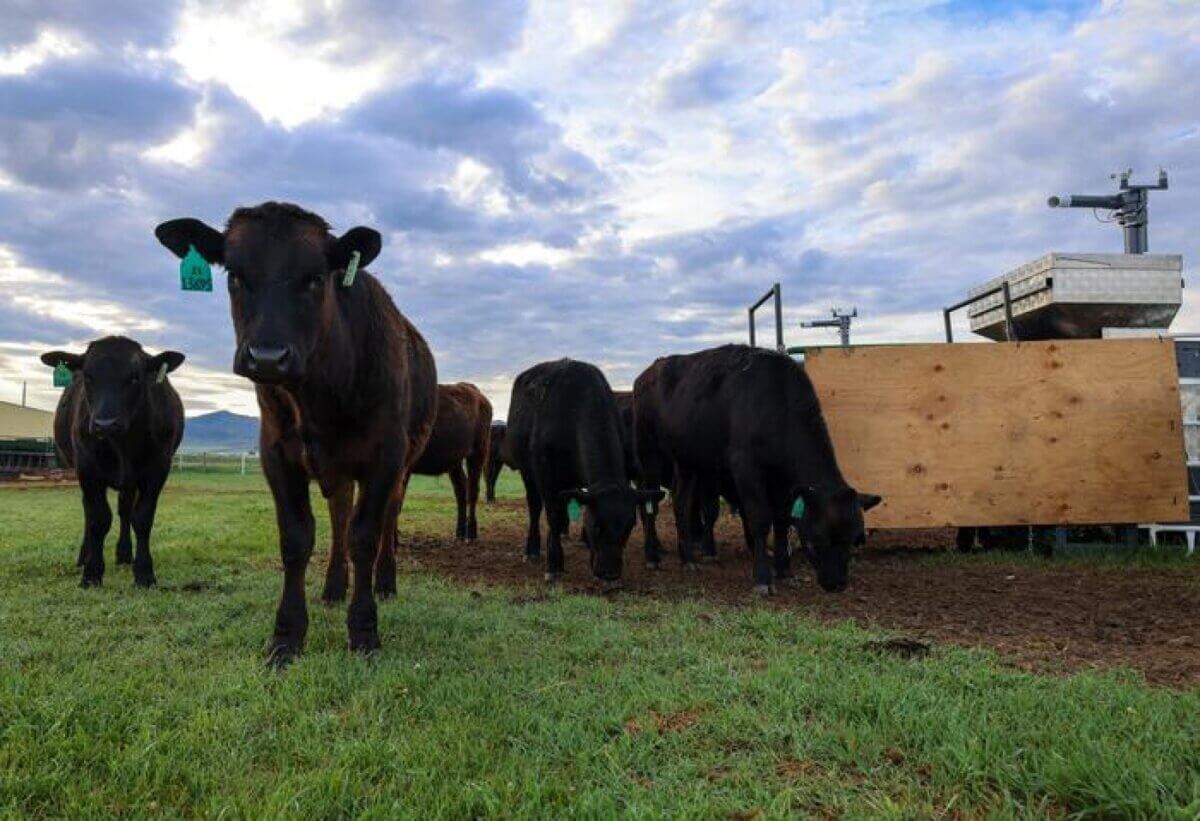
Beef steers graze on a ranch in Dillon, Montana. The machine nearby releases a seaweed supplement while also measuring the cattle's methane emissions. (Credit: Paulo de Méo Filho / UC Davis)
DAVIS, Calif. — When it comes to climate change, one of the most significant yet rarely discussed contributors comes from an unexpected source: cow burps. Now, scientists may have found a potential solution that could reshape the future of sustainable cattle farming: seaweed.
To understand the scale of this challenge, consider the numbers: Livestock account for 14.5% of global greenhouse gas emissions, with the largest portion coming from methane that cattle release when they burp. In the United States alone, there are over 64 million beef cattle and nine million dairy cows contributing to these emissions. When cattle digest fibrous plant materials, their specialized stomach compartments host microorganisms that break down tough cellulose, producing methane as a byproduct. Grazing cattle, which consume more fibrous grass than their feedlot or dairy counterparts, produce even more methane as a result.
“Beef cattle spend only about three months in feedlots and spend most of their lives grazing on pasture and producing methane,” explains senior author Ermias Kebreab, professor in the Department of Animal Science at the University of California, Davis, in a media release. “We need to make this seaweed additive or any feed additive more accessible to grazing cattle to make cattle farming more sustainable while meeting the global demand for meat.”
Breaking New Ground: Testing Seaweed Supplements in Grazing Cattle
Previous research has shown promising results with seaweed supplements, reducing methane emissions by 82% in feedlot cattle and over 50% in dairy cows. However, finding effective solutions for grazing cattle has proven particularly challenging because they spend most of their time on open pastures, making daily supplementation difficult. The UC Davis study represents the first worldwide test of seaweed supplements on grazing beef cattle.
To tackle this challenge, researchers developed a precisely formulated supplement called Brominata, using a specific seaweed species, Asparagopsis taxiformis. The pelleted supplement contained 20% of the seaweed along with distillery solubles (15%), wheat middlings (64.8%), and a small amount of palatability enhancer (0.25%). This careful formulation aimed to make the supplement both effective and palatable to cattle.
The study took place at Matador Ranch in Montana, where researchers worked with 24 Wagyu-Angus crossbred steers. The cattle were divided into two equal groups: one received standard feed pellets, while the other received the Brominata supplement. Using sophisticated monitoring equipment called the GreenFeed system, researchers tracked the animals’ emissions during feeding sessions that occurred up to three times daily over a 70-day period.
The results revealed three distinct phases: a three-week ramp-up period as cattle adjusted to the supplement, a three-week optimal phase where effects were most pronounced, and a two-week decreasing phase. During the optimal and decreasing phases, cattle receiving the seaweed supplement showed an average reduction in methane emissions of 37.7% compared to the control group. Importantly, this significant decrease occurred without negatively impacting the animals’ growth or feed intake.
The researchers discovered a precise relationship between the amount of bromoform (the active compound in the seaweed) consumed and methane reduction: for every 100 milligrams of daily bromoform consumption, methane emissions dropped by approximately 20%. With an average bromoform intake of 193 milligrams per day, the study demonstrated that even voluntary consumption of the supplement could achieve significant results.
The study, published in the Proceedings of the National Academy of Sciences, also tracked other greenhouse gases. Carbon dioxide emissions showed a modest 4% reduction in supplemented cattle, while hydrogen emissions increased significantly – rising 85.7% in production and 76.5% in yield. This increase in hydrogen emissions was expected, as it indicates the successful disruption of methane-producing digestive processes.
Looking toward practical implementation, Kebreab notes, “Ranchers could even introduce the seaweed through a lick block for their cattle.”
This approach could solve one of the biggest challenges in grazing operations: delivering supplements to cattle that often range far from ranch headquarters. While ranchers typically supplement their cattle’s diet during winter months or when grass becomes scarce, having a delivery method that works year-round could maximize the climate benefits.
The Climate Impact of Cattle: A Growing Global Challenge
The global implications of this research extend far beyond American ranches. Pastoral farming supports millions of people worldwide, often in regions most vulnerable to climate change. Making cattle grazing more environmentally sustainable could help protect both these traditional farming practices and the communities that depend on them. This aligns with findings from a related PNAS article emphasizing the importance of improving livestock production in low and middle-income countries through better genetics, feeding practices, and animal health measures.
For the millions of ranchers worldwide who manage grazing cattle, this research offers a practical path toward climate change mitigation. While the 37.7% reduction might not match the more dramatic results seen in controlled feeding situations, it represents a significant breakthrough for grazing operations. The simplicity of the solution – a supplement that can be delivered through existing feeding practices – makes it particularly promising for widespread adoption as the world seeks to balance increasing demand for meat with environmental protection.
Paper Summary
Methodology
To understand this study’s significance, it helps to first grasp how cattle typically graze. Unlike dairy cows or feedlot cattle that receive carefully controlled daily rations, grazing cattle roam pastures eating primarily grass and other forage plants. This natural behavior makes it challenging to deliver supplements or measure their effects.
The researchers tackled this challenge through careful experimental design. They selected 24 Wagyu-Angus crossbred steers of similar age and weight, working at Montana’s Matador Ranch where the cattle grazed on carefully maintained pastures. The pastures contained a diverse mix of plants including orchard grass, meadow brome, tall fescue, and various legumes, all managed through rotational grazing with regular irrigation and fertilization.
The innovative aspect came in how they delivered and measured the supplement’s effects. They used specialized feeding stations called GreenFeed units that served two purposes: delivering the supplement and measuring emissions. These stations recognized individual animals through electronic ear tags, much like an automated gate recognizing your car’s toll pass. When cattle visited these stations (up to three times daily, at least six hours apart), they received either regular pellets or the seaweed-containing Brominata in small portions. This voluntary feeding approach mimicked real-world conditions where cattle might access supplements through methods like lick blocks.
Key Results
The study’s findings revealed several layers of impact. The headline result – a 37.7% reduction in methane emissions – becomes even more impressive when you consider it was achieved through voluntary supplement consumption. While this reduction doesn’t match the 82% seen in feedlot cattle or 50% in dairy cows, it represents a significant achievement given the challenges of working with grazing animals.
The researchers discovered a clear mathematical relationship: for every 100 milligrams of bromoform (the active compound in the seaweed) consumed daily, methane emissions dropped by about 20%. The average daily consumption of 193 milligrams led to the overall reduction observed. This relationship helps explain why the reduction was less dramatic than in feedlot studies – grazing cattle consumed the supplement voluntarily rather than receiving controlled daily doses.
Study Limitations
Beyond the previously discussed technical limitations, this study highlights several practical challenges for implementing seaweed supplements in real-world grazing operations. While the 24-animal sample size provided statistically significant results, it represents a tiny fraction of the world’s grazing cattle population – over 64 million in the U.S. alone. The study also took place during a specific season; year-round effectiveness, particularly during periods when supplemental feeding is less common, remains to be tested.
The researchers acknowledge that delivering supplements to grazing cattle remains challenging, though their suggestion of using lick blocks offers a potential solution. Additionally, while the study showed promising results in Montana’s climate, effectiveness might vary in different geographical regions and grazing conditions.
Discussion & Takeaways
This research represents a crucial step toward making cattle farming more environmentally sustainable while preserving traditional grazing practices that support millions of people globally. The study’s approach – working within existing farming practices rather than trying to fundamentally change them – suggests a practical path forward for adoption.
The findings connect to broader efforts to improve livestock efficiency worldwide, particularly in developing nations where both food security and climate change adaptation are crucial concerns. As highlighted in the related PNAS article, combining innovations like seaweed supplements with improvements in genetics, feeding practices, and animal health could help meet growing global meat demand while limiting environmental impact.
Funding & Disclosures
The research received support from Matador Ranch in Dillon, Montana, where the study was conducted, and the Sesnon Endowed Chair Fund of the University of California, Davis. Senior author Ermias Kebreab served as a scientific advisor to Blue Ocean Barns, the company that supplied the Brominata supplement. The study was conducted by a team including UC Davis postdoctoral researchers Paulo Meo-Filho and John-Fredy Ramirez-Agudelo. These relationships and support sources were properly disclosed in the paper’s competing interest statement.


Cow farts, really? The greatest threat to the planet isn’t cows it’s overpopulation by humans; overproduction and overconsumption of resources which are dwindling by the year. There are 1.5 billion cows on the planet. In 2025 it is estimated that there will be 8.232 billion humans on the planet all farting at one time or another. Get the picture? Don’t even get me started on microplastics, GMOs, fast food and landfills.