
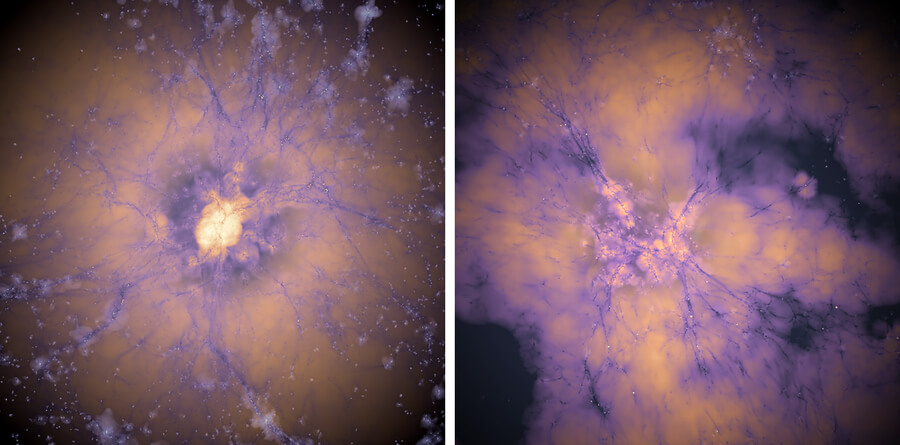
Early dark energy could have triggered the formation of numerous bright galaxies, very early in the universe, a new study finds. The mysterious unknown force could have caused early seeds of galaxies (depicted at left) to sprout many more bright galaxies (at right) than theory predicts. Credits:Josh Borrow/Thesan Team
CAMBRIDGE, Mass. — Imagine if there was a secret ingredient in the early universe that could explain not one but two of the biggest head-scratchers in modern cosmology. Well, according to a new study by MIT physicists, that’s exactly what we might be looking at. The culprit? Something called “early dark energy.”
Before we dive into the solution, let’s talk about the problems. First up, we have what scientists call the “Hubble tension.” It’s basically a fancy way of saying that when we measure how fast the universe is expanding, we get different answers depending on how we look at it. It’s like having two different speedometers in your car that never agree – frustrating, right?
The second puzzle is a bit more recent. Thanks to NASA’s super-powerful James Webb Space Telescope (JWST), we’ve spotted a bunch of bright, massive galaxies in the very early universe. The thing is, they shouldn’t be there – at least according to our current understanding of how galaxies form. It’s as if you went to a small town expecting a few streetlights and instead found New York City.
Enter: Early Dark Energy
Now, you’ve probably heard of dark energy – it’s this mysterious force that scientists think is causing the universe to expand faster and faster. Consider early dark energy its time-limited cousin. The idea is that this force showed up for a brief moment in the universe’s infancy, gave everything a good push, and then disappeared without a trace.
“You have these two looming open-ended puzzles. We find that in fact, early dark energy is a very elegant and sparse solution to two of the most pressing problems in cosmology,” explains Rohan Naidu, a postdoc at MIT and co-author of the study, published in the Monthly Notices of the Royal Astronomical Society.
How Does It Work?
The MIT team, led by postdoc Xuejian (Jacob) Shen, created a model of how galaxies formed in the first few hundred million years of the universe. When they added early dark energy to the mix, something fascinating happened – the number of galaxies that popped up matched what we’re seeing with the JWST.
“The bright galaxies that JWST saw would be like seeing a clustering of lights around big cities, whereas theory predicts something like the light around more rural settings like Yellowstone National Park. And we don’t expect that clustering of light so early on,” Shen says.
However, with early dark energy in play, the “skeleton” of the early universe – made up of invisible dark matter – forms differently.
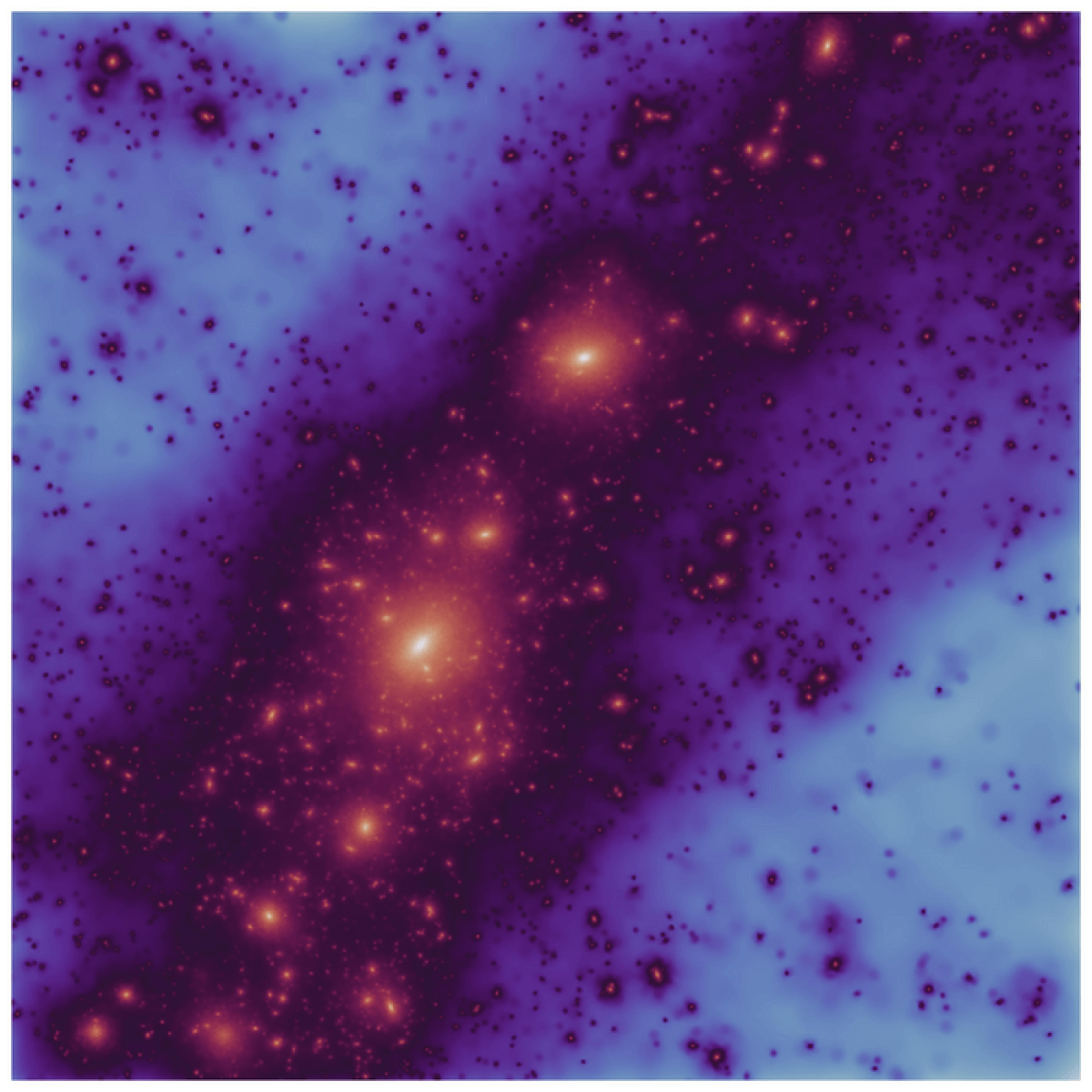
“What we show is, the skeletal structure of the early universe is altered in a subtle way where the amplitude of fluctuations goes up, and you get bigger halos, and brighter galaxies that are in place at earlier times, more so than in our more vanilla models,” Naidu explains.
What Does This Mean for Our Understanding of the Universe?
If the MIT team is right, early dark energy could be the missing piece that brings our observations and theories back into harmony. It would explain why we’re seeing different expansion rates and why there are so many bright galaxies in the early universe.
The Hubble tension arises from conflicting measurements of the universe’s expansion rate – one based on the cosmic microwave background (the afterglow of the Big Bang) and another from observations of nearby celestial objects. The early dark energy model, originally proposed to address this discrepancy, now shows promise in explaining the early galaxy conundrum as well.
“We demonstrated the potential of early dark energy as a unified solution to the two major issues faced by cosmology. This might be an evidence for its existence if the observational findings of JWST get further consolidated,” says Professor Mark Vogelsberger, another co-author of the study.
If the EDE model proves correct, it could fundamentally alter our understanding of the universe’s early history and the forces that shaped it. It suggests that the cosmos may have undergone a period of accelerated expansion in its youth, driven by a mysterious form of energy that has since dissipated.
While this study is exciting, it’s just the beginning. The team plans to incorporate their findings into larger cosmological simulations to see what other predictions they can make.
As we continue to peer deeper into the cosmos and further back in time, who knows what other surprises we might find? One thing’s for sure – the universe is still full of mysteries, and scientists are hot on their trail. Stay tuned, space fans!
Paper Summary
Methodology
The researchers in this study used computer simulations to model how galaxies form and evolve over time. The model incorporated factors like star formation rates and ultraviolet (UV) radiation produced by galaxies. They compared these models against real observations from the JWST, focusing particularly on the “ultraviolet luminosity function” (UVLF). The UVLF essentially measures how much light galaxies emit in UV wavelengths at different points in the universe’s history, which can tell us about the number and size of galaxies over time.
Two main cosmological models were tested: the standard ΛCDM and the Early Dark Energy (EDE) model. ΛCDM has been the leading theory for decades and suggests that dark energy causes the universe to expand at an accelerating rate. The EDE model, on the other hand, introduces a burst of dark energy early in the universe’s history, which would affect galaxy formation at that time. The researchers ran simulations for both models and adjusted various parameters, such as star formation efficiency, to match the JWST’s surprising observations.
Key Results
While the ΛCDM model could explain some of the early galaxy observations, it required extreme and, in some cases, unrealistic conditions. For instance, the brightness of galaxies in the ΛCDM model at a redshift of 16 — a measure of how far back in time we’re looking — could only be explained by assuming a high degree of UV variability. This means that in this model, galaxies would need to produce far more UV light than simulations have ever predicted, pushing the limits of what’s physically possible.
In contrast, the EDE model required less dramatic adjustments. It suggested that galaxies could still be brighter than expected but didn’t need to stretch physical laws to the same extent. The EDE model’s enhanced halo abundance at high redshifts provided a more feasible explanation for the JWST’s observations of early, massive galaxies, offering a better fit without the need for extreme assumptions.
Study Limitations
Despite these intriguing findings, the authors are cautious about drawing strong conclusions from the current data. One major limitation is that many of the JWST observations are still based on photometrically selected galaxy candidates, meaning they haven’t all been confirmed through spectroscopy. There’s always the possibility that some of these candidates might be false positives, meaning that they could be different types of astronomical objects, or their redshifts (and thus their age) could be miscalculated.
Furthermore, the model adjustments necessary for ΛCDM to align with JWST data are extreme and could suggest that we are simply missing key pieces of the puzzle about how galaxies form. While EDE offers a promising alternative, the precise nature of dark energy — both in its early form and its current state — is still a deeply debated topic.
Discussion & Takeaways
The paper makes it clear that the JWST is pushing the boundaries of our understanding of the universe. Its observations force us to rethink how galaxies formed in the first few hundred million years after the Big Bang. The ΛCDM model, while extremely successful in explaining many cosmological phenomena, appears to struggle when faced with these new observations. The introduction of Early Dark Energy as a potential solution is exciting, as it provides a more natural explanation for the early formation of massive, UV-bright galaxies.
The authors suggest that further observations, especially spectroscopically confirmed galaxies at even higher redshifts, will be crucial for determining whether EDE can truly reconcile the gaps between theory and observation. Ultimately, the JWST’s findings could pave the way for a revised understanding of dark energy’s role in shaping the cosmos.
Funding & Disclosures
The research was supported by several academic institutions and funding bodies, including NASA and the National Science Foundation (NSF). The JWST data, made publicly available through various astronomical surveys, provided the foundation for this analysis. The authors declare no competing financial interests in the publication of this research.


Why Dark anything or fantasy black holes when electromagnetism can explain it and does a better job of explaining?