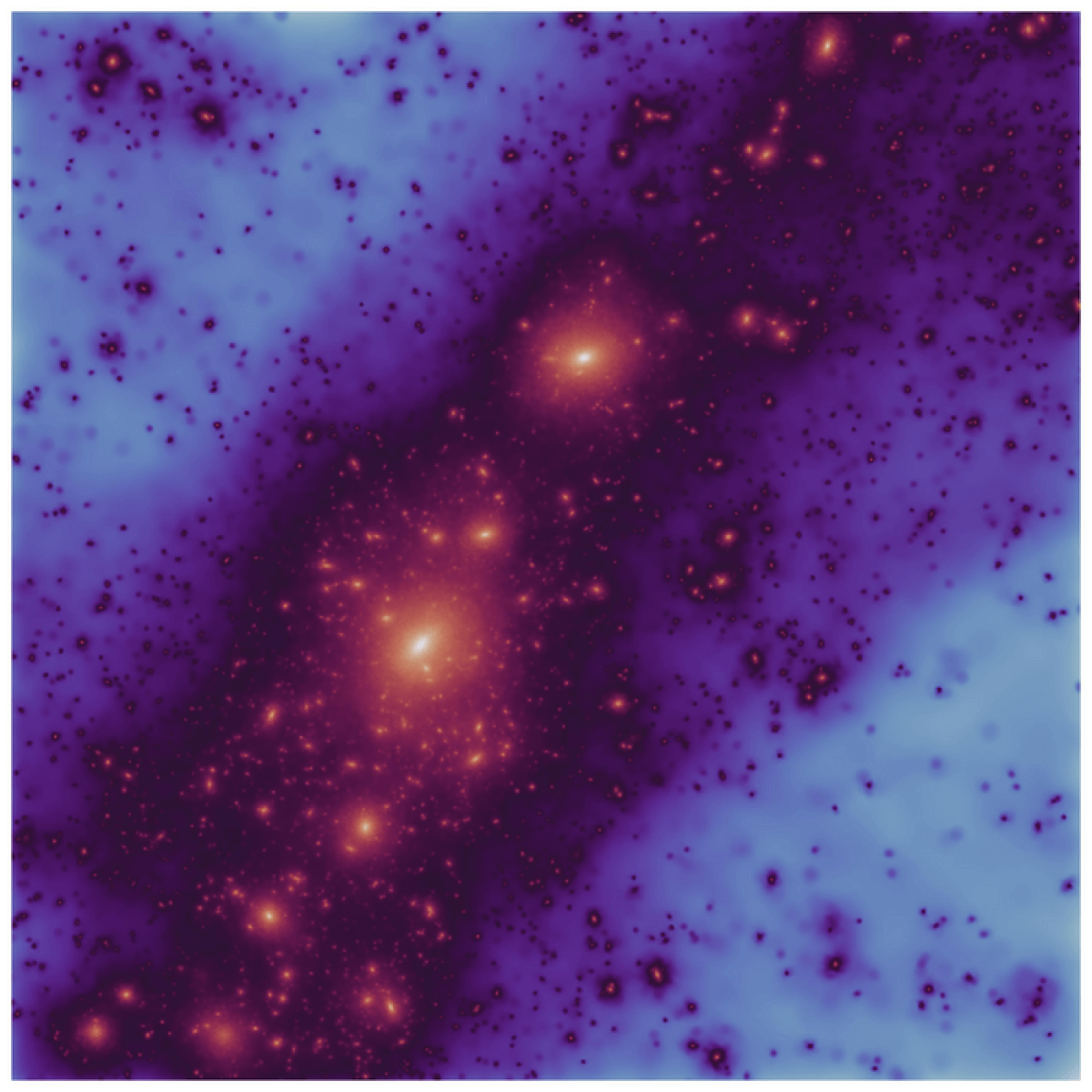
One of the new high-resolution simulations of the dark matter enveloping the Milky Way and its neighbor, the Andromeda galaxy. (CREDIT: Till Sawala/Sibelius collaboration)
MADRID, Spain — Astronomers and physicists have long sought to understand the nature of dark matter, and now, a surprising connection to antimatter might provide the breakthrough they’ve been waiting for. Recent research indicates that dark matter could be the source of rare antihelium nuclei detected in cosmic rays.
This discovery, detailed in a recent study published in the Journal of Cosmology and Astroparticle Physics, offers a potential explanation for puzzling observations made by space-based detectors and opens up new avenues in the search for the elusive dark matter that makes up over 85% of the matter in our universe.
The study, led by Pedro De la Torre Luque of the Institute of Theoretical Physics in Madrid, focuses on the detection of antihelium nuclei in cosmic rays. These particles, which are the antimatter counterparts of ordinary helium nuclei, have been observed in unexpectedly high numbers by the Alpha Magnetic Spectrometer (AMS-02) aboard the International Space Station.
“WIMPs are particles that have been theorized but never observed, and they could be the ideal candidate for dark matter,” explains De la Torre Luque in a statement. “These particles would interact with ordinary matter and other particles only through gravity and the weak interaction force, one of the four fundamental forces that operates only at very close distances.”
The researchers used sophisticated computer simulations to model how dark matter particles, specifically Weakly Interacting Massive Particles (WIMPs), might produce these rare antimatter particles through annihilation events. Their findings suggest that while standard astrophysical processes struggle to account for the observed antihelium, certain types of dark matter could potentially produce detectable amounts.
Importantly, the study indicates that dark matter annihilation could explain the observed antihelium-3 nuclei, but falls short of accounting for the even rarer antihelium-4. This discrepancy hints at the possibility of even more exotic particles or processes at play.
“Even in the most optimistic models, WIMPs could only explain the amount of antihelium-3 detected, but not antihelium-4,” De la Torre Luque notes, suggesting that we may need to expand our theoretical models to include new, as-yet-undiscovered particles.
The implications of this research extend far beyond particle physics. If confirmed, these findings could provide scientists with a new tool for studying dark matter, potentially allowing them to map its distribution throughout the universe. Moreover, it underscores the importance of interdisciplinary approaches in modern cosmology, combining insights from particle physics, astrophysics, and theoretical physics.
This study comes at a crucial time in the search for dark matter. While WIMPs were once considered the most promising candidates, years of unsuccessful searches have narrowed the range of possible WIMP types.
“Of the numerous best-motivated proposed models, most have been ruled out today and only a few of them survive today,” says De la Torre Luque.
However, the antihelium observations have reopened the case, suggesting that WIMPs – or even more exotic particles – might still be viable candidates for dark matter.
As we await further observations and experiments, the excitement in the scientific community is palpable. The possibility that dark matter might be leaving traces of its existence through antimatter production offers hope that we are on the verge of a breakthrough in our understanding of the cosmos.
Paper Summary
Methodology
The researchers used a cosmic ray propagation code called DRAGON2 to simulate how particles travel through space. They incorporated the latest data on particle interactions and used a technique called the event-by-event coalescence model to predict how antinuclei form. The team then compared their predictions for antinuclei production from both normal cosmic ray interactions and dark matter annihilation to current experimental data and future detector sensitivities.
Key Results
The study found that standard astrophysical processes could produce about 1 antideuteron event detectable by AMS-02 over 15 years, but only about 0.1 antihelium-3 events. In contrast, dark matter annihilation could potentially produce 1 antideuteron and 1 antihelium-3 event in optimistic scenarios. The researchers also calculated upper limits on antinuclei production from dark matter based on current antiproton measurements.
Study Limitations
The main limitations of the study include uncertainties in the coalescence model used to predict antinuclei formation and in the branching ratios for certain particle decays. The researchers note that their predictions for dark matter-induced antihelium production depend on processes that haven’t been directly measured in particle accelerators yet. Additionally, the study focuses primarily on dark matter annihilation into b-quark pairs, while other annihilation channels could potentially produce different results.
Discussion & Takeaways
The researchers conclude that while standard astrophysical processes are unlikely to explain the tentative antihelium observations by AMS-02, certain dark matter models could potentially account for antihelium-3 detections. However, explaining any potential antihelium-4 observations remains challenging and would require more exotic theories. The study emphasizes the importance of future experiments in constraining these models and potentially discovering new physics.
Funding & Disclosures
The research was supported by various grants, including funding from the Swedish Research Council, the Juan de la Cierva program, and the MultiDark Network. The study used computing resources from the Swedish National Infrastructure for Computing. The authors declared no conflicts of interest.


