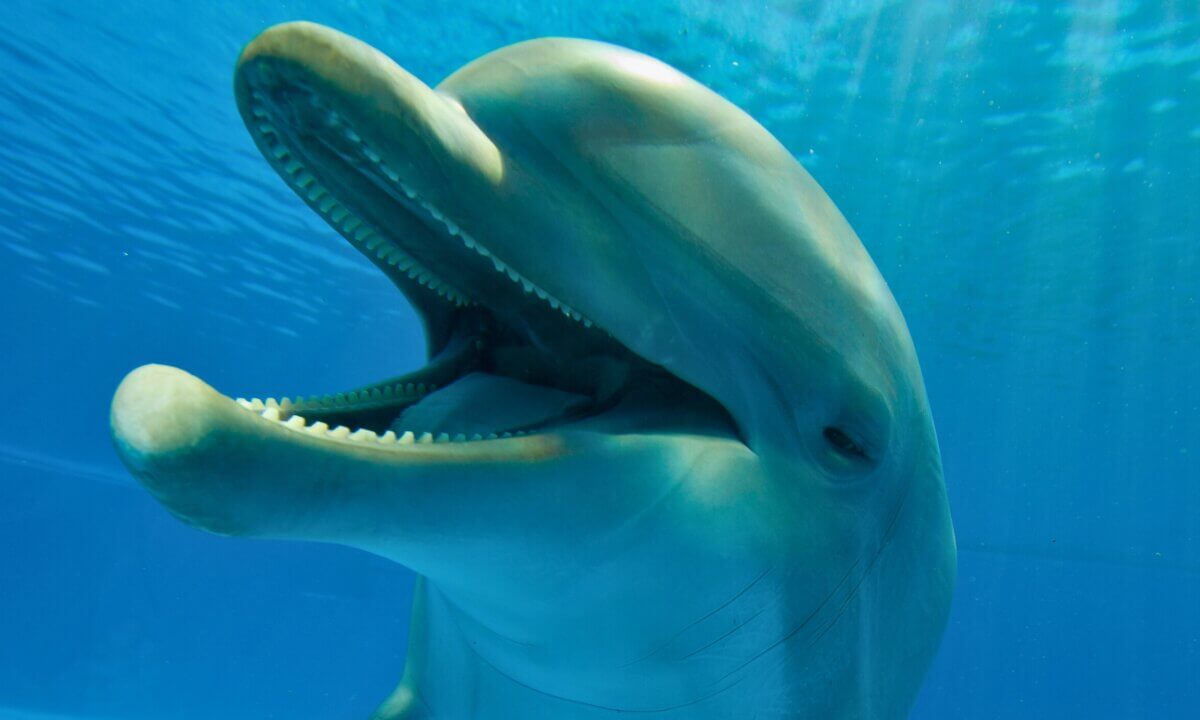
(Credit: Kavindu Induranga/Shutterstock)
PISA, Italy — You can tell a lot from a smile. For humans, it’s a symbol of joy. For bottlenose dolphins (Tursiops truncates), they have similar “open mouth” facial expressions to convey playful intentions. A new study finds that this “smile” is returned a third of the time by their playmates.
“We’ve uncovered the presence of a distinct facial display, the open mouth, in bottlenose dolphins, and we showed that dolphins are also able to mirror others’ facial expression,” says Elisabetta Palagi, the study’s senior author and an evolutionary biologist at the University of Pisa in Italy, in a media release. “Open-mouth signals and rapid mimicry appear repeatedly across the mammal family tree, which suggests that visual communication has played a crucial role in shaping complex social interactions, not only in dolphins but in many species over time.”
Dolphins are playful creatures by nature. They can take on many fun tasks, from acrobatics and surfing to chasing, playing with objects, and play-fighting. According to the study published in iScience, the open-mouth gesture likely came from biting. Animals would mimic the biting sequence but without contact.
“The relaxed open mouth, seen in social carnivores, monkeys’ play faces, and even human laughter, is a universal sign of playfulness, helping animals—and us—signal fun and avoid conflict,” Palagi says.
However, while mammals have used their facial expressions to let others know they are playful, this behavior hasn’t been explored thoroughly among marine mammals.
There are many photos and videos of dolphins sporting a smile-like expression. Dolphins usually have this open-mouth expression when playing with other dolphins but not when playing with their peers or with humans. To confirm whether open-mouth expressions indicate playful behavior, researchers recorded bottlenose dolphins in captivity when playing in pairs and with human trainers.

Researchers recorded dolphins making the open-mouth expression 1,288 times when playing with others, with 92% of these incidents happening while playing with other dolphins. Only one time were dolphins recorded using the open-mouth expression when playing alone.
Dolphins made a smile-like expression 89% of the time when their faces were in front of their playmate. When seeing this open-mouth look, playmates smiled back 33% of the time.
“Some may argue that dolphins are merely mimicking each other’s open mouth expressions by chance, given they’re often involved in the same activity or context, but this doesn’t explain why the probability of mimicking another dolphin’s open mouth within 1 second is 13 times higher when the receiver actually sees the original expression,” Palagi explains.
The study notes that other behaviors could be stronger indicators of playfulness than a smile. The researchers did not record the dolphins’ cries when playing, and they suggest future studies should also observe acoustic signals and their possible role in playful behavior.
“Dolphins have developed one of the most intricate vocal systems in the animal world, but sound can also expose them to predators or eavesdroppers. When dolphins play together, a mix of whistling and visual cues helps them cooperate and achieve goals, a strategy particularly useful during social play when they’re less on guard for predators,” concludes study co-author Livio Favaro, a zoologist from the University of Torino in Italy.
Paper Summary
Methodology
The researchers watched bottlenose dolphins at two different aquariums. They recorded videos of the dolphins playing alone and with each other. They looked for three main things:
- When dolphins open their mouths during play (called “open mouth display” or OM)
- If dolphins did this more when playing together than alone
- If dolphins copied each other’s open-mouth displays quickly
They also checked if dolphins did the OM when their playmate could see them. To make sure their findings were accurate, they used special computer programs to analyze their data.
Key Results
Dolphins use the open mouth display much more when playing with other dolphins than when playing alone. When dolphins do the OM, they usually do it when their playmate can see them. If one dolphin does an OM, there’s a good chance the other dolphin will do it back within one second – but only if they saw the first dolphin do it.
These results suggest that dolphins use the open-mouth display as a way to communicate during play, kind of like how humans might smile at each other while having fun.
Study Limitations
The researchers only studied dolphins in aquariums, not in the wild. They didn’t have a huge number of dolphins to study. Sometimes it was hard to tell if a dolphin was doing an OM to play or to defend itself. They couldn’t record the sounds dolphins make or measure how sensitive their skin is, which might be important. They didn’t look at how dolphins play with humans, just with other dolphins.
Discussion & Takeaways
Dolphins seem to use facial expressions, like the open mouth display, to communicate during play. They appear to be aware of whether their playmate can see them when they make these expressions. Dolphins can quickly copy each other’s facial expressions, which might help them play together better.
The researchers think this kind of communication might be important for dolphins because they need to work together for things like hunting and mating. They also wonder if other animals that are related to dolphins, like deer or camels, might communicate in similar ways when they play.
Funding & Disclosures
The study doesn’t mention any specific funding sources. The researchers declared that they have no competing interests, which means they don’t have any financial or personal relationships that could have influenced their research unfairly.


