
Богдан Скрипник
New evidence suggests Earth sits in a massive ‘bubble’ of sparse space that could solve astronomy’s biggest puzzle
In A Nutshell
- New research supports the idea that Earth lies in a massive cosmic void, an underdense region of space about 300 million light-years wide.
- This could explain why local measurements show the universe expanding faster than expected, a problem known as the Hubble tension.
- The study analyzed 20 years of galaxy survey data and found that void-based models fit observations significantly better than standard models.
- If confirmed, the findings offer a simple, physics-preserving solution to a major mystery in cosmology.
PORTSMOUTH, England — What if everything we can see, stretching hundreds of millions of miles in all directions, sits inside a cosmic bubble where matter is spread more thinly than everywhere else in the universe? New research published in the Monthly Notices of the Royal Astronomical Society says that’s exactly where we might be living, and it could solve one of astronomy’s most confusing problems.
For years, scientists have been grappling with what study author Indranil Banik describes as “a crisis known as the Hubble tension: the local universe appears to be expanding about 10% faster than expected.” When astronomers measure how fast space is expanding using two different methods, they get answers that don’t match. The discrepancy has grown large enough to suggest our fundamental understanding of the universe might be wrong.
“Looking up at the night sky, it may seem our cosmic neighborhood is packed full of planets, stars and galaxies. But scientists have long suggested there may be far fewer galaxies in our cosmic surroundings than expected,” Banik writes in a commentary for The Conversation. His study provides the strongest evidence yet that Earth sits inside a massive cosmic void called the “KBC void,” a region roughly 300 million light-years across where matter is about 20% less dense than the cosmic average.
How Scientists Used Ancient Sound Waves to Test the Theory
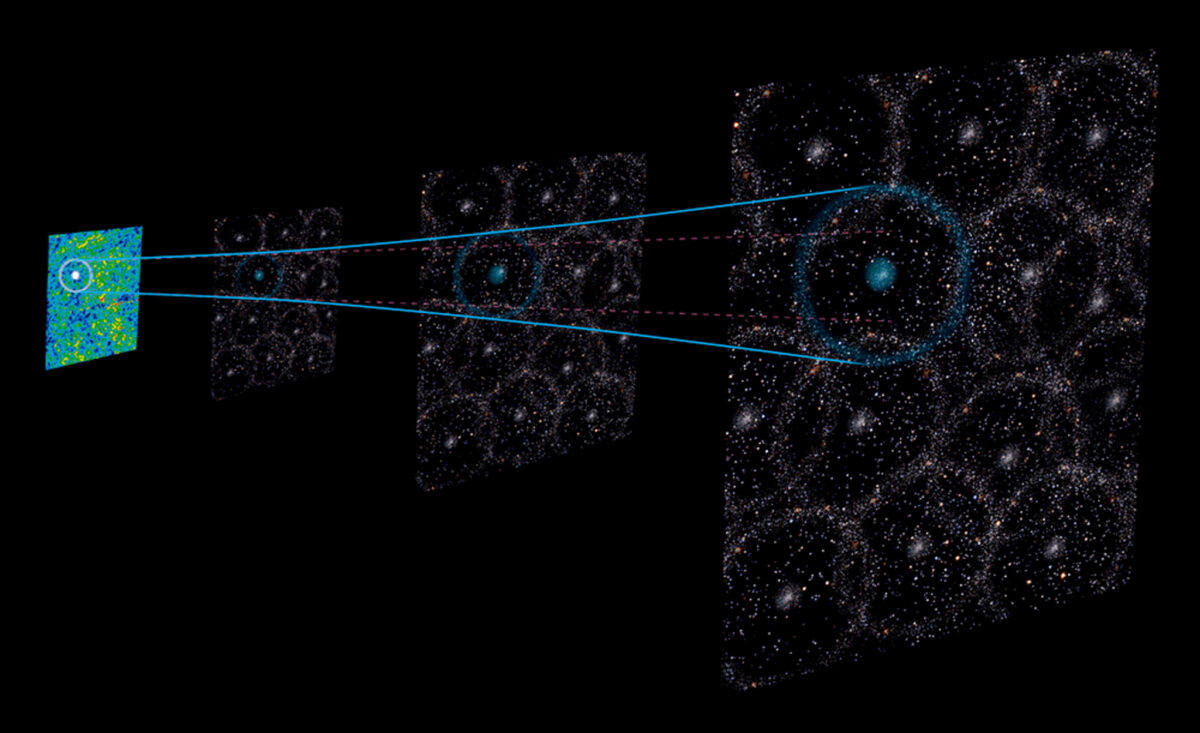
To test whether we live in a cosmic void, the researchers examined fossilized sound waves from when the universe was young. About 380,000 years after the Big Bang, the cosmos cooled enough for atoms to form, and sound waves that had been traveling through the hot, dense early universe suddenly stopped. These waves left behind patterns that astronomers can still detect today by studying how galaxies cluster together.
“By studying CMB temperature fluctuations on different scales, we can essentially ‘listen’ to the sound of the early universe, which is especially ‘noisy’ at particular scales,” Banik explains in his commentary. These ancient sound patterns, called baryon acoustic oscillations, work like a cosmic measuring stick that astronomers use to gauge distances across the universe.
The team compiled measurements from major sky surveys over the past two decades, including data from the Sloan Digital Sky Survey and the Dark Energy Spectroscopic Instrument (DESI). They then compared how well different models matched these observations: the standard model assuming space is uniform everywhere versus models that account for us living in a local void.
The concept works because if Earth sits in a cosmic void, the sparse matter around us would be gravitationally pulled toward denser regions outside the void, creating an outward flow. “My colleagues and I previously argued that the Hubble tension might be due to our location within a large void. That’s because the sparse amount of matter in the void would be gravitationally attracted to the more dense matter outside it, continuously flowing out of the void,” Banik writes.
The Evidence Strongly Supports the Void Theory
The results were dramatic. When the researchers tested their void models against 20 years of astronomical data, they found compelling evidence that we do live in such a cosmic bubble. In their analysis of 42 separate distance measurements, the standard model without a void showed significant tension with the observations. But the void models reduced this tension from 3.3-sigma to just 1.1-1.4 sigma, which is well within normal statistical variation.
To put this in perspective, Banik uses a coin-flipping comparison: “Our research shows that the ΛCDM model without any local void is in ‘3.8 sigma tension’ with the BAO observations. This means the likelihood of a universe without a void fitting these data is equivalent to a fair coin landing heads 13 times in a row. By contrast, the chance of the BAO data looking the way they do in void models is equivalent to a fair coin landing heads just twice in a row.”
Interestingly, the researchers didn’t adjust their void model parameters to fit the data. Instead, they used parameters established in previous work based on completely different observations, like galaxy counts and local expansion measurements.
What This Means for Our Understanding of the Universe
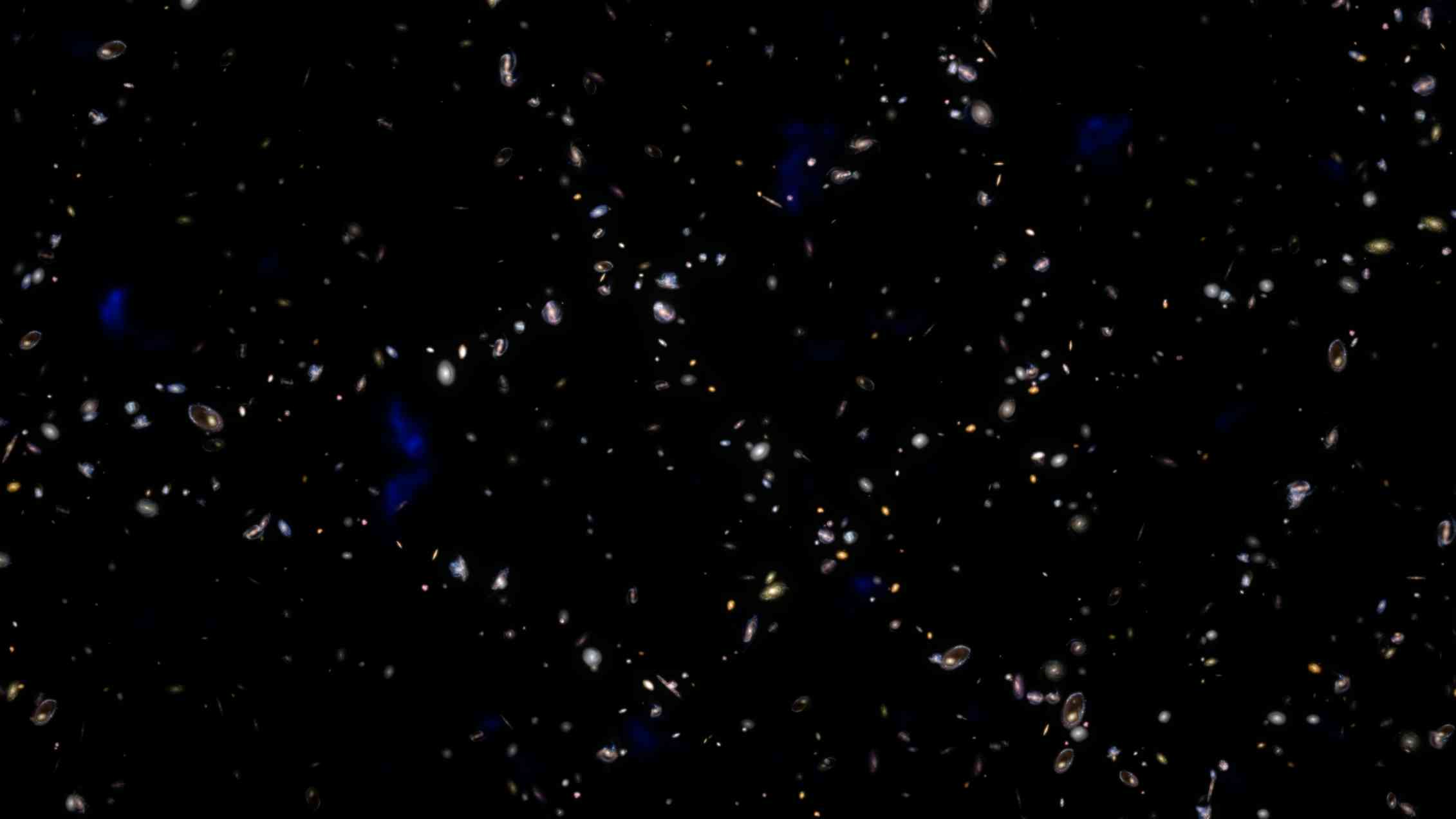
Rather than overturning current theories, this study proposes that where we are in the universe might be skewing our measurements. A large cosmic void around Earth could help explain why the local universe appears to be expanding faster than expected. The results encourage more precise low-redshift observations to test whether this local effect is real and significant.
The evidence extends beyond statistics. Galaxy surveys have consistently found fewer galaxies than expected in our local region across multiple types of observations, from optical light to X-ray wavelengths. Recent data from DESI, one of the most ambitious galaxy-mapping projects ever undertaken, also supports this interpretation.
As Banik writes, expanded research will be paramount: “In the future, it will be crucial to obtain more accurate BAO measurements at low redshift, where the BAO standard ruler looks larger on the sky – even more so if we are in a void.”
If confirmed by future studies, this research could offer a relatively simple explanation for the ongoing Hubble tension. Instead of requiring new physics or revisions to the standard cosmological model, the presence of a large local void would mean that our measurements are influenced by an unusual cosmic environment. This idea is consistent with existing data and avoids some of the more complex solutions proposed in recent years.
Disclaimer: This article is based on a peer-reviewed scientific study and a commentary by the study’s lead author. The proposed explanation for the Hubble tension is supported by statistical modeling but has not yet been definitively proven. Ongoing research and future observations will be needed to confirm or refute this hypothesis.
Paper Summary
Methodology
The researchers compiled baryon acoustic oscillation (BAO) measurements from the past 20 years of astronomical surveys, including data from major projects like the Sloan Digital Sky Survey and the Dark Energy Spectroscopic Instrument. BAO measurements detect fossilized sound waves from the early universe that create patterns in galaxy distributions, serving as cosmic rulers for measuring distances. The team tested how well different cosmological models fit this data by comparing the standard uniform universe model against three different “local void” models where Earth sits in an underdense region of space.
Results
The void models dramatically outperformed the standard model. While the uniform universe model showed 3.3-sigma tension with the BAO observations, the void models reduced this tension to just 1.1-1.4 sigma. The analysis included 42 separate distance measurements, and the void models consistently provided better fits across different types of BAO observations.
Limitations
The research assumes Earth is located near the center of the proposed void, which simplifies the analysis but may not reflect reality. The study also assumes that different BAO measurements are independent, which may not always be true since some surveys overlap or reuse data. While the statistical evidence is strong, the research relies on indirect measurements and cannot directly observe the void structure.
Funding and Disclosures
Lead author Indranil Banik is supported by Royal Society University Research Fellowship grant 211046 and was previously supported by Science and Technology Facilities Council grant ST/V000861/1. Second author Vasileios Kalaitzidis received support from an undergraduate research bursary from the Royal Astronomical Society. The authors declare no competing interests.
Publication Information
The paper “Testing the local void hypothesis using baryon acoustic oscillation measurements over the last 20 yr” was published in Monthly Notices of the Royal Astronomical Society, Volume 540, pages 545-561, on May 13, 2025. The research was conducted by Indranil Banik from the University of Portsmouth’s Institute of Cosmology and Gravitation, and Vasileios Kalaitzidis from the University of Saint Andrews.


