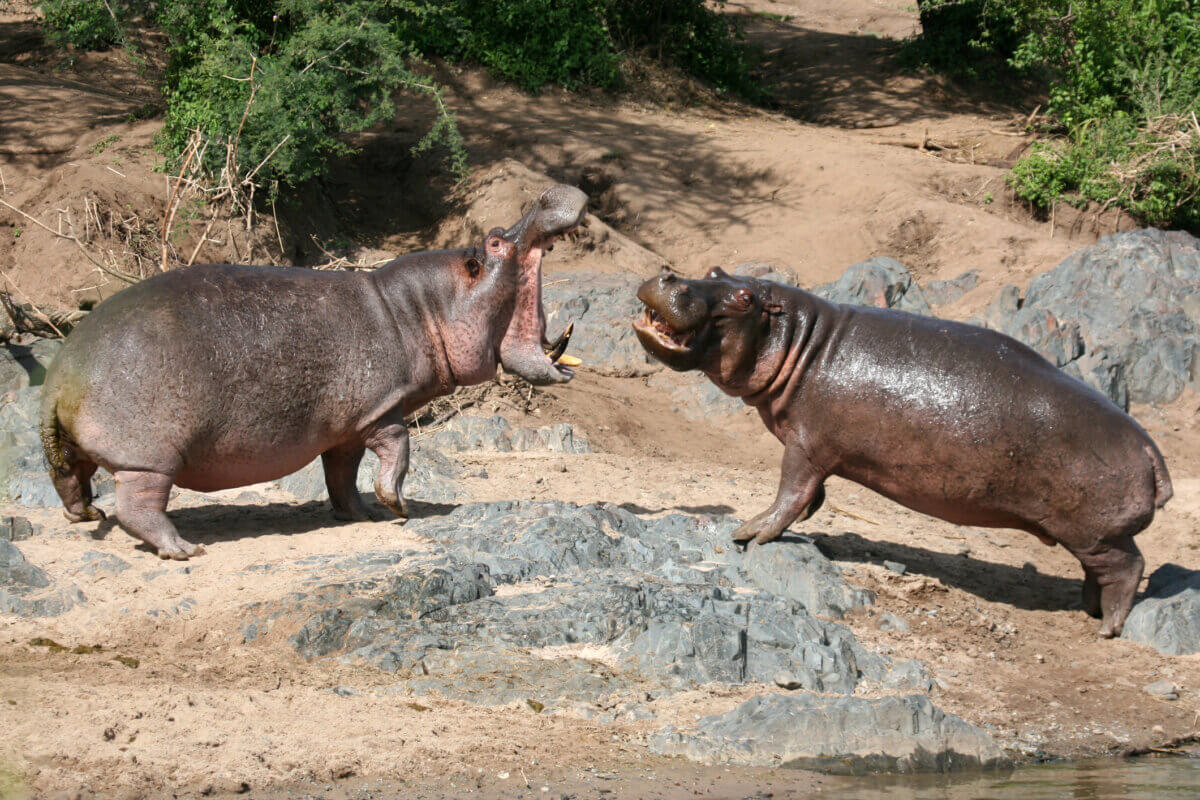
Hippos Fighting in Africa. Hippos Fighting - Serengeti Wildlife Conservation Area, Safari, Tanzania, East Africa. (ID 10368413 © Sam D\'cruz | Dreamstime.com)
BERKELEY, Calif. — Can animals be jealous of one another? For decades, scientists have debated whether our sense of fairness — that gut feeling when someone gets a better deal than us — is uniquely human or shared with other species. Now, a comprehensive new analysis suggests our animal cousins may not care as much about fairness as previously thought.
The findings, published in Proceedings of the Royal Society B, challenge the notion that other species exhibit “inequity aversion,” a negative response to receiving less than others. Researchers analyzed data from 23 studies covering over 60,430 observations across 18 different species, from chimpanzees to cockatoos, specifically focusing on experiments where animals could accept or reject offered rewards.
‘She gets grapes? That’s not fair!’
The scientific investigation of animal fairness and jealousy began in earnest in 2003 with primatologist Frans de Waal’s landmark study of capuchin monkeys. In a now-famous experiment, two monkeys performed the same task for rewards. When both received cucumber slices, they completed their tasks contentedly. However, when one monkey received a grape, a more desirable treat, instead of cucumber, the other monkey appeared to protest by refusing the cucumber and even throwing it back at the researcher.
This apparent display of fairness became a sensation, suggesting even monkeys understand inequity. Similar studies with corvids, dogs, and mice reportedly showed comparable responses. However, the researchers suggest this interpretation may be overly simplistic and perhaps anthropomorphic, attributing human characteristics to animal behavior.
Our sense of fairness in distributing resources appears fundamental to human society, potentially enabling our ancestors to build shelters, share food, and develop increasingly complex social structures. While different cultures may have varying perceptions of fairness, the core concept involves what psychologists call “inequity aversion” — a disinclination toward unequal distribution of resources and judgments about how things should be shared.
Deep dive into studies of animal jealousy
Many of these earlier studies were limited by small sample sizes and difficulties in replication, issues that have challenged psychology and other disciplines. “We thought it’d be a valuable contribution to try to pull together as much data as we can on this question and see what kind of pattern emerges with the larger dataset,” says lead author Oded Ritov, a fourth-year Ph.D. candidate in UC Berkeley’s Department of Psychology, in a statement.
To investigate this question systematically, researchers combed through two decades of experiments testing animals’ responses to unequal rewards. The typical setup involved two animals performing a task, often exchanging tokens for food rewards. Sometimes both received the same reward, while other times one got something better. Would the disadvantaged animal protest by refusing to participate?
Across species, the analysis found no strong evidence that animals reject rewards specifically because of unfair treatment. While they did sometimes refuse lesser rewards after seeing better ones, this behavior was better explained by simple disappointment rather than a sophisticated sense of fairness.
Supporting this interpretation, follow-up studies showed similar reactions even when better treats were placed in empty cages where there was no other animal present to trigger jealousy.
“We can’t make the claim that animals experience jealousy based on this data,” says Ritov. “If there is an effect, it’s very weak and might show up in very specific settings. But it’s nothing like what we see in humans in terms of our deep-seated sense of fairness.”
To be fair is human
This doesn’t mean animals are completely self-interested. Many species cooperate extensively and may have other ways of maintaining equitable relationships. But the specific ability to recognize and protest unfair treatment — a cornerstone of human moral psychology — appears to be distinctly human.
Looking back at the monkey throwing the cucumber at the researcher, Ritov suggests the action was driven by the animal’s disappointment.
“We think that the rejections are a form of social protest,” he says. “But what animals are protesting isn’t receiving less than someone else. Rather, it seems like they’re protesting the human not treating them as well as they could.”
This distinction between disappointment and fairness highlights how challenging it can be to interpret animal behavior without projecting human qualities onto them. While animals clearly demonstrate complex emotional and social relationships, our sophisticated understanding of equity and justice — and our strong negative reactions to unfair treatment — may indeed be uniquely human.
Paper Summary
Methodology
The researchers conducted an individual participant data meta-analysis, focusing specifically on accept/reject paradigms where animals could either accept or refuse a reward after seeing what their partner received. This standardized approach enabled meaningful comparison across species and studies, with careful coding of whether conditions were “inequitable” (partner received better treatment) or simply involved exposure to better rewards.
Results
When analyzing over 60,000 observations, the researchers found that while animals often rejected lesser rewards, this behavior wasn’t specifically tied to seeing others get better treatment. Instead, simply being exposed to better rewards – regardless of whether another animal received them – was enough to trigger rejections. This suggests the animals were responding to disappointment rather than unfairness.
Limitations
The study couldn’t include all relevant research – data from 7 out of 30 eligible studies weren’t available. Additionally, the analysis only looked at one type of experimental setup (accept/reject paradigms) and couldn’t account for more naturalistic situations where animals might show fairness concerns. The researchers also note that specific individuals or contexts might still elicit fairness-like responses, even if it’s not a general feature across species.
Discussion & Takeaways
The study suggests that what we’ve interpreted as protests against unfairness in animals may actually be simpler responses to disappointment. This doesn’t diminish animals’ cognitive abilities but suggests that the human sense of fairness – which includes complex social comparisons and expectations about equal treatment – may be unique to our species. This could reflect our particularly strong dependence on cooperation throughout human evolution.
Funding and Disclosures
This international collaboration involved researchers from the University of California, Berkeley; University of Veterinary Medicine Vienna; University College London; and University of Auckland. The paper is published under open access terms, allowing free public access to the research. No specific funding sources or conflicts of interest were noted in the paper.


