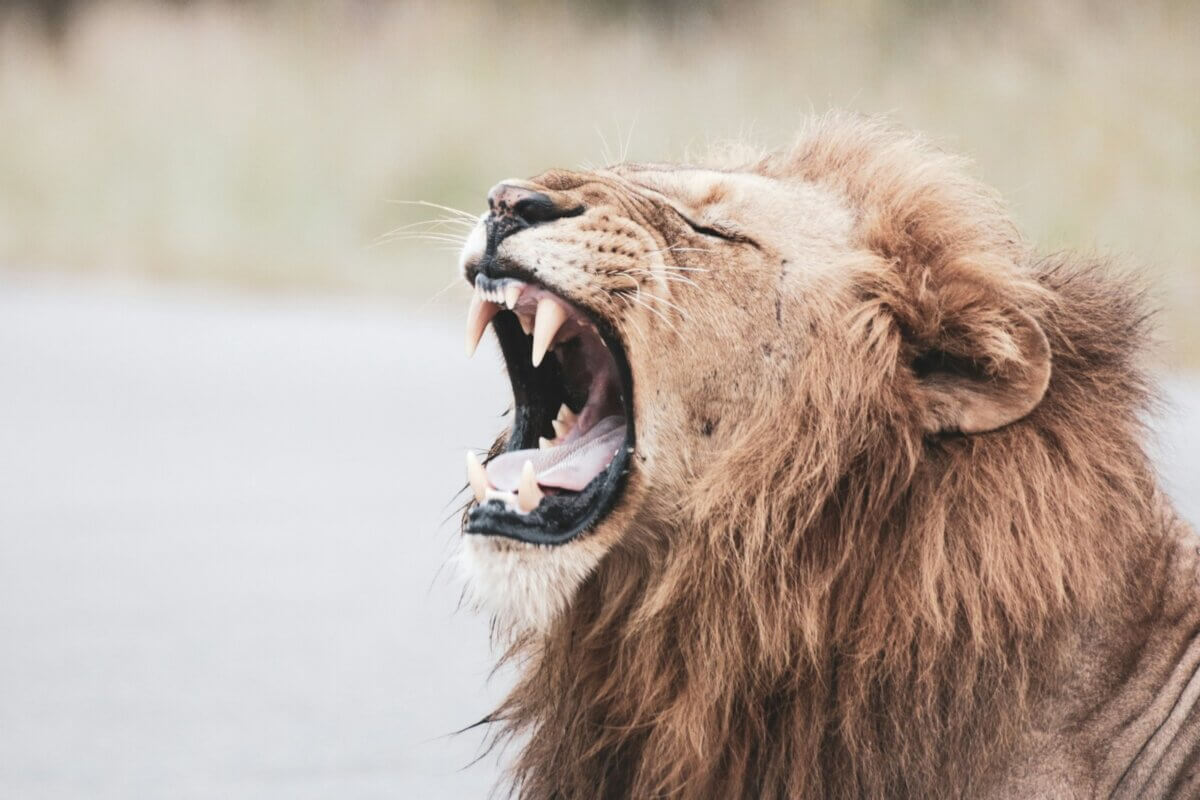
Lions from different regions appear to develop unique roaring patterns. (Photo by Glen Carrie from Unsplash)
Just like people, lion roar ‘accents’ may form from a mixture of location, social learning, and genetics.
In A Nutshell
- Scientists discovered lions produce two distinct roars during roaring bouts—full-throated roars (loud and individually unique) and intermediary roars (shorter, lower-pitched versions that appear later in the sequence).
- Lions from Tanzania and Zimbabwe produce roars with different frequencies and durations, and one Botswanan male’s roars were so unusual that machine learning algorithms misclassified 83% of his vocalizations.
- AI achieved 87% accuracy in identifying specific lions from their roars alone, offering a new tool for conservation that doesn’t require cameras or physical capture.
African lions living in widely separated populations in Tanzania and Zimbabwe roar in noticeably different ways, according to research suggesting one of nature’s most iconic sounds varies by geography. The discovery raises intriguing questions about whether lions develop regional vocal patterns similar to human languages and bird songs.
Scientists comparing lion roars from the two countries found that males from each population produce distinct vocalizations, with Tanzanian lions emitting roars at different frequencies and durations compared to their Zimbabwean counterparts. One male lion from Botswana produced such unusual roars that machine learning algorithms struggled to classify them alongside other individuals in the Zimbabwe study site.
The findings, published in Ecology and Evolution, emerged from a broader effort to improve conservation monitoring of lions using acoustic technology. Researchers from the University of Oxford and University of Exeter deployed audio recording devices in Tanzania’s Nyerere National Park and analyzed existing recordings from Zimbabwe’s Bubye Valley Conservancy to better understand the structure of lion roars.
Scientists Discover Two Types of Lion Roars
Lions have long been known to produce roaring bouts, which combine different vocalizations including moans, roars, and grunts. However, the new research reveals that what scientists previously lumped together as a single type of roar actually consists of two distinct vocalizations: full-throated roars and what researchers have newly named “intermediary roars.”
Full-throated roars are the powerful, sustained vocalizations that reach maximum amplitude and are individually unique to each lion. Intermediary roars are shorter and at lower frequencies, appearing later in the roaring sequence as the full-throated roars taper off. Using Hidden Markov Models, the team classified calls within roaring bouts at about 85% overall accuracy based on the shape of each roar’s frequency pattern over time. A simpler method that used just two measurements for each call (its duration and peak frequency) still separated call types with over 90% accuracy when moans were excluded from the analysis.
The distinction matters because only full-throated roars contain enough individual variation to reliably identify specific lions. Previous research has demonstrated that these roars are as unique as fingerprints, containing acoustic signatures that allow lions to recognize one another and assess potential rivals.
When Algorithms Met an Outsider Lion
When the researchers applied their classification system to lions across different locations, they encountered an unexpected complication. Maximum frequency and duration varied noticeably between Tanzanian and Zimbabwean populations, suggesting lions from different regions may develop distinctive roaring patterns.
The most striking case involved a male lion designated A4 in the Zimbabwe study, who was known to have originated from Botswana’s Tuli Block, more than 60 kilometers from the study site. When the team’s algorithm attempted to automatically classify his roars, it identified only five out of 30 vocalizations that human experts had labeled as full-throated roars. The algorithm struggled, possibly because A4 wasn’t producing full-throated roars in those bouts, or because his full-throated roars had lower peak frequency or shorter duration than the other males in the Zimbabwe population.
Earlier observations support the possibility of geographic variation. A 1988 study by researchers P.E. Stander and J. Stander noted that lions in Namibia’s Etosha National Park produced shorter roars compared to lions elsewhere in Africa. The current research adds quantitative evidence to these anecdotal observations.
Why Geography Might Shape How Lions Roar
Several factors could explain why lion roars vary geographically. Environmental characteristics like vegetation density and terrain affect how sound travels, potentially favoring different acoustic properties in different habitats. Lions might unconsciously adjust their vocalizations to maximize transmission in their local environment.
Another possibility involves social learning within prides. Young lions learn behaviors from their elders, and subtle differences in roaring technique could accumulate over generations within isolated populations, similar to how dialects develop in human languages and whale songs. Nearly 20% of lion populations include nomadic males who can disperse more than 200 kilometers from their birth pride, but if these individuals develop roaring patterns during their formative years, they may carry those characteristics to new territories.
Genetic differences between populations could also play a role, though the researchers note this remains speculative without further study comparing the genetics and acoustics of different lion populations.

Machine Learning Takes Conservation Into the Wild
The research team developed their classification system primarily to improve acoustic monitoring of wild lion populations. Traditional methods for estimating lion numbers rely on camera traps or counting tracks, both of which have limitations in dense vegetation or large territories.
Because full-throated roars are individually unique, researchers can theoretically use audio recorders to identify specific lions without physically capturing or observing them. The new study demonstrated that using data-driven classification of full-throated roars improved a balanced performance measure (called an F1-score) from 0.80 to 0.87 when the algorithm selected which roars to analyze instead of humans making those choices manually.
However, the geographic variation poses a potential complication. If nomadic males from distant populations produce roars with unusual acoustic characteristics, automated systems might fail to detect them or misclassify their vocalizations. Researchers would need to account for regional differences when developing conservation monitoring programs that span large geographic areas.
The study deployed custom-built autonomous recording units called CARACALs at 50 locations across Tanzania’s Matambwe sector. These devices recorded continuously for 62 days, capturing audio data that researchers manually reviewed to identify solo roaring bouts from individual lions. The team analyzed 1,416 vocalizations from nine recording stations in Tanzania and compared them with 1,733 vocalizations from five male lions wearing acoustic biologgers in Zimbabwe.
By extracting the fundamental frequency contour (the lowest frequency of the sound wave), they could model the temporal pattern of different call types. Using Hidden Markov Models and K-means clustering (relatively simple machine learning techniques), the researchers successfully automated the classification of vocalizations within roaring bouts. The approach requires minimal computational resources compared to more advanced deep learning methods, making it accessible to conservation organizations with limited technical infrastructure.
Paper Notes
Limitations
The study’s conclusions about geographic variation rest on samples from only two populations separated by substantial distance. The researchers note that intermediate populations between Tanzania and Zimbabwe were not sampled, leaving uncertainty about whether the differences represent a gradual continuum or discrete regional types. Sample sizes were relatively modest, with recordings from nine stations in Tanzania and five individuals in Zimbabwe, though this reflects the difficulty of collecting lion acoustic data from wild populations. The Zimbabwean recordings came exclusively from male lions, as female lions in that study did not produce roaring bouts during the recording period, attributed to the presence of small cubs. The researchers manually classified moans before applying their automated system, introducing some human judgment into the otherwise data-driven approach. One of the key findings regarding individual A4 from Botswana relies on a single lion known to have originated outside the study population, providing limited statistical power for conclusions about cross-population roaring differences.
Funding and Disclosures
The lead author, J.G., received funding via a doctoral training grant awarded as part of the UKRI AI Centre for Doctoral Training in Environmental Intelligence (UKRI grant number EP/S022074/1). The camera trap survey received funding from Wildlife Conservation Network’s Lion Recovery Fund (TZ-RC-02), the Darwin Initiative Capability and Capacity Fund (DARCC009), and WWF Germany (213/10143411). The Zimbabwean study data analyzed in this research were collected during a previous project by Wijers et al. (2020), which involved custom-designed biologgers fitted to eight lions in November 2014 at Bubye Valley Conservancy. The authors declared no conflicts of interest.
Publication Details
The research paper “Roar Data: Redefining a Lion’s Roar Using Machine Learning” was authored by Jonathan Growcott, Alex Lobora, Andrew Markham, Charlotte E. Searle, Johan Wahlström, Matthew Wijers, and Benno I. Simmons. It appears in the journal Ecology and Evolution, published in November 2025 (volume 15, e72474). The study was conducted across multiple institutions: Centre for Ecology and Conservation at University of Exeter, Wildlife Conservation Research Unit at University of Oxford, Tanzania Wildlife Research Institute, Department of Computer Science at University of Oxford, and Lion Landscapes in Tanzania. Research permissions were granted by the Tanzania Wildlife Research Institute (TAWIRI), Tanzania National Parks Authority (TANAPA), and the Commission for Science and Technology (COSTECH) under research permits 2023-780-NA-2023-879 and 2023-665-ER-2021-287. The published article is open access under Creative Commons Attribution License terms, DOI: 10.1002/ece3.72474.


Who paid for this?
So how much taxpayer money are the US citizens spending on this useless study?