
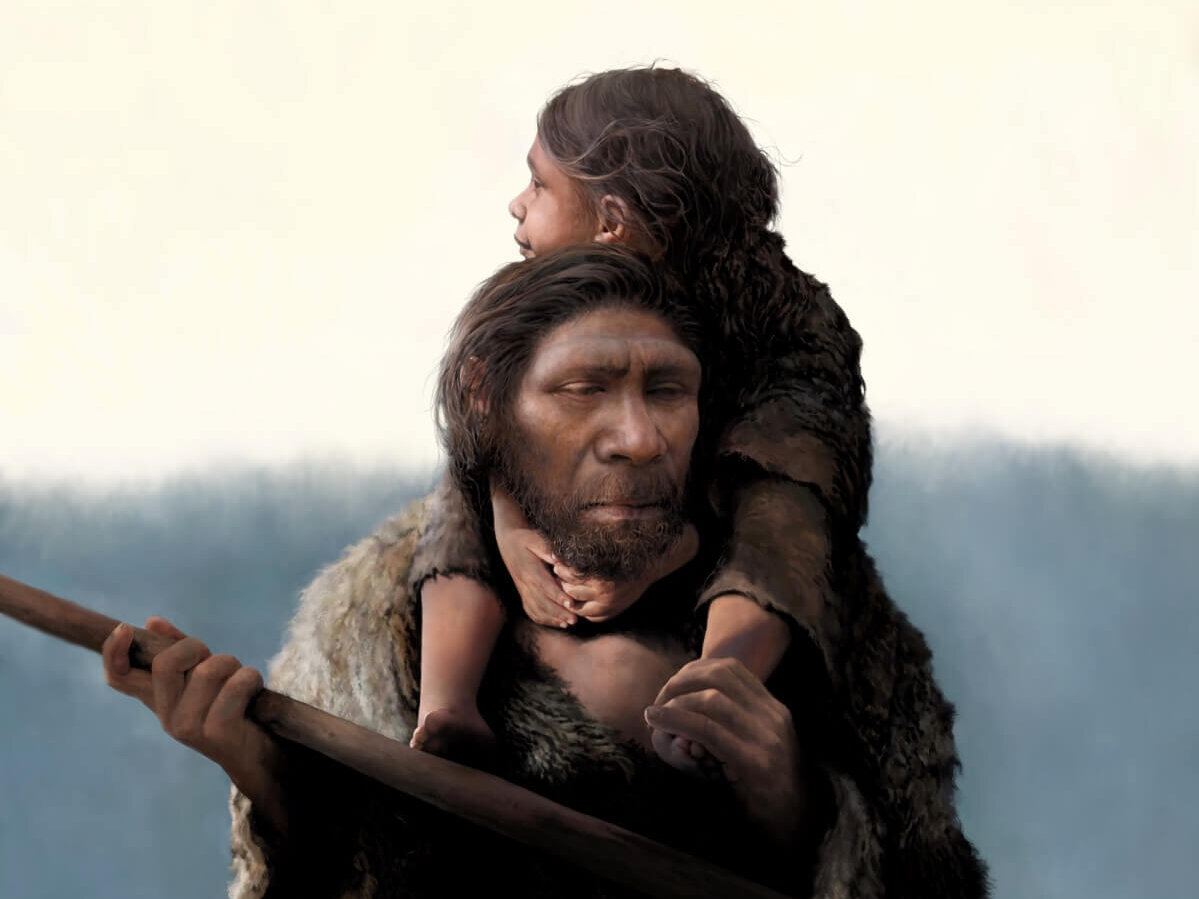
A Neanderthal father and his daughter. (Credit: Tom Bjorklund)
COPENHAGEN, Denmark — Being a social butterfly has been a key to survival for modern humans — a trait new research finds Neanderthals lacked and most likely led to their extinction 40,000 years ago. New genetic evidence taken from a cave in France reveals Neanderthals were more reclusive, preferring to interact only with each other. Meanwhile, Homo Sapiens (modern-day humans) were more likely to connect with other groups and exchange ideas, an evolutionary advantage for survival.
Archaeologists have debated the reason why the Neanderthal species perished. A new study published in Cell Genomics supports a growing theory that the Neanderthals’ downfall was not due to environmental changes or disease but their antisocial lifestyle.
“It is something that we have talked about for a while. But we needed more evidence, and this is some of the evidence that we were looking for and needed to figure out how likely this hypothesis of them going extinct because of their isolated lifestyle is,” says Tharsika Vimala, a postdoc at the University of Copenhagen, in a media release.
Researchers uncovered a tooth from a Neanderthal male in a cave in southern France, giving them a rare opportunity to study preserved genes left on the samples. Uncovering the genetic information of the Neanderthals has always been a challenge. Despite finding Neanderthal remains across Eurasia, there has never been enough DNA to analyze genetically. One of the oldest Neanderthal DNA samples dates back 120,000 years, from the Altai Mountains, Belgium, and Germany.
The authors took these new DNA samples to examine the Neanderthal’s nuclear genome. A nuclear genome is DNA found in the core of cells, and this information was compared with other Neanderthal genomes to get a better glimpse of their ancient lifestyles.
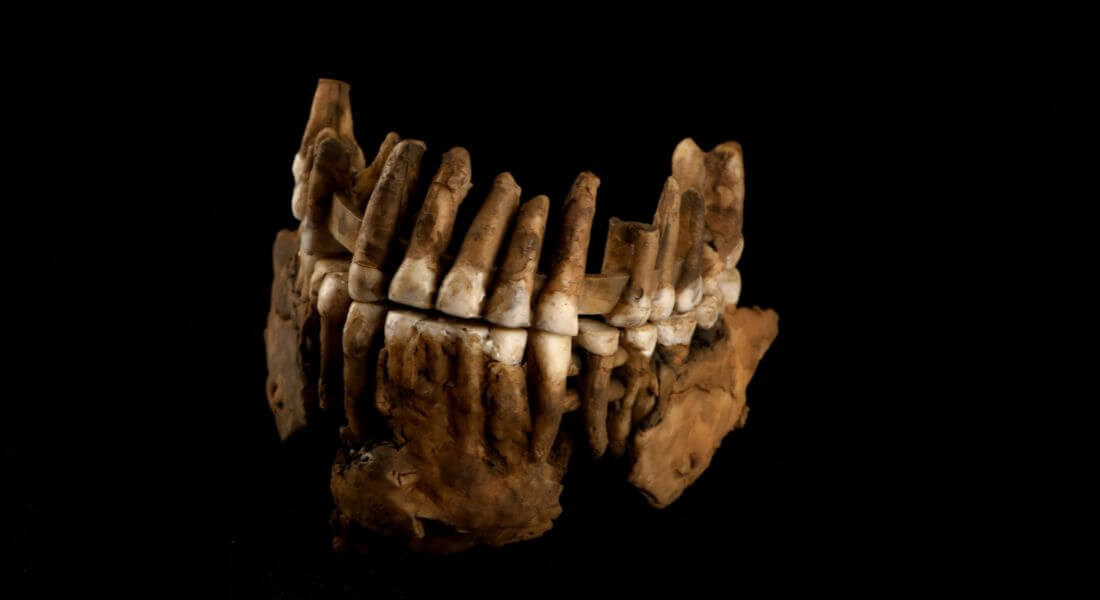
The “new” Neanderthal genome has been isolated for roughly 50,000 years-old. Moreover, it’s only the fifth sample coming from Western Europe, showing how isolated this particular group of Neanderthals was.
“The newly found Neanderthal genome is from a different lineage than the other late Neanderthals previously studied,” notes Martin Sikora, an associate professor from the University of Copenhagen. “This supports the notion that social organization of Neanderthals was different to early modern humans who seemed to have been more connected.”
A striking observation researchers made when analyzing the genetic remains of the Neanderthal male was that there was not much genetic diversity, suggesting these people preferred to inbreed.
“They have been living in small groups for many generations. We know that inbreeding reduces genetic diversity in a population, which can be detrimental to their ability to survive if it occurs over a longer term,” explains Sikora.
Neanderthals’ low genetic diversity is in contrast to early modern humans. This suggests that early modern humans were more likely to interact with other human species, which served as an evolutionary advantage for survival. According to the authors, connections with other groups helped increase genetic diversity and helped in exchanging knowledge and ideas for early modern humans.
Researchers also examined a genome from another Neanderthal from France. The individual has ancestry from a different Neanderthal lineage than the one found in the cave. The distinct genomes from both Neanderthals suggest these humans continued to alienate themselves from other human species in Western Europe until extinction.
Paper Summary
Methodology
The researchers discovered a Neanderthal fossil, nicknamed “Thorin,” in a cave in southern France. They used a variety of methods to study this fossil, including DNA analysis, radiocarbon dating, and other scientific techniques like isotope and proteomic analysis to determine the age, genetic lineage, and environmental context of the fossil. By studying the fossil’s teeth and bones and comparing its DNA with other known Neanderthals, they were able to reconstruct Thorin’s genetic history. They also used advanced scanning technology to create virtual models of the fossil remains. The goal was to learn more about this individual Neanderthal and understand how isolated his population may have been from others.
Key Results
The study found that “Thorin” belonged to a group of Neanderthals that had been genetically isolated for about 50,000 years. This means his group didn’t mix with other Neanderthal groups in Europe. The researchers also found that Thorin’s group had very small populations, which led to inbreeding. Thorin’s DNA was different from other late Neanderthals, which suggests that his population was cut off from other Neanderthal groups for a long time. This isolation might have played a role in why Neanderthals eventually went extinct.
Study Limitations
The researchers acknowledge that their findings are based on a single Neanderthal genome, which may not fully represent the entire population. Additionally, some of the dating methods used have a degree of uncertainty, meaning the exact age of the fossil is still an estimate. Another limitation is that the fossil was still being excavated at the time of the study, which could lead to further discoveries that might slightly alter the conclusions. Finally, because Neanderthal fossils are rare, there isn’t enough genetic data to definitively conclude the extent of the genetic isolation they observed.
Discussion & Takeaways
This study challenges previous ideas that Neanderthals in Europe were part of one large, interconnected population. Instead, it shows that at least some Neanderthals, like Thorin, lived in small, isolated groups that didn’t mix much with others. This isolation could have made these populations more vulnerable and may have contributed to their extinction. Additionally, the finding that Thorin’s group didn’t interact with early humans suggests that Neanderthals were not as socially or genetically connected as once thought, which might explain why they disappeared while humans thrived.
Funding & Disclosures
This study was supported by a range of institutions, including the Lundbeck Foundation, the Danish National Research Foundation, and the European Research Council. Additionally, various universities and scientific institutes from France, Denmark, and Australia contributed to the research. The authors have declared that they have no conflicts of interest or competing financial interests related to this study.


Yeah, sure. As if that is a problem in the so-called Animal Kingdom. And. A laack of data is more than notable.
I dare you write the piece that relates this Neanderthal/antisocial behavior finding to modern day autism antisocial behavior preponderance in men ????