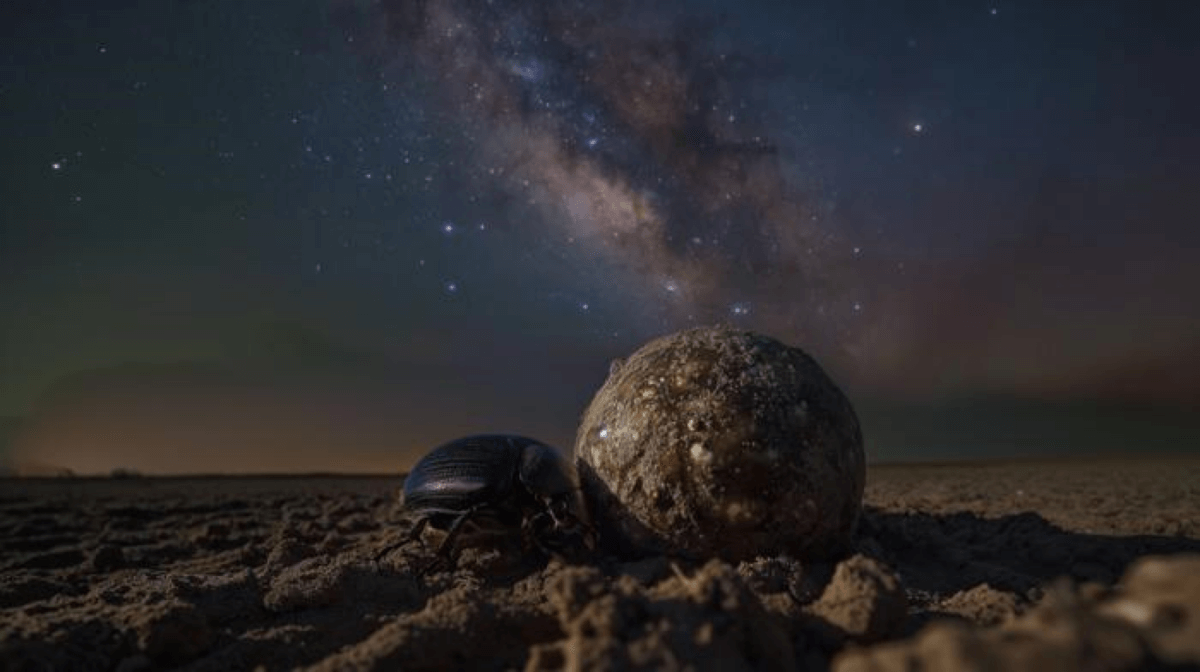
Dung beetles use the Milky Way at night to navigate. Engineers have used the same technique to develop an AI sensor for navigation in low light. (Credit: University of South Australia)
ADELAIDE, Australia — Move over, Neil Armstrong. The real space pioneer might just be a tiny insect with a ball of poop. The dung beetle’s galactic guidance system is launching a new era in navigation technology, proving that sometimes the best solutions are right under our noses – or in this case, our feet.
This unassuming insect, which evolved around 130 million years ago, has become the focus of a groundbreaking study published in the journal Biomimetics. Researchers from the University of South Australia have demonstrated that the Milky Way’s orientation can be accurately measured using computer vision techniques, even in the presence of significant motion blur. This discovery has potential applications in improving navigation systems for drones, robots, and even orbiting satellites.
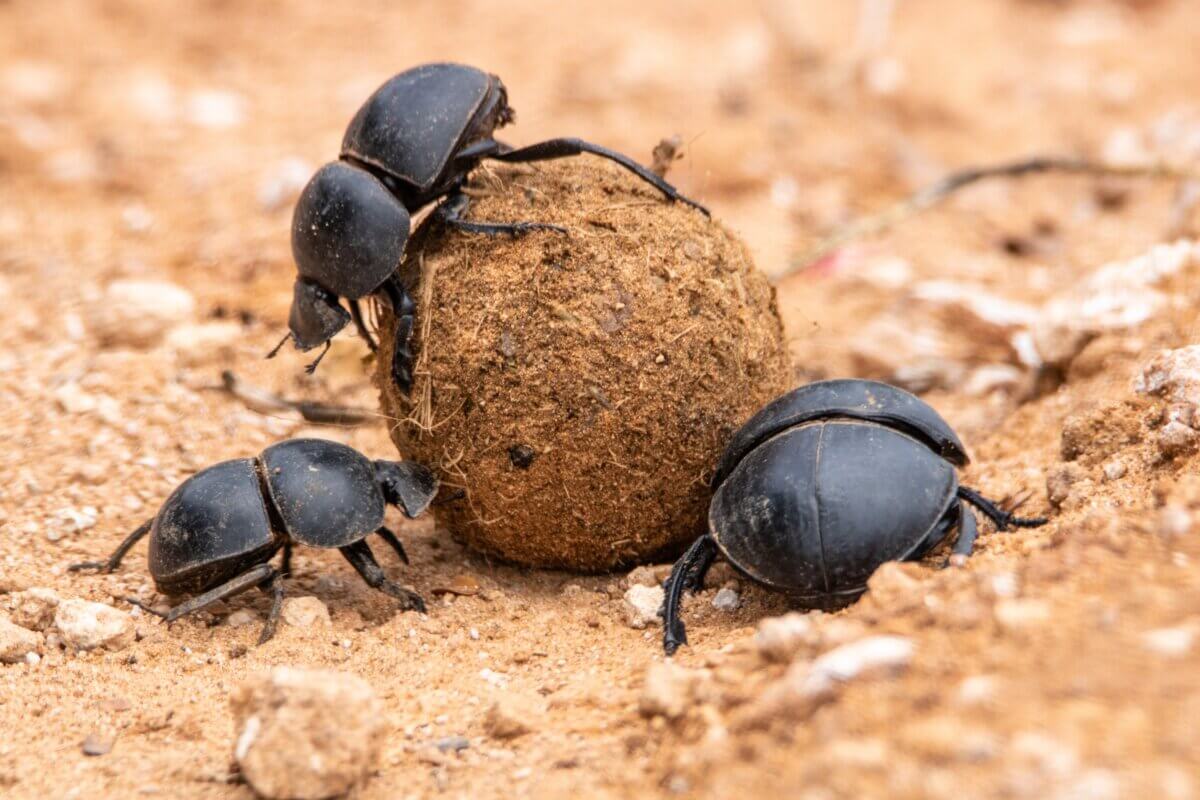
The study builds upon a 2013 finding by Swedish researchers, who first discovered that the dung beetle species Scarabaeus satyrus uses the Milky Way for navigation. These industrious insects need to move in straight lines away from competitors while rolling balls of dung, a task that requires a fixed orientation point in the night sky.
What makes this navigation method particularly interesting is its resilience to motion blur.
“Nocturnal dung beetles move their head and body extensively when rolling balls of manure across a field, needing a fixed orientation point in the night sky to help them steer in a straight line,” explains study co-author Professor Javaan Chahl, a remote sensing engineer at the University of South Australia, in a statement. “Their tiny compound eyes make it difficult to distinguish individual stars, particularly while in motion, whereas the Milky Way is highly visible.”
To investigate this phenomenon, the research team conducted a series of experiments using a camera mounted on the roof of a vehicle. They captured images of the Milky Way while the vehicle was both stationary and in motion, simulating the visual conditions a dung beetle might experience. Using these images, they developed a computer vision system capable of reliably measuring the Milky Way’s orientation.
For real night sky images, the system achieved an angular accuracy between 0.00° and 0.08°, while for synthetic images, the accuracy ranged from 0.22° to 1.61°. This high level of precision, even in the presence of motion blur, demonstrates the robustness of the Milky Way as a navigational reference point.
Lead author and PhD candidate Yiting Tao sees potential applications beyond just understanding insect behavior.
“The orientation sensor could be a backup method to stabilize satellites and help drones and robots to navigate in low light, even when there is a lot of blur caused by movement and vibration,” Tao states.
The next step in the research involves implementing the algorithm on a drone to control its flight during nighttime conditions.
This study is part of a broader field of research that draws inspiration from insect navigation. Many insects use celestial cues for orientation, with different species relying on the sun, moon, or stars depending on their activity patterns. The dung beetle’s use of the Milky Way is particularly noteworthy because it provides a solution for navigation on moonless nights when other celestial reference points may be unavailable.
“Insects have been solving navigational problems for millions of years, including those that even the most advanced machines struggle with. And they’ve done it in a tiny little package,” says Chahl. “Their brains consist of tens of thousands of neurons compared to billions of neurons in humans, yet they still manage to find solutions from the natural world.”
This research not only sheds light on the remarkable abilities of nocturnal insects but also opens up new possibilities for biomimetic navigation systems. By mimicking nature’s time-tested solutions, engineers may be able to develop more efficient and resilient navigation technologies for use in challenging environments, from Earth’s surface to the depths of space.
Looking ahead, the humble dung beetle reminds us that sometimes the most elegant solutions to complex problems can be found simply by gazing up at the night sky – or by observing the determination of a tiny insect pushing its precious cargo across the savanna.
Paper Summary
Methodology
The researchers used a two-pronged approach to test their hypothesis. First, they collected real night sky images using a camera mounted on a vehicle roof in rural South Australia. These images were taken under various conditions, including when the vehicle was stationary and moving, to simulate different levels of motion blur. Second, they generated synthetic night sky images using planetarium software and applied artificial motion blur to these images.
The team then developed a computer vision algorithm that could detect the Milky Way in these images and calculate its orientation. This algorithm was designed to mimic how an insect’s visual system might process the night sky, focusing on large-scale patterns rather than individual stars.
Key Results
The study’s key finding was the robustness of the Milky Way as an orientation cue, even under significant motion blur. For real night sky images, the algorithm achieved incredibly high accuracy, with errors as low as 0.00° and never exceeding 0.08°. Synthetic images, while slightly less accurate, still showed impressive results with errors between 0.22° and 1.61°.
Importantly, the algorithm consistently outperformed traditional methods like the Radon transform, especially when dealing with blurred images. This suggests that the Milky Way’s shape and overall brightness distribution remain detectable and useful for orientation even when individual stars become indistinct due to motion.
Study Limitations
The study acknowledges several limitations. The real-world data was collected in a specific location in South Australia, which may not represent all possible night sky conditions globally. Additionally, while the synthetic images allowed for more controlled testing, they may not perfectly replicate the complexities of real-world atmospheric and light pollution effects.
The study also focused on computer vision algorithms rather than directly observing insect behavior, so further biological studies would be needed to confirm if insects truly use the Milky Way in the manner suggested by this research.
Discussion & Takeaways
The researchers propose that the resilience of the Milky Way as an orientation cue may explain why some nocturnal insects have evolved to use it for navigation. Unlike individual stars, which can become indistinct with motion blur, the overall shape and brightness gradient of the Milky Way remains relatively stable. This could be particularly advantageous for insects like dung beetles, which experience significant body motion while moving.
The study also suggests potential applications in robotics and autonomous navigation, where low-resolution, motion-resistant orientation methods could be valuable in low-light conditions. The researchers speculate that this principle could even have applications in space navigation, where the Milky Way could serve as a reliable orientation landmark.
Funding & Disclosures
The study does not mention any specific external funding sources. The authors declared no conflicts of interest, indicating that the research was likely conducted as part of their regular academic duties at their respective institutions. This information suggests that the study was independently conducted without influence from commercial interests or specific funding agendas.


