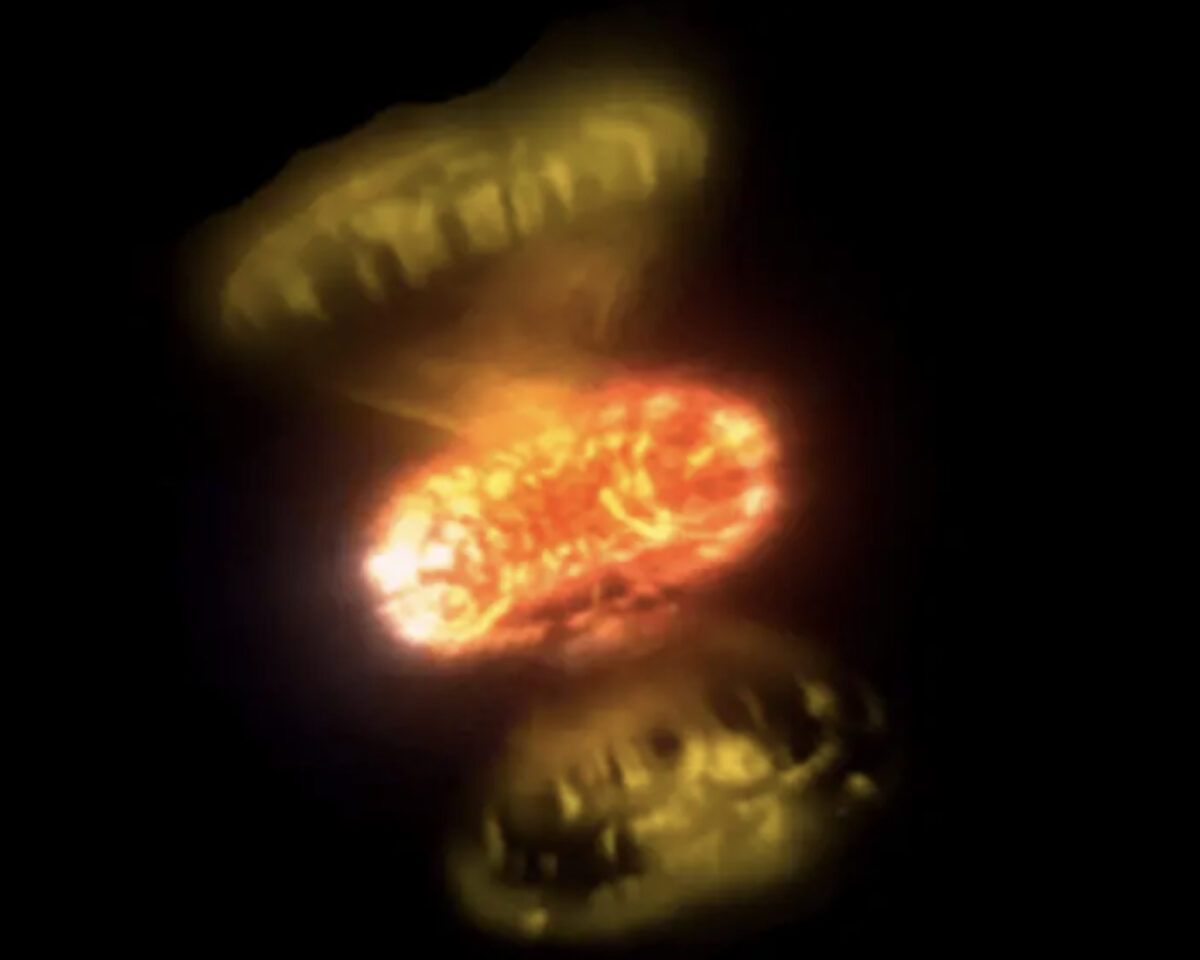
Artistic impression of Nova V1674 Herculis (Courtesy: The CHARA Array)
Turns out the deaths of massive stars may be messier than scientists long believed.
In A Nutshell
What happened: Astronomers used the CHARA Array to capture the first detailed images of two novae within days to weeks of their eruptions in 2021.
What they found: Nova V1674 Her showed two perpendicular outflows colliding at thousands of kilometers per second. Nova V1405 Cas held onto most of its material for more than 50 days before finally expelling it.
Why it matters: The findings overturn the simple model of novae as single, spherical explosions. These eruptions involve multiple outflows, delayed ejections, and shocks powerful enough to produce gamma rays, making them valuable laboratories for studying extreme physics that also occurs in supernovae and stellar mergers.
The bottom line: Nova explosions are far messier and more drawn-out than textbooks suggest, and the companion star may play a bigger role in driving the ejection than previously thought.
For decades, textbooks have described novae as relatively straightforward events. A dense stellar remnant called a white dwarf, about the size of Earth but with the mass of the Sun, slowly steals gas from a nearby companion star. Eventually, the stolen hydrogen piles up, heats up, and ignites in a thermonuclear explosion that blasts everything outward in a single, spherical burst.
Now, images captured within days of two stellar explosions tell a very different story. What researchers found looks less like a tidy cosmic sneeze and more like a violent, drawn-out eruption that can take months to fully expel its debris. Material races outward at thousands of miles per second, crashes into other material, and produces high-energy radiation detected by NASA’s Fermi Space Telescope from thousands of light-years away.
The findings, published in Nature Astronomy, come from observations made using the CHARA Array, a collection of six telescopes at Mount Wilson Observatory in California. By combining light from all six telescopes, the array can resolve details far smaller than any single telescope could manage on its own, picking out structures about the size of a quarter viewed from 2,500 miles away. The international research team, led by Elias Aydi of Texas Tech University, captured images of two novae that erupted in 2021 and found that neither behaved the way standard models predicted.
Two Supernova, Two Surprises
Nova V1674 Herculis, discovered on June 12, 2021, became one of the fastest novae ever recorded. It went from invisible to bright enough to see without a telescope in less than 16 hours, then faded dramatically within a day. When the CHARA Array observed it just two to three days after discovery, the images revealed something unexpected: two separate streams of material shooting outward in perpendicular directions, like jets from a garden sprinkler crossed with an expanding balloon.
One stream formed an elongated central structure, racing outward at around 8.5 million miles per hour. A second, faster stream spread toward the northeast and southwest at roughly 12 million miles per hour, fast enough to travel from Earth to the Moon in about 70 seconds. That faster material, launched shortly after the first wave, caught up with the slower debris ahead of it.
When the two streams collided, the crash was violent enough to accelerate particles to extreme speeds and produce gamma rays, a form of radiation far more energetic than visible light or even X-rays. NASA’s Fermi telescope picked up this gamma-ray signal during the first two days of the eruption.
Nova V1405 Cassiopeiae, discovered on March 18, 2021, behaved completely differently. This nova took its time, spending 53 days just climbing to peak brightness, then hovering near that peak for more than 200 days while flaring at least nine separate times.
The CHARA images taken around peak brightness, roughly 53 and 55 days after discovery, showed something the team did not expect: almost nothing had been ejected. The central region accounted for more than 95 percent of the detected light. If the explosion had kicked out its material at the start, that shell of debris should have stretched far wider by then, perhaps 20 to 40 times the distance from Earth to the Sun. Instead, the glowing region measured only about 1.7 times that distance across.

The Explosion That Waited
The size mismatch pointed to a surprising conclusion. Most of the stolen gas had not been thrown off at the beginning. Instead, it stayed wrapped around both stars for more than 50 days, like a shared cocoon, before finally escaping.
Only after that long delay did the material break free, coinciding with the detection of gamma rays by Fermi and X-rays by the Neil Gehrels Swift Observatory. Spectral measurements, which act like fingerprints identifying how fast material moves, showed new absorption features at progressively higher speeds with each flare. The nova appeared to be ejecting material in repeated bursts, each one faster than the last.
These observations matter beyond novae themselves. Because these explosions involve crashes violent enough to accelerate particles and produce gamma rays, novae act as nearby testing grounds for understanding how shocks work in space. The same physics operates in far more distant and energetic events, including certain supernovae and colliding stars, where getting a close look is impossible.

What This Means for Understanding Stellar Pairs
The companion star, the one getting robbed of its gas, appears to play a bigger role than scientists previously thought. Older models assumed the nuclear explosion alone provided enough force to blow off the accumulated material. The new observations support a different idea: the orbital motion of the two stars swinging around each other can transfer energy into the expanding gas, helping push it out of the system.
If future observations of other novae show similar behavior, it would confirm these explosions as small-scale versions of a process called common-envelope evolution. Normally, this process takes thousands of years and affects how binary star systems age and eventually die. Novae would let astronomers watch it unfold in days or weeks instead. More than 10 percent of all stars go through some form of this interaction during their lifetimes, yet scientists still understand it poorly because it usually happens too slowly to observe directly.
The team plans to image additional novae with CHARA and similar facilities to see whether delayed ejection is common or unusual.
“Resolving the evolution and asymmetry of multiple ejecta components just 2–3 days into a nova event is remarkable,” the researchers wrote. The images also show that nova ejections are more complicated than a single blast, revealing clues about how shocks form during these eruptions.
The study drew on data from multiple sources: gamma-ray observations from NASA’s Fermi Space Telescope, X-ray and ultraviolet measurements from the Swift Observatory, optical spectra from the Gemini-North telescope and the University of Hawaii’s 2.2-meter telescope, and visible-light measurements contributed by amateur astronomers through the American Association of Variable Star Observers and the Astronomical Ring for Access to Spectroscopy.
Paper Summary
Limitations
The study examined only two novae, both of which erupted in 2021. While V1674 Her and V1405 Cas sit at opposite ends of the speed spectrum, the researchers acknowledge that a larger sample is needed to determine how common delayed ejections and multiple outflows are among novae generally. The CHARA Array’s imaging capabilities depend on how many telescope pairs contribute data, and some features in the reconstructed images may reflect those limitations rather than actual structures in the debris. For the third observation of V1405 Cas, about half the light came from material too spread out for the array to image clearly, and the lack of shorter-distance telescope pairings made it difficult to capture the diffuse outer regions. Distance estimates for V1674 Her depend on assumptions about the system’s tilt relative to Earth and how fast the material expands, introducing uncertainties of roughly 20 to 30 percent.
Funding and Disclosures
The work was supported by NASA award 80NSSC20K01237. CHARA Array observing time was granted through the NOIRLab community access program. The CHARA Array is supported by National Science Foundation grants AST-2034336 and AST-2407956, with institutional support from Georgia State University. Lead author Elias Aydi acknowledges support from a NASA Hubble Fellowship. Additional funding came from the NSF, NASA, the Packard Foundation, the UK Space Agency, the Simons Foundation, the Polish National Science Center, and the European Research Council. The authors declare no competing interests.
Publication Details
Title: Multiple outflows and delayed ejections revealed by early imaging of novae
Authors: Elias Aydi, John D. Monnier, Antoine Mérand, Gail H. Schaefer, Laura Chomiuk, and 32 additional co-authors from institutions across the United States, Europe, South Africa, Taiwan, Ethiopia, and Poland.
Journal: Nature Astronomy | DOI: https://doi.org/10.1038/s41550-025-02725-1 | Received: July 13, 2025 | Accepted: October 28, 2025 | Published online: December 5, 2025
Data availability: Supporting data are available via figshare at https://doi.org/10.6084/m9.figshare.30330472


