
(Credit: iurii/Shutterstock)
BARCELONA, Spain — Have you ever wondered when the first humans set foot in Europe? A new study suggests it happened much earlier than scientists previously thought — and in a surprising way. Researchers in Spain are saying their findings may rewrite the story of human migration.
Imagine a time long before primitive vehicles or even writing existed. We’re talking about 1.3 million years ago. That’s when researchers now believe the first humans arrived in Europe, specifically in what is now southern Spain.
A team of scientists, led by Lluís Gibert from the University of Barcelona, has been digging into the past at a place called Orce in southern Spain. What they’ve found is pretty mind-blowing: the oldest human remains ever discovered in Europe.
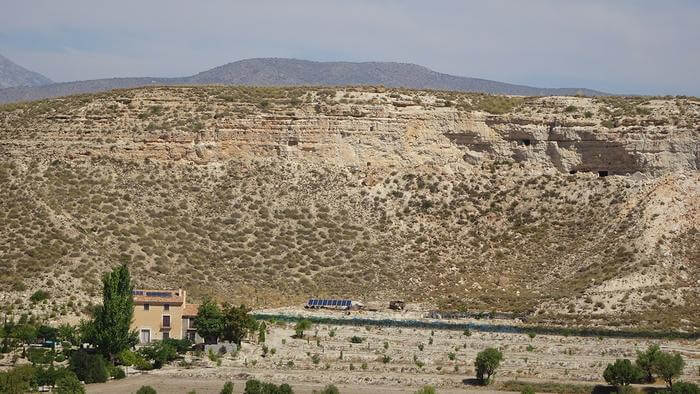
So, how do researchers know how old these remains are? It’s not like ancient humans kept records and time stamps! This is where some cool science comes in. The researchers, who published their work in the journal Earth-Science Reviews, used a technique called paleomagnetism.
Paleomagnetism is like reading the Earth’s magnetic diary. Researchers note that our planet’s magnetic poles flip from time to time. When this happens, it leaves a mark on certain minerals, kind of like invisible ink. Scientists can read these marks to figure out when things happened in the past.
“The uniqueness of these sites is that they are stratified and within a very long sedimentary sequence, more than eighty meters long. Normally, the sites are found in caves or within very short stratigraphic sequences, which do not allow you to develop long palaeomagnetic sequences in which you can find different magnetic reversals,” says Gibert in a media release.
In other words, Orce is like a giant history book with many pages, while most other sites are more like short stories. This gives scientists a much clearer picture of what happened when.

So, what exactly did they find? The study points to three important sites in Orce: Venta Micena (1.32 million years-old), Barranco León (1.28 million years-old), and Fuente Nueva 3 (1.23 million years-old). These dates make the Orce remains significantly older than those found at other famous European sites.
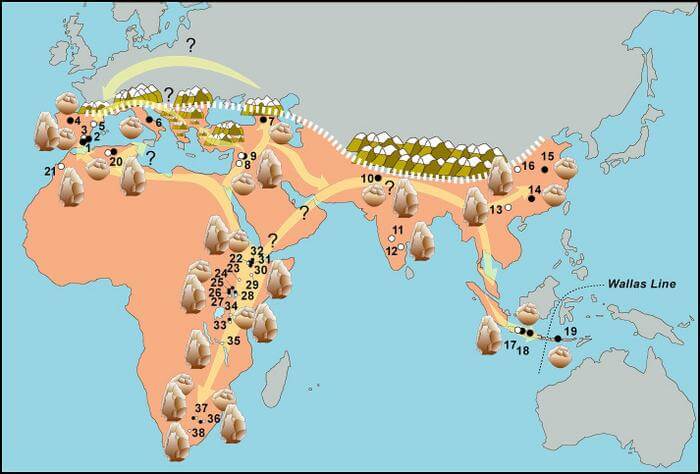
However, it’s not just about when humans arrived in Europe. The study also sheds light on how they got there. For years, scientists have debated whether early humans entered Europe through the Middle East or by crossing the Strait of Gibraltar from Africa.
This new research supports the Gibraltar route theory. Why? For one thing, the stone tools found at Orce are similar to those used in North Africa at the time. Moreover, researchers have found the remains of African animals like hippos in southern Spain but nowhere else in Europe.
“We also defend the hypothesis that they arrived from Gibraltar because no older evidence has been found at any other site along the alternative route,” Gibert adds.
Crossing the Strait of Gibraltar was no easy feat, the team explains. Today, it’s about 14 kilometers (8.7 miles) wide at its narrowest point. However, Gibert suggests that in the past, this distance might have been shorter due to changes in sea level and tectonic activity.
The researchers draw an intriguing parallel with another ancient human migration.
“Humanity arrived in Europe when it had the necessary technology to cross maritime barriers, as happened before a million years ago on the island of Flores (Indonesia),” says Gibert.
This suggests that our ancient ancestors were more capable seafarers than we previously thought.
The study also looked at the animal remains found at Orce. The types of animals present can tell us a lot about when humans were there. For instance, the researchers found that certain rodent species at Orce were less evolved than those found at younger sites. They also noticed that pig ancestors, which came from Asia, were absent at Orce but present at later sites.
All of this paints a picture of early humans gradually spreading across the globe. They left Africa about two million years ago, reached Asia around 1.8 million years ago, and finally made it to Europe about 1.3 million years ago.
This research doesn’t just push back the date of Europe’s first human inhabitants. It also challenges our understanding of early human capabilities. These ancient explorers crossed seas and adapted to new environments, showing a level of ingenuity and adventurousness that resonates with us even today.
Paper Summary
Methodology
The research team employed a sophisticated magnetostratigraphic approach to date the sediment layers in Orce, where significant paleontological and archaeological finds have been made. This technique analyzes the magnetic properties of rock layers to identify and date changes in Earth’s magnetic field.
Over 80 meters of fluvio-lacustrine sedimentary successions were examined, revealing crucial paleomagnetic boundaries. The study also incorporated a Bayesian age-stratigraphic model, which utilized both magnetic and fossil data to refine the age estimates of these ancient deposits, providing a high-resolution timeline for the appearance of early humans in Europe.
Key Results
The study identified four paleomagnetic boundaries within the sedimentary layers of Orce, placing the oldest hominin sites between two key magnetozones — the Olduvai and Jaramillo. This dating suggests that the first human activities in Europe can be traced back to more than 1.07 million years ago, significantly older than previous estimates. The detailed chronological framework established by this research provides compelling evidence that early hominins with Oldowan tool technology were present in Southwestern Europe long before they were thought to have arrived.
Study Limitations
The accuracy of magnetostratigraphy can be impacted by the remagnetization of rocks and the complex depositional history of the region. Moreover, the absence of volcanic material for radiometric dating and the inherent challenges in correlating paleontological data across different sites introduce uncertainties that must be carefully managed.
Discussion & Takeaways
This study significantly advances our understanding of human migration and settlement patterns. Establishing a more accurate timeline for the arrival of hominins in Europe challenges previous models that suggested a later entry. The implications of this research extend beyond mere dates, influencing how we understand the technological and cultural capacities of early humans. The findings suggest a scenario where early hominins may have navigated geographical barriers like the Strait of Gibraltar, much earlier than previously believed, marking a crucial step in the spread of human populations throughout the continent.
In conclusion, while this study shifts the timeline of human history backward by several hundred thousand years, it also opens new avenues for research into the origins and spread of early human societies in Europe. The journey to understand our ancestors continues, with each discovery adding a piece to the puzzle of our collective past.


