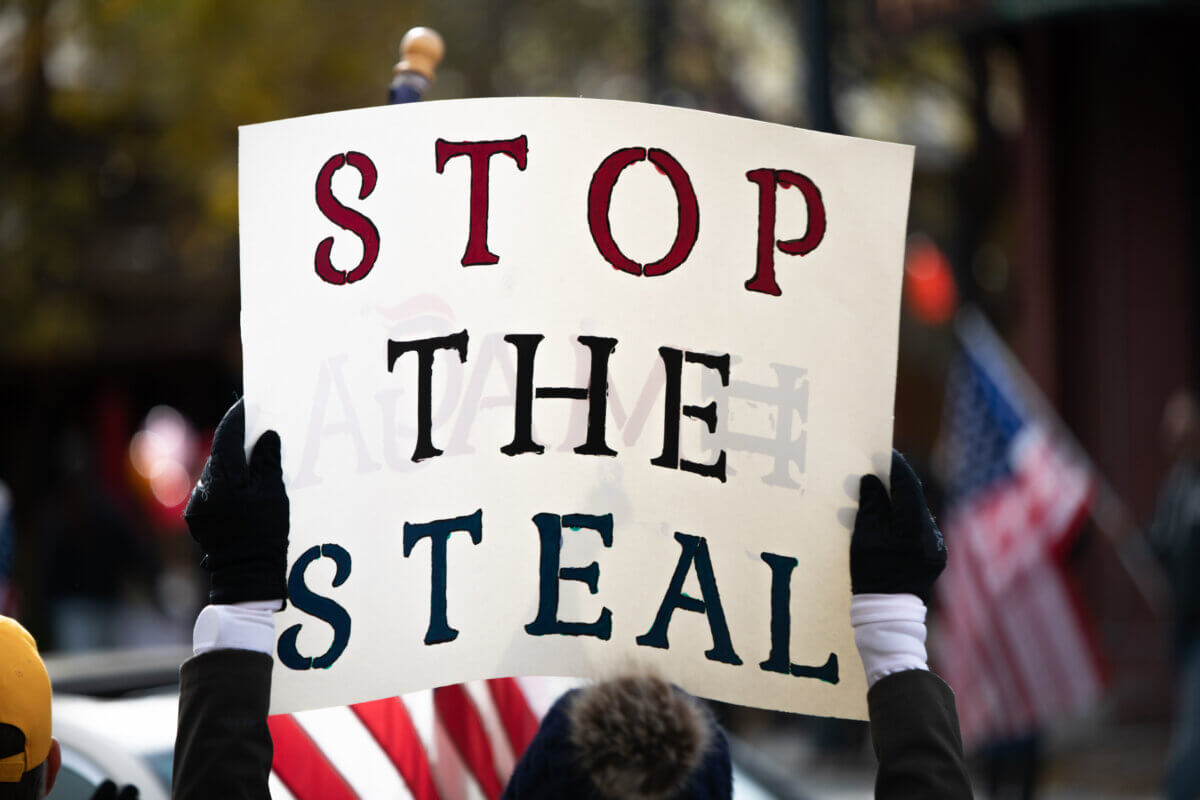
"Stop the Steal" protest after the 2020 election.(Credit: Trevor Bexon/Shutterstock)
NEW HAVEN, Conn. — In an era where instant gratification is a way of life, waiting for election results can feel like an eternity. However, with political polarization seemingly reaching a breaking point, a new study finds election night delays are more than an inconvenience — they’re threatening our trust in democracy.
An alarming new study published in PNAS Nexus reveals that the longer it takes to count votes and declare winners, the less voters trust the results. Researchers from Yale, USC, and UC San Diego note that the 2020 and 2022 U.S. elections were both marked by unusual delays in vote counting and result declarations.
Specifically, it took four days to call Joe Biden’s presidential victory in 2020 and even longer to determine control of Congress in 2022. These delays sparked intense debate and, in some cases, fueled conspiracy theories and protests about election integrity.
So, do delays alone — even without any claims of fraud or irregularities — shake voter confidence? To find out, researchers conducted a large-scale experiment involving nearly 10,000 Americans from various states.
The study focused on the 2022 Arizona gubernatorial election, where vote-counting delays had been a hot topic. Participants were randomly divided into groups. Some were told about the six-day delay in calling the race, while others weren’t given this information. Additionally, some participants watched a short video explaining why accurate vote counting can sometimes take time, while others didn’t see the video.
Results reveal that simply informing voters about the delay in election results caused a significant drop in trust. Among those who weren’t told about the delay, 66.7% said they had “some” or “a lot” of trust in Arizona’s elections. However, when these voters were informed of the six-day wait for results, trust plummeted to 60.2% — a 6.5 percentage point decrease.
There was a silver lining to the study’s findings. The research also shows that the simple informational video can significantly counteract this erosion of trust in government.
The 40-second informational video, produced by Arizona’s Secretary of State, acted as a powerful antidote. Participants who watched the video before learning about the ballot-counting delay only had a 2.6 percentage point drop in trust compared to those who neither saw the video nor learned about the election night delays. In other words, the video wiped out about 60% of the distrust voters had in their election system.
The impact was even more pronounced among Republican voters. Their drop in trust was nearly three times larger than Democrats when they learned of unusual delays in counting ballots. However, they also responded more positively to the informational video, with Republicans who watched it reporting a 7.5% increase in trust in their elections.
These findings have significant implications for election officials and policymakers. They suggest that unexpected delays in vote counting can shatter voter confidence even if nothing sinister is happening once the polls close. However, proactive communication about the reasons why voters won’t see results on election night can substantially mitigate this effect.
The study underscores the importance of transparency and education in maintaining public trust in the electoral process. As we sprint towards the 2024 elections, clear communication about these processes becomes incredibly crucial.
Paper Summary
Methodology
The researchers used a “2×2 experimental design,” which means participants were randomly assigned to one of four groups: those who saw the video and learned about the delay, those who only saw the video, those who only learned about the delay, and those who experienced neither. This allowed the researchers to isolate the effects of both the delayed information and the informational video. Participants then answered questions about their trust in Arizona’s elections.
Key Results
The key findings were a 6.5 percentage point decrease in trust among those informed of the delay and a 2.5 percentage point increase in trust among those who watched the video but weren’t told about the delay. The video negated about 4 of the 6 percentage points of distrust caused by the delayed information.
Study Limitations
The study focused on a single election in Arizona, so the results might not apply equally to all states or types of elections. Additionally, the sample, while large and diverse, was recruited online and may not perfectly represent the entire U.S. population.
Discussion & Takeaways
The researchers emphasize that their findings have two main implications. First, policies that allow for faster vote counting without compromising election integrity could help maintain voter trust. Second, election officials should prioritize clear, proactive communication about the vote-counting process, as even simple messages can significantly boost voter confidence.
Funding & Disclosures
The study was funded by the MIT Election Data and Science Lab’s “Learning from Elections” program and the UC San Diego Yankelovich Center. The authors declared no competing interests.


