
(Photo by Spech on Shutterstock)
In a nutshell
- Simple two-tone warning sounds on electric vehicles make it harder for pedestrians to locate cars, especially when multiple vehicles are present
- Traditional engine noise performs significantly better than artificial warning sounds for helping people pinpoint vehicle locations
- Current regulations requiring identical warning sounds for same-model vehicles may create dangerous confusion in parking lots and busy areas
GOTHENBURG, Sweden — You’re walking through a busy parking lot when three electric vehicles start backing out simultaneously. Their beeping warning sounds fill the air, but instead of helping you locate each car, the overlapping tones create a confusing audio maze that makes it nearly impossible to tell where any of the vehicles actually are.
New research from Sweden’s Chalmers University of Technology reveals a troubling flaw in how we’ve designed safety sounds for electric and hybrid vehicles. While these acoustic vehicle alerting systems (AVAS) were created to protect pedestrians from dangerously quiet electric cars, the study found that certain types of warning sounds actually make it harder to pinpoint where vehicles are located, especially when multiple cars are present.
The findings, published in The Journal of the Acoustical Society of America, could have serious implications for pedestrian safety as electric vehicles become increasingly common on our roads.
Electric Cars Need Warning Sounds—But Which Ones Work?
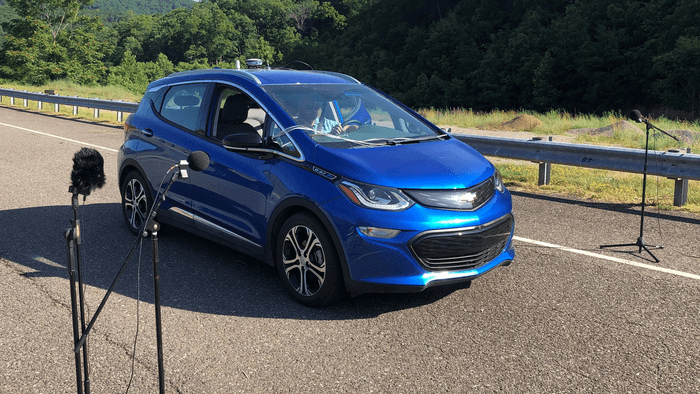
Electric vehicles are so quiet at low speeds that they pose a real danger to pedestrians, cyclists, and visually impaired individuals who rely on engine noise to detect approaching cars. Government regulations now require all new electric vehicles to emit artificial warning sounds when traveling slowly or in reverse.
Swedish researchers discovered that not all warning sounds are created equal. In their experiment involving 52 participants, they tested four different types of vehicle sounds: traditional combustion engine noise, a filtered noise signal, a two-tone beeping sound, and a complex multi-tone signal.
The results were striking. Two-tone AVAS signals — the kind of simple beeping you might hear from a reversing truck — performed significantly worse than all other sound types. Participants had the most trouble locating vehicles that used these two-tone warnings, taking longer to identify their positions and making more errors.
Even more concerning was what happened when multiple vehicles with the same warning sound were present simultaneously. The study found that “the percentage of failed localizations drastically increased for all three AVAS signals, with the two-tone AVAS performing worst.”
How Scientists Tested Vehicle Warning Sounds
To understand how people actually locate vehicles by sound, researchers created an elaborate setup in an anechoic chamber, a room designed to eliminate echoes. They surrounded participants with 24 concealed speakers arranged in a circle, then played various vehicle sounds while people tried to point toward the source using a motion controller.
The experiment simulated real-world scenarios: single vehicles, two vehicles with identical sounds, three vehicles with identical sounds, and pairs of vehicles with different warning sounds. Participants used a laser pointer-like device to indicate where they thought each vehicle was located.
Lead researcher Leon Müller and his team found that combustion engine noise consistently achieved the highest accuracy and fastest response times. The traditional rumble of a gas engine provides much clearer directional information than artificially created warning sounds.
The multi-tone AVAS (which uses multiple frequencies) and filtered noise performed similarly to each other but still worse than traditional engine sounds. Two-tone signals performed the worst across all scenarios.

Multiple Electric Cars Create Audio Chaos
Perhaps most alarming were the results when three vehicles with identical warning sounds were present simultaneously. In these scenarios, many participants simply couldn’t locate all the vehicles. With two-tone AVAS sounds, “20 out of 52 participants having more than 50% of failed localizations,” meaning they couldn’t successfully identify where most of the vehicles were positioned.
Compare that to traditional engine noise, where “45 out of 52 participants achieved 0% of failed localizations,” they could locate all the vehicles correctly.
Current U.S. regulations actually require that vehicles of the same model use identical AVAS sounds, creating exactly the kind of confusing scenarios the study identified as problematic.
Humans locate sounds using subtle differences in timing and volume between their two ears. Broadband sounds, like engine noise with many frequencies, provide rich information that our brains can easily process. Simple tones, however, don’t give our auditory system much to work with.
“It has been known since the early days of psychoacoustic research that wideband sound sources are easier to localize than narrowband or tonal sounds,” the researchers note in their paper. But few studies have tested how these principles apply to electric vehicle warning systems in realistic multi-vehicle scenarios.

The Real-World Safety Risk
These results matter because localization accuracy could be crucial in preventing accidents. If a pedestrian hears multiple electric vehicles but can’t tell where they’re coming from, they might walk directly into danger while trying to avoid a vehicle that’s actually in a different location.
Current electric vehicle regulations were developed primarily based on single-vehicle detection studies. The Swedish research reveals this approach missed a critical piece of the puzzle: what happens when multiple electric vehicles are present simultaneously.
The study’s authors recommend implementing “a certain level of randomness so that two vehicles never radiate exactly the same AVAS sound.” However, they caution that more research is needed to determine exactly how different two warning sounds need to be to avoid the confusion documented in their study.
As electric vehicles rapidly replace gas-powered cars, we’re essentially conducting a massive real-world experiment with pedestrian safety. In our effort to make silent electric vehicles safer, we may have inadvertently made them harder to locate when it matters most. As millions more electric vehicles hit the roads in the coming years, fixing this acoustic confusion could be a matter of life and death.
Paper Summary
Methodology
Researchers at Chalmers University of Technology tested how well 52 participants (ages 20-38) could locate different types of vehicle warning sounds. The experiment took place in an anechoic chamber with 24 speakers arranged in a circle around participants. Four sound types were tested: combustion engine noise, filtered noise AVAS, two-tone AVAS, and multi-tone AVAS. Participants used a motion controller to point toward sound sources while researchers measured accuracy and response time. The study included scenarios with single vehicles, two vehicles with identical sounds, three vehicles with identical sounds, and two vehicles with different sounds.
Results
Combustion engine noise performed best across all measures, followed by multi-tone and noise AVAS signals, with two-tone AVAS performing worst. When multiple vehicles with identical sounds were present, localization became significantly more difficult. With three two-tone AVAS vehicles, 20 out of 52 participants failed to locate more than half the vehicles, compared to only 7 participants having any failures with combustion engine noise. The two-tone AVAS showed mean localization errors up to 27 degrees and response times up to 4.1 seconds longer than combustion noise.
Limitations
The study was limited to stationary vehicles in an anechoic environment, which may not reflect real-world conditions with moving vehicles, reflective surfaces, and varying background noise. All sounds were normalized to the same loudness level, which removes natural loudness differences. The experiment focused only on localization accuracy and didn’t measure detection probability. The sample consisted mainly of university students and faculty, potentially limiting generalizability to broader populations.
Funding and Disclosures
Research was funded by FORMAS, a Swedish research council for sustainable development, under Grant No. FR-2020-01931. The authors declared no conflicts of interest. The study was conducted in accordance with the Declaration of Helsinki and approved by the Swedish ethical review authority.
Publication Information
“Auditory localization of multiple stationary electric vehicles” by Leon Müller, Jens Forssén, and Wolfgang Kropp was published in the Journal of the Acoustical Society of America, Volume 157, Issue 3, pages 2029-2041, on March 24, 2025. DOI: https://doi.org/10.1121/10.0036248.


