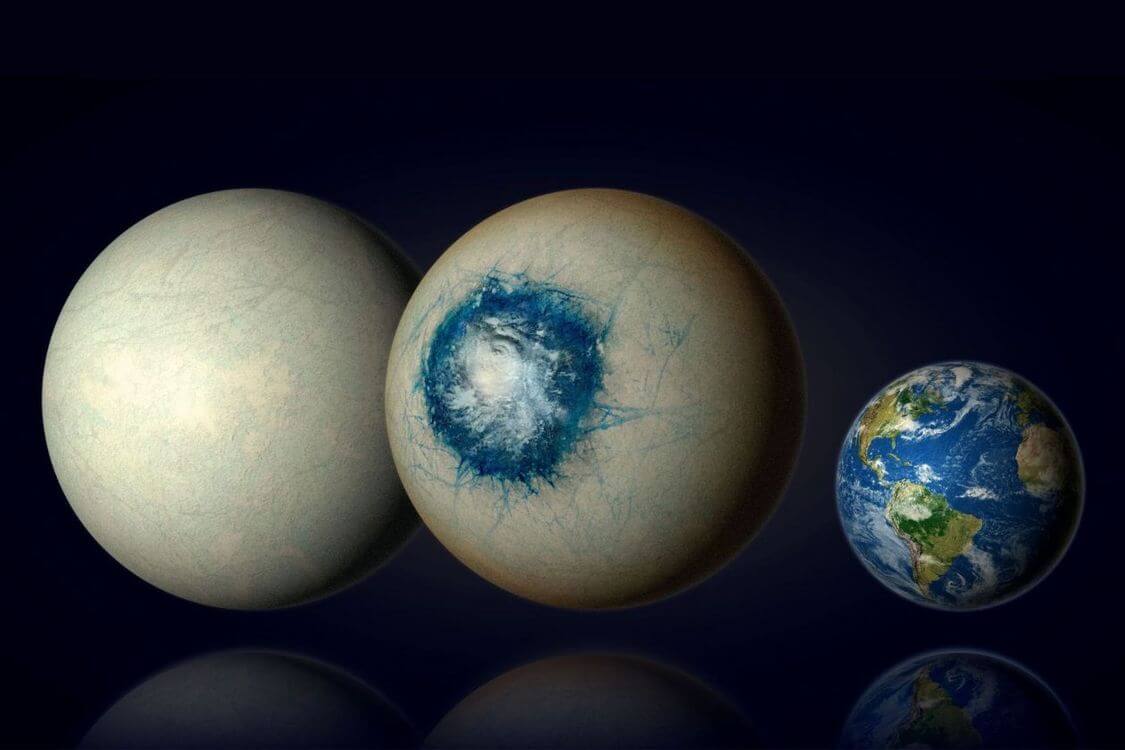
Temperate exoplanet LHS 1140 b may be a world completely covered in ice (left) similar to Jupiter’s moon Europa or may be an ice world with a liquid substellar ocean and a cloudy atmosphere (center). LHS 1140 b is 1.7 times the size of our planet Earth (right) and is the most promising habitable zone exoplanet yet found in the search for liquid water beyond the Solar System. (CREDIT: BENOIT GOUGEON, UNIVERSITÉ DE MONTRÉAL)
MONTREAL, Quebec — A distant world that may look to many like a giant eyeball floating through space could be the perfect place to search for alien life. Researchers at the University of Montreal believe the vast ocean on exoplanet LHS 1140 b may be teeming with alien life.
When astronomers first spotted LHS 1140 b, they thought it might be a mini-Neptune – a small, gassy planet similar to our own solar system’s ice giant. Thanks to the James Webb Space Telescope (JWST), however, that theory has just been turned on its head!
The Canadian astronomers have been poring over data from the Webb telescope, along with information from other space observatories like Spitzer, Hubble, and TESS. Their findings? LHS 1140 b isn’t a gas ball at all – it’s more likely a “super-Earth” with some incredibly fascinating features.
First off, LHS 1140 b is essentially sitting right in our cosmic backyard. The exoplanet is approximately 48 light-years away in the constellation Cetus. That’s close enough for our most powerful telescopes to get a good look at this alien world.
What makes this planet an exciting find for astronomers is its location in the “Goldilocks Zone” around its home star. This means it’s not too hot (too close), not too cold (too far away), but just right for liquid water to potentially exist on its surface. As we Earthlings know, where there’s liquid water, there’s a chance for life!
Now, here’s where the team’s observations get really interesting. The researchers, led by Ph.D. student Charles Cadieux, have figured out that LHS 1140 b is about 1.7 times the size of Earth and 5.6 times more massive. However, this is still less dense than you’d expect for a rocky planet. This suggests that a good chunk of its mass – between 10 and 20% – could be water.
“Of all currently known temperate exoplanets, LHS 1140 b could well be our best bet to one day indirectly confirm liquid water on the surface of an alien world beyond our Solar System,” says Cadieux, lead author of the new study in a media release. “This would be a major milestone in the search for potentially habitable exoplanets.”
The findings are published in ArXiv and are scheduled to be published in Astrophysical Journal Letters.
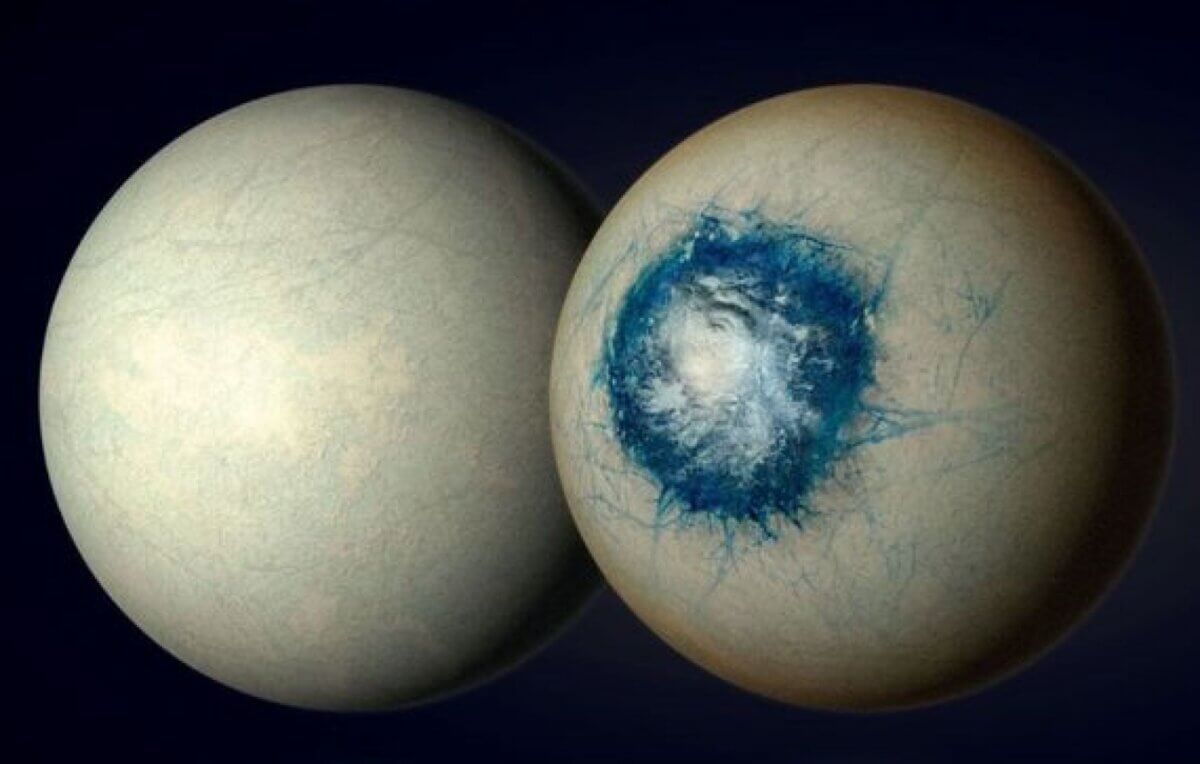
So, does this world really look like an eyeball?
Scientists have a couple of ideas of how LHS 1140 b appears in reality. It could be a “snowball” planet, mostly covered in ice. Or, it might have a “bull’s-eye” ocean. Imagine a huge circular sea, about 2,500 miles across (half the size of the Atlantic Ocean), always facing the planet’s star. The center of this alien ocean could even be a balmy 20 degrees Celsius (68 degrees Fahrenheit). Talk about a perfect spot for a space beach vacation!
The Webb telescope data hints at something else incredibly exciting – LHS 1140 b might have an atmosphere rich in nitrogen. If confirmed, this would be the first temperate planet scientists have found with evidence of a “secondary” atmosphere – one that formed after the rocky planet came together.
Discussion & Takeaways: Why is this a big deal?
An atmosphere helps a planet hold onto heat and maintain a stable climate. It’s like a cozy blanket wrapped around the planet, creating conditions that could potentially support life — keeping warmth from escaping into space.
“Detecting an Earth-like atmosphere on a temperate planet is pushing Webb’s capabilities to its limits – it’s feasible; we just need lots of observing time,” explains Professor René Doyon, who supervised the research. “The current hint of a nitrogen-rich atmosphere begs for confirmation with more data. We need at least one more year of observations to confirm that LHS 1140 b has an atmosphere, and likely two or three more to detect carbon dioxide.”
The hunt for carbon dioxide is crucial because it could indicate the presence of greenhouse gases – another important factor for creating habitable conditions.
Unfortunately, studying LHS 1140 b isn’t as simple as pointing the Webb telescope at it whenever we want. The planet’s position means scientists can only observe it a maximum of eight times per year. This means it could take several years of dedicated observations to unlock all of LHS 1140 b’s secrets.


