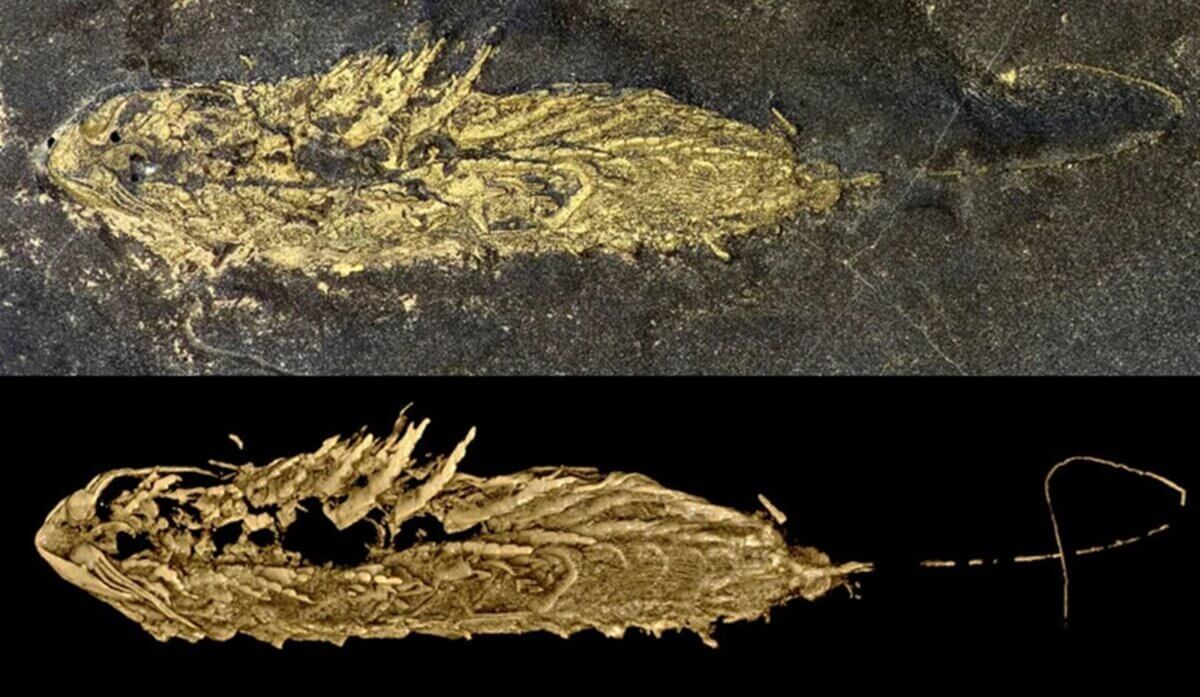
In these images, the morphology of Lomankus edgecombei was reconstructed using computed tomography. The fossils are infused with pyrite (fool’s gold), causing the gold color. (Credit: Yale University)
NEW HAVEN, Conn. — Around 450 million years ago, a peculiar bug-like creature roamed the ancient seas – and researchers have just unearthed its remarkable fossilized remains. These spectacular specimens, preserved in a dazzling coat of fool’s gold, are shedding new light on the origins and evolution of modern arthropods.
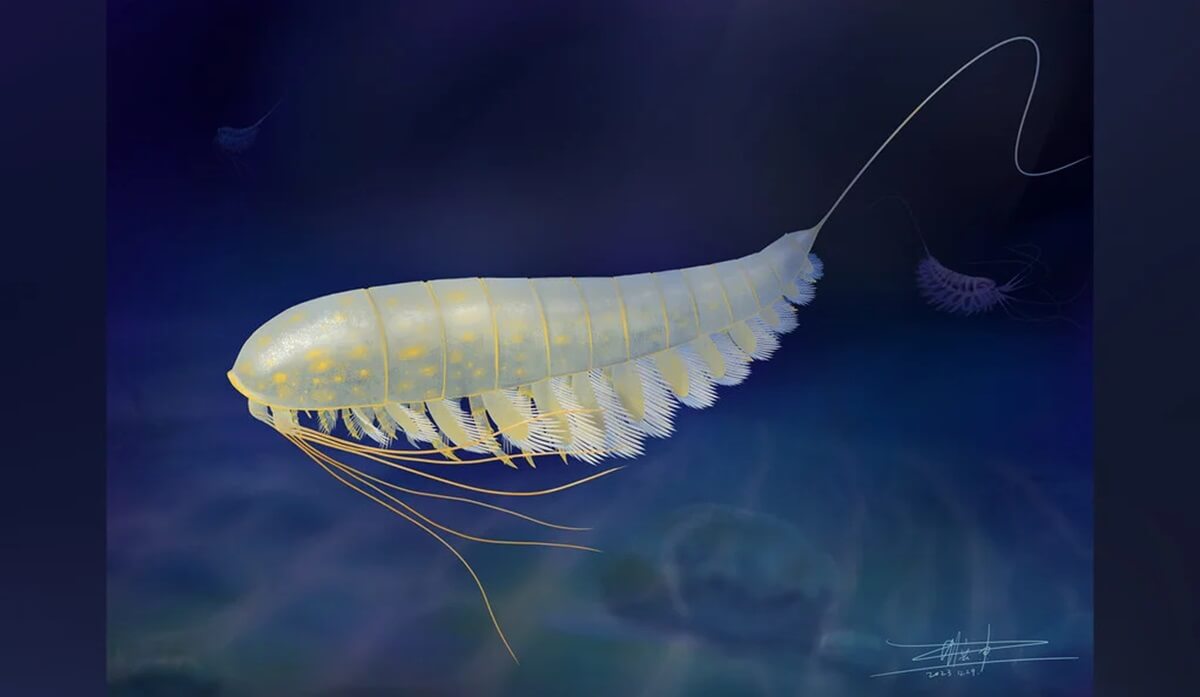
The newly identified species, named Lomankus edgecombei, was a distant relative of today’s horseshoe crabs, scorpions, and spiders. This ancient arthropod had no eyes, but its small front appendages were perfectly adapted for burrowing through the dark seafloor sediments that once covered what is now upstate New York.
Lomankus edgecombei was a small, elongated arthropod measuring around 8-20 millimeters in length, not including its lengthy tail-like telson. What sets it apart from its cousins in the Cambrian Period (485 to 541 million years ago) is the unique structure of its signature “great appendage” – the large, multi-pronged limb that was likely used for feeding or sensing the environment.
In Lomankus, the great appendage lacks the elongated “endites” seen in other leanchoiliids, with the three slender flagella attaching directly to the limb segments. This suggests the appendage may have shifted from a grasping, predatory function to a more sensory role.
What makes Lomankus truly extraordinary, however, is its brilliant golden hue – the result of pyrite, or “fool’s gold,” slowly replacing the creature’s soft tissues over millions of years. This unique process of fossilization has preserved exquisite anatomical details that would have been lost long ago.
“These remarkable fossils show how rapid replacement of delicate features in pyrite before decay preserves critical evidence of life in the ancient oceans,” explains Derek Briggs, a paleontologist at Yale University and co-author of the new study published in Current Biology.
The researchers also noted other differences, like the absence of eyes and the unusual, flagellum-like telson. These features, along with the overall body plan, indicate that Lomankus occupied a distinct ecological niche compared to earlier leanchoiliids. Lead author Luke Parry of the University of Oxford explains that the creature was likely a deposit-feeder, combing through the seafloor for nutrients rather than actively hunting.
Lomankus is not just a fascinating creature in its own right – its very existence challenges the conventional wisdom about the fate of Cambrian life. The Cambrian explosion, which occurred around 541 to 515 million years ago, saw a remarkable flourishing of complex animal life, including many strange and wonderful arthropods.
However, the popular view has been that most of these “Cambrian monsters” went extinct as newer, more familiar forms like trilobites and early chelicerates (the group that includes modern arachnids and horseshoe crabs) took over. Lomankus, however, proves that at least some of the iconic Cambrian arthropods managed to hang on long after their heyday.
The fossil was discovered in the famous Beecher’s Trilobite Bed in upstate New York, a site renowned for its exceptional preservation of pyritized (iron sulfide-encased) soft-bodied fossils. Parry and his colleagues used advanced imaging techniques like computed tomography (CT) scanning to meticulously reconstruct Lomankus in 3D, revealing its intricate anatomy in unprecedented detail.
“The preservation is truly remarkable,” Briggs marvels. “The density of the pyrite contrasts beautifully with the surrounding mudstone, allowing us to extract astonishing 3D details through CT scanning.”
Paper Summary
Methodology
The team’s investigation centered on five exceptionally well-preserved Lomankus specimens from the Beecher’s Trilobite Bed. Using CT scanning, they were able to generate high-resolution 3D models that allowed them to study the creature’s anatomy, including features like the great appendage and telson that are not always visible in flattened fossil specimens.
The researchers also conducted a phylogenetic analysis, comparing Lomankus to other related arthropods to determine its evolutionary position. This involved coding a dataset of 283 anatomical characters across 87 taxa, then using computational methods to infer the most likely relationships.
Key Results
The analysis confirmed that Lomankus is indeed a member of the leanchoiliid arthropods, a group known primarily from the Cambrian period. However, it represents the first post-Cambrian discovery of this iconic clade, extending their range by around 60 million years.
Anatomically, Lomankus exhibits several unique features compared to its Cambrian counterparts. Most notably, the great appendage lacks the elongated “endites” seen in other leanchoiliids, with the three flagella instead attaching directly to the limb segments. This suggests a shift in function, from a grasping, predatory role to a more sensory one.
Lomankus also lacks evidence of eyes, in contrast to earlier leanchoiliids. Additionally, its triangular telson extends into a long, flexible flagellum-like structure, unlike the spiny telson typical of Cambrian forms. These differences point to Lomankus occupying a distinct ecological niche, likely as a deposit-feeder on the seafloor.
Study Limitations
As with any paleontological study, the researchers note that their conclusions are limited by the available fossil evidence. The Beecher’s Trilobite Bed, while exceptionally preserving soft tissues, only provides a snapshot of the ancient ecosystem. It’s possible that other leanchoiliid lineages persisted into the Ordovician but have yet to be discovered.
Additionally, the phylogenetic analysis, while utilizing a comprehensive dataset, still has some inherent uncertainties. The placement of Lomankus within the leanchoiliid family tree is not fully resolved, and further fossil discoveries may refine our understanding of its evolutionary relationships.
Discussion & Takeaways
The discovery of Lomankus edgecombei challenges the prevailing view of the Cambrian explosion as a fleeting moment in Earth’s history. It demonstrates that at least some of the bizarre arthropods that flourished during that time were able to adapt and persist for millions of years, even as newer forms like trilobites and chelicerates emerged.
This finding underscores the resilience and adaptability of life, even in the face of major environmental changes. Lomankus shows us that the Cambrian explosion was not just a brief blip, but a foundational event that shaped the evolution of life for a very long time.
Beyond its implications for the Cambrian, the study also highlights the importance of exceptional fossil deposits like the Beecher’s Trilobite Bed in revealing the hidden diversity of the past. By using advanced imaging techniques, the researchers were able to uncover the intricate anatomy of Lomankus, shedding new light on the evolutionary innovations and ecological adaptations of this ancient arthropod.
Funding & Disclosures
The new fossil specimens were donated to the Yale Peabody Museum. This research was supported by a Natural Environment Research Council (NERC) independent research fellowship awarded to Luke Parry, as well as a grant from the Natural Science Foundation of Yunnan Province in China. The authors declare no competing interests.


