
(Credit: H_Ko/Shutterstock)
OSAKA, Japan — Could the key to healthier gums be hiding in your morning grapefruit? A new study suggests that a modified version of a compound found in citrus fruits and coconuts may help combat gum disease by targeting harmful bacteria in the mouth. This discovery could lead to more effective and gentler oral care products, especially beneficial for children and the elderly.
Gum disease, also known as periodontal disease, is a widespread problem affecting nearly half of all adults worldwide. It starts when bacteria in the mouth form a sticky film called plaque on teeth, leading to inflammation of the gums. If left untreated, it can progress to more severe forms, potentially causing tooth loss and even contributing to other health issues like heart disease and diabetes.
Current treatments for gum disease often involve harsh chemicals that can irritate the mouth, making them challenging for some people to use regularly. This is where the new research conducted by a team of Japanese scientists comes into play. According to the journal Foods, the team found that a modified version of a natural compound called prunin, which is derived from citrus fruits, could be a game-changer in the fight against gum disease.
The star of the show is a substance called prunin laurate, or Pru-C12 for short. It’s created by combining prunin, a compound found in grapefruit peels, with lauric acid, a type of fat found in coconut oil and breast milk. This combination creates a substance that appears to be effective at killing bacteria associated with gum disease without harming human cells.
“Pru-C12 is tasteless and hypoallergenic,” says Professor Shigeki Kamitani from Osaka Metropolitan University in a media release. “If its safety in humans is confirmed in the future, it could be an inexpensive antimicrobial solution.”
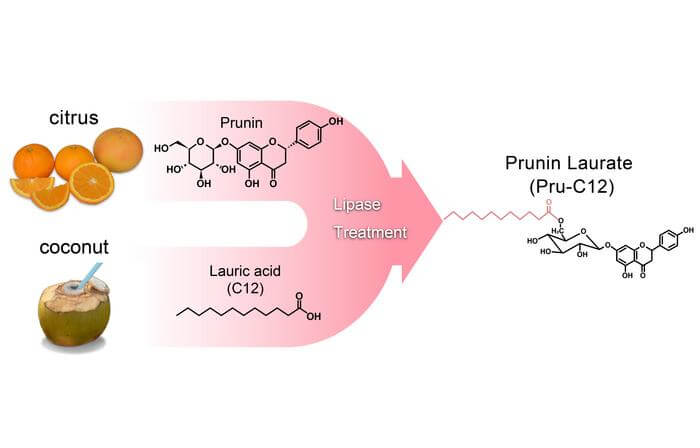
In laboratory tests, Pru-C12 showed a remarkable ability to inhibit the growth of Porphyromonas gingivalis, a type of bacteria strongly linked to gum disease. Even more impressively, it managed to do this at concentrations much lower than those typically used for other antimicrobial agents. This suggests that Pru-C12 could be a more targeted and efficient way to combat harmful oral bacteria.
However, Pru-C12 doesn’t just kill bacteria – it also helps prevent them from forming biofilms. Biofilms are like fortresses that bacteria build to protect themselves, making them much harder to eliminate. By inhibiting biofilm formation, Pru-C12 could make it easier to keep teeth and gums clean and healthy.
One of the most exciting aspects of this research is that Pru-C12 appears to be gentle on human cells. When tested on human cell lines, it showed no toxic effects, even at concentrations much higher than those needed to kill bacteria. This suggests that Pru-C12 could be a safer alternative to some of the harsher chemicals currently used in oral care products.
The potential of Pru-C12 isn’t just theoretical – the researchers also tested it in mice with experimentally induced gum disease. While the results weren’t dramatic, there was a trend towards reduced bone loss in the jaws of mice treated with Pru-C12, suggesting it could help slow the progression of gum disease.
If further research confirms these promising results, we might see a new generation of oral care products that are both effective and gentle. Imagine mouthwashes or toothpastes that work just as well as current products but don’t leave your mouth feeling stripped and irritated. This could be particularly beneficial for young children, who often struggle with strong-tasting oral care products, and for older adults, who may have more sensitive mouths.
Paper Summary
Methodology
The researchers conducted a series of experiments to test Pru-C12 and similar compounds. They first grew bacteria in lab dishes to see how well the compounds prevented bacterial growth.
They then tested whether the compounds could stop bacteria from forming biofilms. To check for safety, they applied the compounds to human cells to see if they caused any damage. Finally, they gave mice Pru-C12 in their food and infected them with gum disease-causing bacteria to see if it could prevent bone loss in their jaws.
Key Results
Pru-C12 and two similar compounds were able to stop the growth of gum disease bacteria at low concentrations. They also prevented these bacteria from forming biofilms. Unlike the other compounds, Pru-C12 didn’t harm human cells even at high concentrations. In mice with gum disease, Pru-C12 showed a trend toward reducing jaw bone loss, though the effect wasn’t statistically significant.
Study Limitations
The study was primarily conducted in lab dishes and mice, so we don’t yet know how well Pru-C12 would work in human mouths. The mouse experiments didn’t show a strong effect, suggesting more research is needed to find the right dose or delivery method. The researchers also couldn’t fully explain how Pru-C12 kills bacteria, which is important for understanding its potential and limitations.
Discussion & Takeaways
This study suggests that Pru-C12 could be a promising new tool for fighting gum disease. Its ability to kill bacteria and prevent biofilm formation at low concentrations, combined with its apparent safety for human cells, makes it an attractive candidate for new oral care products.
The researchers suggest it could be particularly useful for children and the elderly, who often struggle with current products. However, more research is needed to confirm its effectiveness in humans and to understand exactly how it works.
Funding & Disclosures
This research was funded by a grant from JSPS KAKENHI (grant number 17K00867). The authors declared no conflicts of interest, meaning they don’t have any financial or personal relationships that could have influenced their research.


