
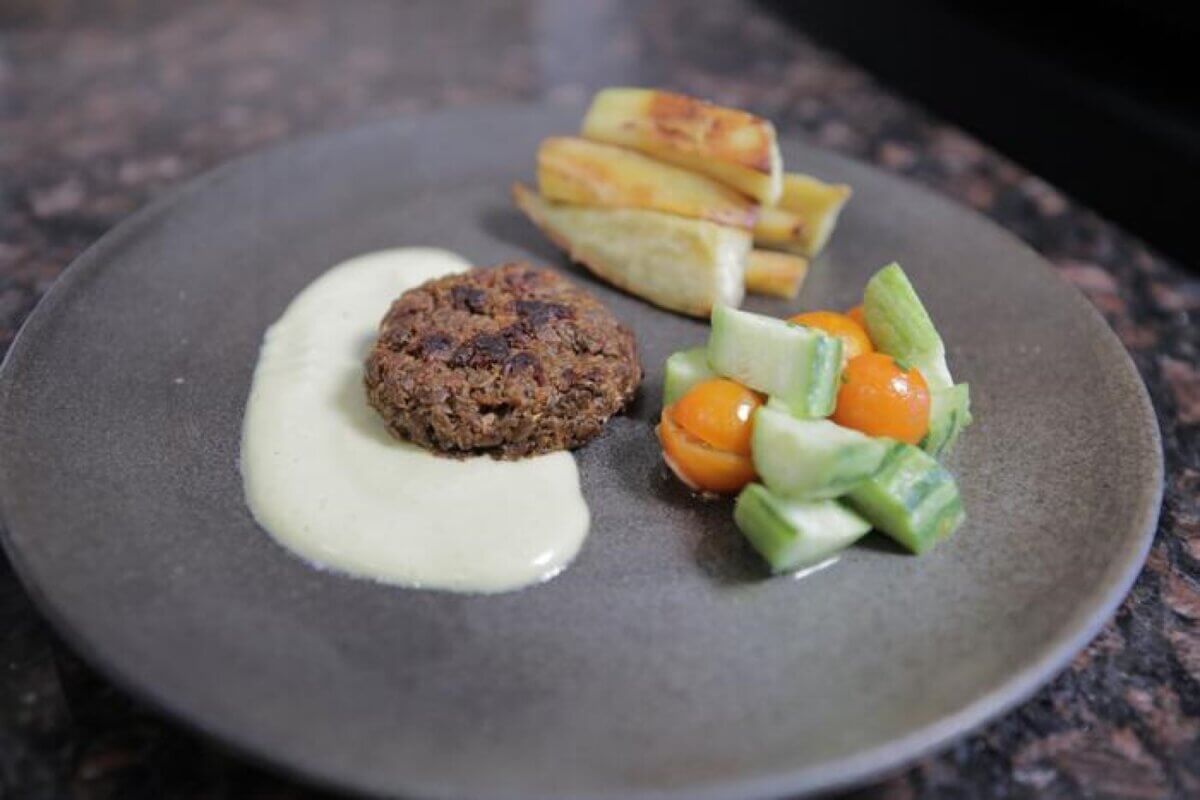
A sauteed patty composed of soy pulp inoculated with Neurospora mold and left to ferment for several days. UC Berkeley postdoctoral fellow Vayu Hill-Maini prepared and cooked the patty, plating it with a cashew cream sauce, baked yams and a fresh cherry tomato and cucumber salad. (Credit: Vayu Hill-Maini, UC Berkeley)
BERKELEY, Calif. — In the bustling kitchens of Java, Indonesia, a culinary secret has been simmering for centuries. Now, this ancient wisdom is poised to revolutionize how we think about food waste worldwide. Meet Neurospora intermedia, a humble fungus that’s about to take center stage in the global fight against food waste and sustainability.
Imagine a world where the leftover pulp from your morning soy latte becomes a protein-packed snack by dinnertime. Where the discarded oats from your favorite plant milk transform into a savory burger that rivals any beef patty. This isn’t science fiction – it’s the promising future unveiled by a groundbreaking study published in Nature Microbiology, led by chef-turned-scientist Vayu Hill-Maini and his colleagues at the University of California, Berkeley.
Hill-Maini’s journey from high-end kitchens to cutting-edge laboratories is as fascinating as the fungus he studies. Growing up in Stockholm with a mother who introduced Swedes to Indian cuisine, Hill-Maini developed an early appreciation for the transformative power of cooking. His culinary adventures took him to New York City, where at just 18, he was redesigning menus for Manhattan eateries. But the siren call of science beckoned, leading him through biochemistry at Harvard and eventually to UC Berkeley, where he now combines his passions for cooking and research.
The Microscopic Master Chef: Neurospora intermedia
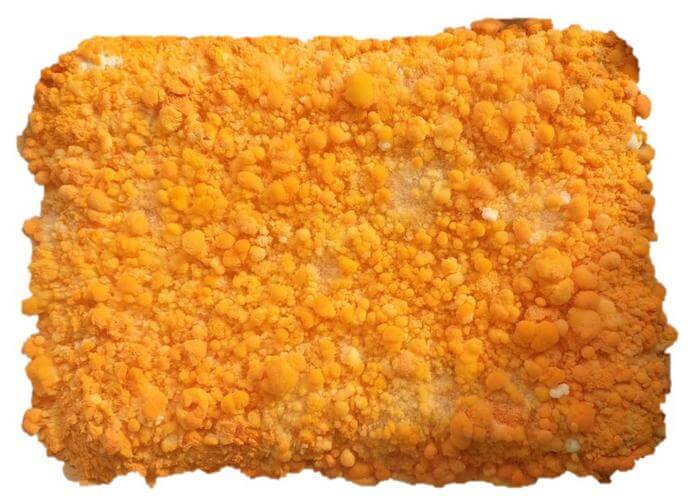
The star of Hill-Maini’s research, as mentioned, is Neurospora intermedia, the fungus responsible for oncom — a traditional Indonesian food made from soy pulp leftovers. What makes this fungus extraordinary is its ability to turn indigestible plant waste into nutritious, flavorful food in just 36 hours. It’s like having a microscopic master chef working round the clock in your kitchen, transforming what you’d normally throw away into gourmet treats.
But Hill-Maini and his team didn’t stop at soy pulp. They tested N. intermedia on a smorgasbord of 30 different agricultural waste products, from sugar cane bagasse to banana peels. The results were astounding – the fungus thrived on almost all of these substrates, proving its potential as a versatile food upcycler.
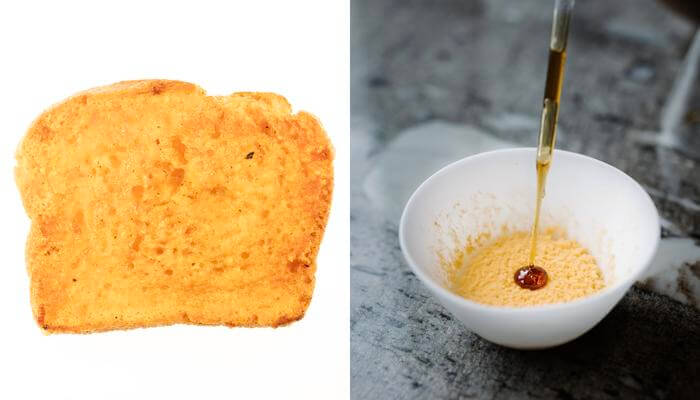
The science behind this fungal alchemy is fascinating. N. intermedia belongs to a group called filamentous fungi, which grow as thread-like structures similar to the mycorrhizae found in forest soils. These fungi produce enzymes that break down complex plant materials like cellulose and pectin – components that human digestive systems struggle with. In doing so, they not only make the waste edible but also increase its protein content and enhance its flavor profile.
One of the most exciting discoveries was the existence of two distinct types of N. intermedia: wild strains found globally and strains that have adapted specifically to human-generated agricultural waste. This suggests a fascinating co-evolution between the fungus and human food production practices.
“What we think has happened is that there’s been a domestication as humans started generating waste or by-products, and it created a new niche for Neurospora intermedia,” Hill-Maini explains in a statement. “And through that, probably the practice of making oncom emerged.”
The Culinary Potential Of Fungus-Based Foods
The million-dollar question still remained: Would people actually want to eat this fungus-transformed food? To answer this, Hill-Maini collaborated with Rasmus Munk, head chef of the Michelin two-star restaurant Alchemist in Copenhagen. They presented red oncom to 60 people who had never encountered it before. The results were overwhelmingly positive.
“We found that, basically people who never tried this food before assigned it positive attributes — it was more earthy, nutty, mushroomy,” Hill-Maini says. “It consistently rated above six out of nine.”
This culinary potential hasn’t gone unnoticed in the fine dining world. Munk has already incorporated Neurospora into Alchemist’s menu, creating a dessert that showcases the fungus’s ability to impart fruity, complex flavors to simple ingredients. Meanwhile, at Blue Hill at Stone Barns in New York, chefs are experimenting with Neurospora-fermented grains and pulses, creating dishes that push the boundaries of sustainable gastronomy.
A Sustainable Food Future
The implications of this research extend far beyond haute cuisine. In a world where a third of all food produced in the U.S. is wasted, N. intermedia offers a tantalizing solution. It could transform industrial food waste – the grain left over from brewing, the pulp from plant milk production – into valuable, nutritious food sources.
Moreover, the fungus appears to be safe for consumption, unlike some mushrooms and molds that can produce toxins. This safety profile, combined with its versatility and flavor-enhancing abilities, makes N. intermedia a promising candidate for large-scale food upcycling efforts.
As we grapple with the challenges of feeding a growing global population while reducing our environmental footprint, innovations like N. intermedia fermentation could play a crucial role. By turning what was once considered waste into delicious, nutritious food, this humble fungus from Java might just help us build a more sustainable and delicious future.
The journey from traditional Indonesian kitchens to cutting-edge laboratories and back to innovative restaurant kitchens represents a beautiful synergy of ancient wisdom and modern science. It reminds us that solutions to our most pressing global challenges might be hiding in plain sight, waiting for curious minds to uncover their potential.
As Hill-Maini continues his research, now transitioning to a position as an assistant professor of bioengineering at Stanford University, the future of fungal foods looks bright. With each experiment, each new dish created, we inch closer to a world where “waste not, want not” isn’t just a saying, but a delicious reality.
Paper Summary
Methodology
The researchers employed a multi-faceted approach to study N. intermedia. They collected oncom samples from various producers in Java, Indonesia, and analyzed their microbial composition using DNA sequencing techniques. They then isolated N. intermedia and cultivated it in laboratory conditions on different food waste substrates.
The fungus’s genetic makeup was thoroughly examined using advanced sequencing methods, and its ability to break down various plant materials was tested through enzyme assays and chemical analysis. The team also conducted sensory trials with human participants to assess the palatability of N. intermedia-fermented foods.
Key Results
The study revealed that N. intermedia dominates the microbial community in red oncom and can grow on a wide variety of food waste substrates. It produces enzymes that break down complex plant materials like cellulose and pectin. When grown on okara (soy pulp), it increases the protein and lipid content and produces beneficial metabolites.
In sensory trials, N. intermedia-fermented okara was well-received by consumers who had never tried it before. Genetic analysis revealed that N. intermedia strains used in food production belong to a distinct subpopulation that has adapted to grow on human-generated by-products.
Study Limitations
While the study’s findings are promising, there are some limitations to consider. The research primarily focused on one strain of N. intermedia and a limited number of food waste substrates.
Although positive, the sensory trials were conducted with a relatively small group of participants and may not represent global taste preferences. Long-term safety studies and larger-scale production experiments would be needed before the widespread implementation of N. intermedia in food upcycling.
Discussion & Takeaways
The research suggests that N. intermedia has significant potential for transforming food waste into nutritious and palatable foods. Its ability to grow on diverse substrates, produce beneficial compounds, and enhance flavor could make it a valuable tool in addressing food waste and sustainability challenges.
The study also highlights the importance of traditional fermented foods as sources of innovative solutions for modern food systems. However, further research is needed to optimize production methods, ensure consistent quality and safety, and explore consumer acceptance in various cultural contexts.
Funding & Disclosures
The study was supported by several institutions, including the U.S. Department of Energy, the Philomathia Foundation, and the Novo Nordisk Foundation. One of the authors, Jay D. Keasling, disclosed financial interests in several biotechnology companies, although these interests were not directly related to the study at hand.


