(Photo by KomootP on Shutterstock)
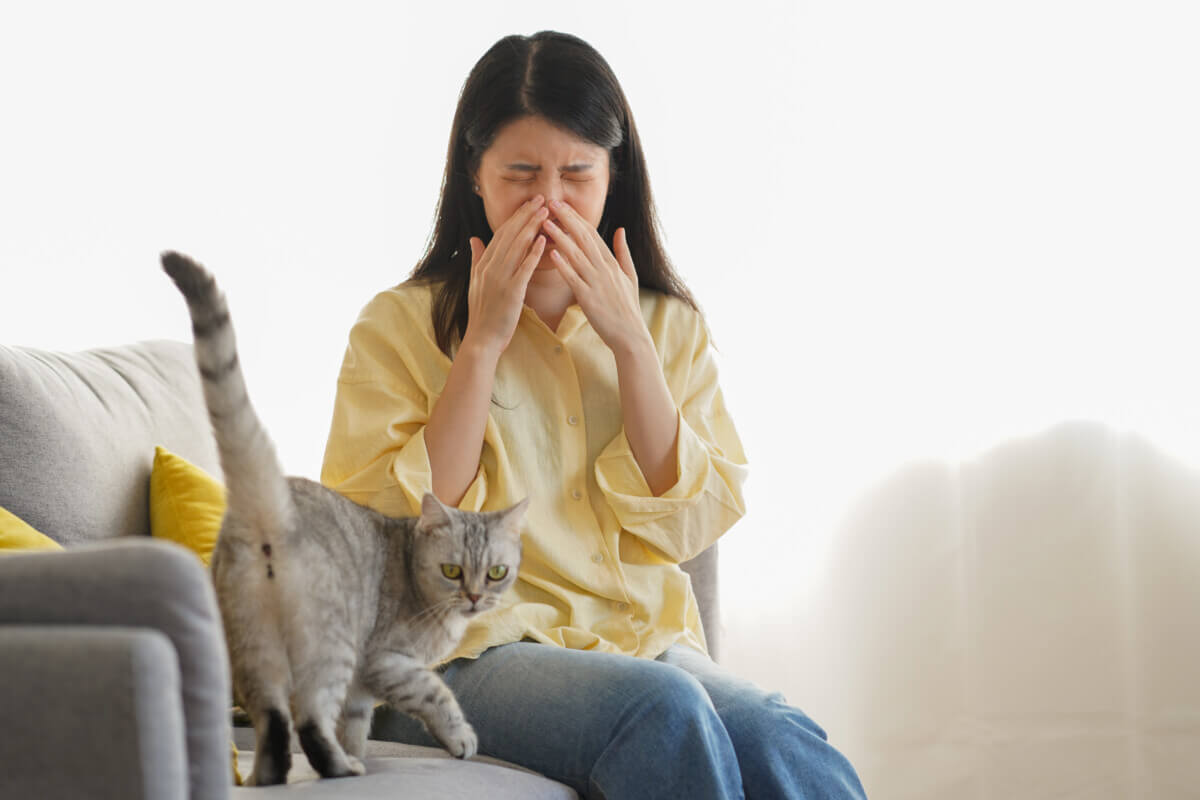
CHARLOTTESVILLE, Va. — For millions of people who adore cats but are plagued by allergies, the dream of snuggling a furry friend without sneezing might soon become reality.
Researchers are on the verge of engineering the holy grail of pet ownership: the truly hypoallergenic cat. Nearly 15% of the population struggles with cat allergies — a condition that can transform the simple joy of cuddling a furry companion into a nightmare of sneezing, itching, and wheezing. By delving into the intricate world of genetic engineering, a team of scientists led by Martin Chapman has uncovered a potential solution using CRISPR, a revolutionary gene-editing technique often described as molecular scissors that can precisely cut and modify DNA.
The secret lies in Fel d 1, a small protein that cats produce in their saliva, skin, and tears. This protein, which goes airborne when cats groom themselves, is the leading cause of allergic reactions in humans. Scientists have long studied Fel d 1, but this new study published in PNAS Nexus provides unprecedented insights into its genetic diversity and evolutionary history. This research might pave the way for creating hypoallergenic cats through genetic manipulation.
Of the 15% of the population in the United States dealing with, Fel d 1 is responsible for the majority of these cases, triggering immune responses in sensitive individuals. Despite its notorious reputation, Fel d 1’s function in cats remains a mystery. Some researchers believe that it aids in immune regulation or chemical communication among cats, while others suggest it might be entirely nonessential. The question of whether Fel d 1 could be safely eliminated from cats has intrigued scientists for years.

The study, led by researchers from InBio and Texas A&M University, took a comparative approach to understanding Fel d 1. The team analyzed DNA sequences for the two genes that encode Fel d 1 — CH1 and CH2 — in 276 cats, including both domestic breeds and exotic species like lions and leopards. They discovered striking genetic variability in Fel d 1, particularly in the CH2 gene.
More than 40% of the protein’s building blocks (amino acids) differ between species, suggesting that Fel d 1 has evolved differently depending on the cat’s environment and lineage. Interestingly, some variations in the protein may even reflect evolutionary adaptations to different ecological pressures.
The researchers also noted that Fel d 1 does not appear to be highly conserved, meaning it has not been preserved in the same form across species over millions of years of evolution. This lack of conservation hints that the protein might not be critical for cats’ survival or health. Adding weight to this theory is evidence from a recent CRISPR study that successfully edited the CH2 gene in domestic cats, disabling Fel d 1 production entirely. The gene-edited cats showed no adverse health effects, remaining active and healthy — a finding that could be a game changer for allergy sufferers.
The study is not without its challenges and unanswered questions. While genetic diversity in Fel d 1 suggests it might not be essential, its exact role in cats remains unclear. Proteins with similar structures in other species are involved in functions like chemical communication or immune responses. Understanding whether Fel d 1 serves a unique purpose in cats is crucial before widespread gene editing can be ethically and safely pursued. Moreover, researchers must consider unintended consequences, such as how changes to Fel d 1 might affect a cat’s interactions with other animals or humans.
Still, the potential for creating allergy-friendly cats is closer than ever. With advancements in genetic technology and a growing understanding of Fel d 1, scientists are optimistic that we may one day see a world where cat lovers with allergies can adopt feline companions without fear. This breakthrough could not only transform the lives of millions of allergy sufferers but also reduce the number of cats relinquished to shelters due to allergen concerns.
Paper Summary
Methodology
The study involved analyzing the genetic sequences of Fel d 1 from 276 cats, including 140 domestic cats and 136 wild or exotic species. Researchers used databases of cat genomes and obtained additional DNA samples from routine veterinary procedures. They sequenced the CH1 and CH2 genes and compared their amino acid structures across species. Advanced tools like sequence alignment and structural modeling helped pinpoint genetic variations and predict their effects on the protein’s structure.
Key Results
The researchers found substantial genetic variability in Fel d 1, with more than 40% of amino acids differing across species. CH2 showed greater variability than CH1, particularly in regions that might influence the protein’s shape and function. This variability suggests that Fel d 1 has adapted to different environments and may not be critical for survival. Additionally, cats with edited CH2 genes lacked Fel d 1 but remained healthy, indicating the potential for gene editing to eliminate the allergen.
Study Limitations
While the study offers valuable insights, it does not definitively establish the biological role of Fel d 1 in cats. The structural predictions rely on computational models, which may not fully capture the protein’s natural functions. Furthermore, the study does not explore long-term effects of removing Fel d 1 or potential ecological implications.
Discussion & Takeaways
The findings highlight the evolutionary flexibility of Fel d 1 and its potential as a target for gene editing. If Fel d 1 is indeed nonessential, disabling it could offer a solution for cat allergies without harming cats. However, more research is needed to understand the protein’s role in communication, immunity, or other biological processes.
Funding & Disclosures
This study was funded by InBio, a biotechnology company, and supported by the National Institutes of Health. Some researchers involved in the study are employees or founders of InBio, which may have an interest in commercial applications of the findings. The data and methods are publicly available for further scientific scrutiny.


