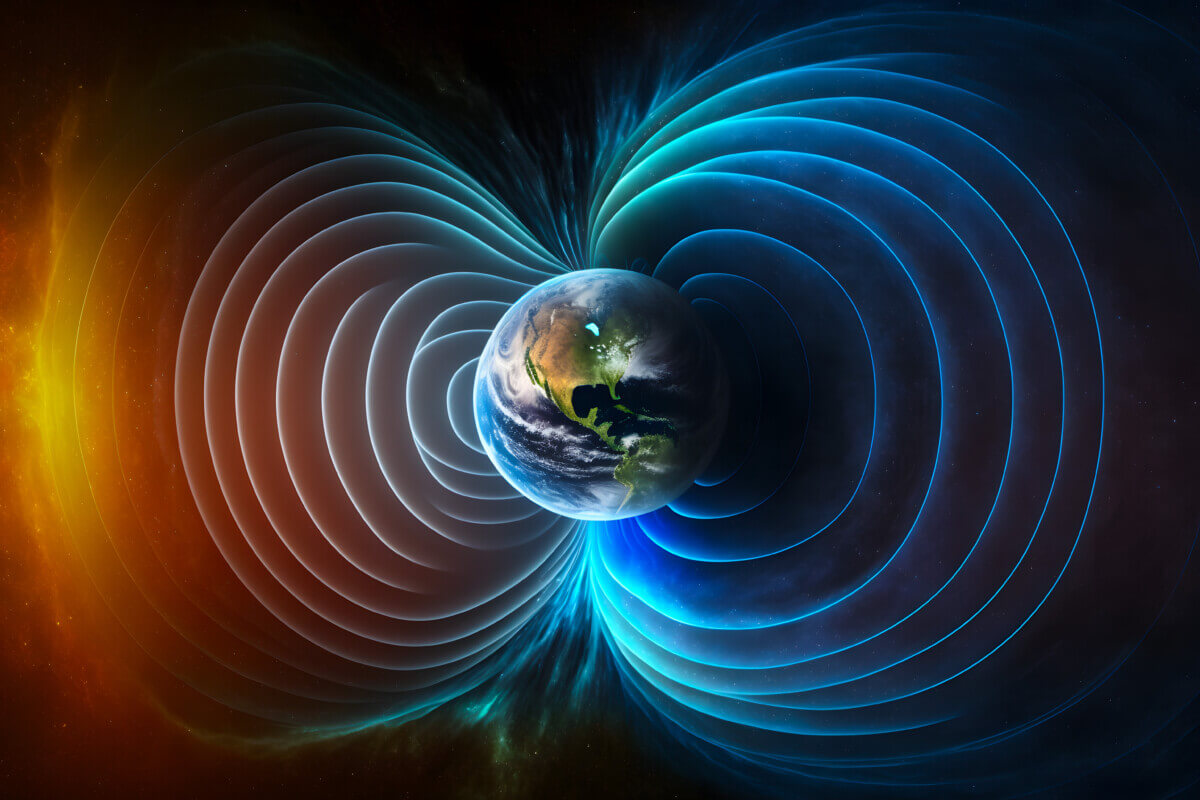
Earth's magnetic field, the Magnetosphere (© aapsky - stock.adobe.com)
In A Nutshell
- Two massive hot regions deep beneath Africa and the Pacific Ocean have been influencing Earth’s protective magnetic field for at least 265 million years
- Ancient volcanic rocks preserved magnetic field patterns that match computer simulations showing how these deep structures affect the dynamo
- The structures help stabilize the magnetic shield that protects us from solar radiation, preventing the field from collapsing into weaker, chaotic states
- Understanding this connection could help scientists predict future magnetic field behavior, including potential pole reversals that would affect satellites and power grids
Right now, the Sun is firing charged particles at Earth like a cosmic shotgun, traveling at more than a million miles per hour. The only thing standing between you and this radiation bath is an invisible magnetic bubble that most people never think about. Scientists now have strong evidence that two vast regions of exceptionally hot rock, each the size of a continent and sitting nearly 2,000 miles beneath your feet, have helped shape how that protective shield behaves for at least the past 265 million years.
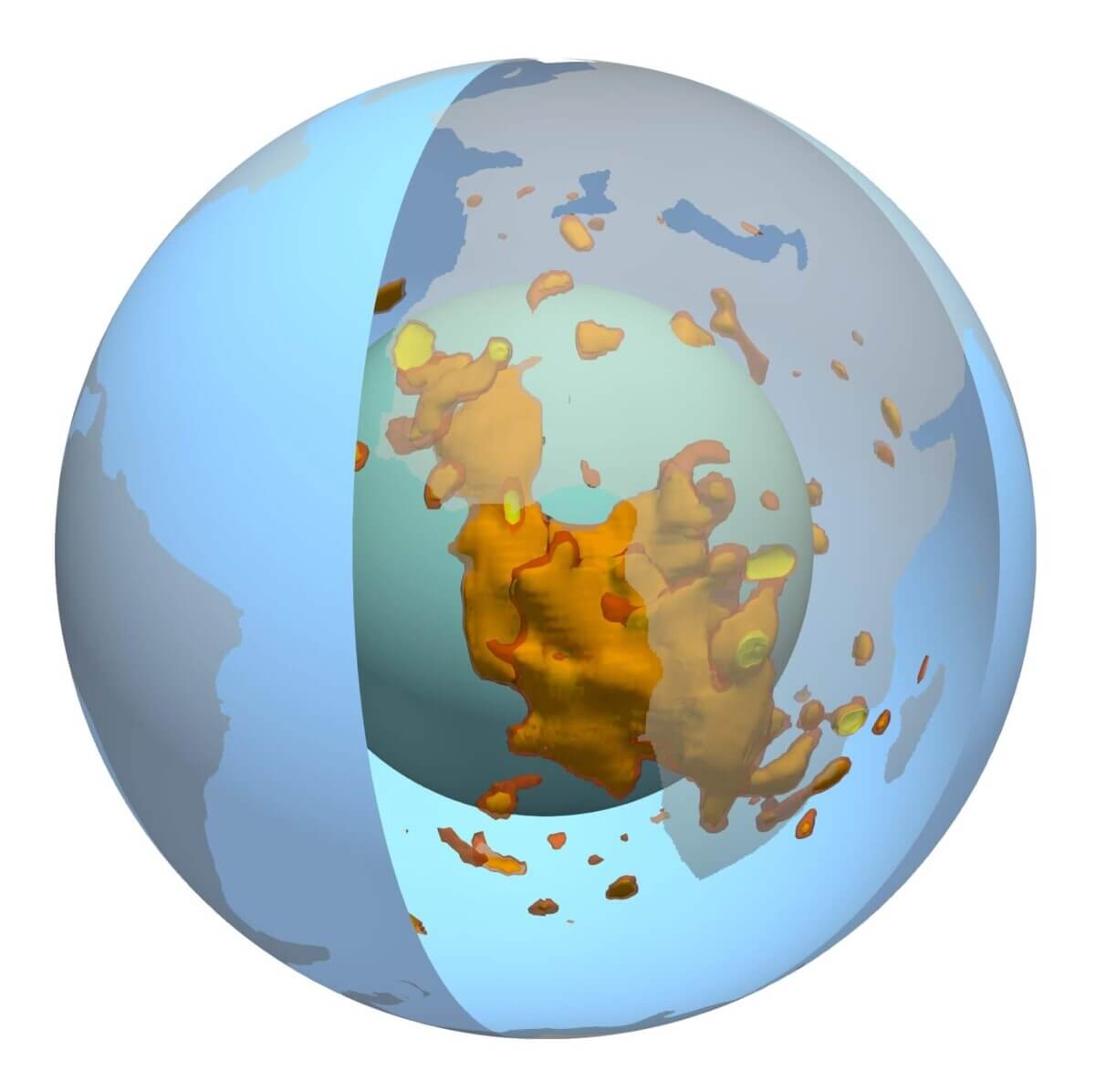
One region lurks under Africa. The other sits under the Pacific Ocean. Seismologists detect these zones as areas where seismic waves slow down dramatically, likely because they’re hotter than their surroundings, though composition may also play a role. Scientists call them Large Low Velocity Provinces. These structures influence the magnetic field that reduces the damage solar storms can cause to satellites, power grids, and life on Earth’s surface.
Researchers figured this out by examining ancient lava flows that recorded the direction and variability of the magnetic field, then running sophisticated computer simulations of Earth’s churning liquid iron core. The magnetic field’s quirks and wobbles over millions of years turned out to be a signature of these deep structures. Almost like finding fingerprints at a crime scene, except the scene is the entire planet and the prints are hundreds of millions of years old.
Why Your Life Depends on an Invisible Bubble
Earth’s magnetic field shapes itself into a teardrop stretching about 40,000 miles toward the Sun. Without it, the steady stream of solar particles would slowly strip away our atmosphere. Mars probably lost its air and any shot at keeping life on its surface when its magnetic field died billions of years ago.
A strong magnetic field with clean north and south poles does the best job protecting us. But when the field weakens or gets messy, gaps open up. During magnetic pole reversals, when north and south flip places, the field strength can drop to a fraction of its usual strength for thousands of years. Compasses go haywire, migration patterns get disrupted, and more radiation reaches the surface.
The field comes from Earth’s outer core, a shell of liquid iron about 1,400 miles thick spinning around a solid iron ball at the center. Heat escaping from that inner core drives the liquid metal into motion, generating electric currents that create the magnetic field. It’s basically a planet-sized electrical generator that’s been running for billions of years.
Scientists knew the basics of how this dynamo works, but they didn’t know the mantle, the thick rocky layer above the core, was setting the conditions the core has to work under. Turns out, temperature variations in the lower mantle act like a thermostat, controlling where the liquid iron churns most vigorously and where it calms down.
Ancient Rocks That Remember
When lava erupts and cools into rock, tiny iron-rich minerals inside freeze in place like compass needles, recording the magnetic field’s direction at that moment. These rocks scattered across every continent became a library of Earth’s magnetic history.
The research, published in Nature Geoscience, gathered data from thousands of these volcanic time capsules dating back 265 million years. They noticed something odd in the records from near the equator: the magnetic field wobbled more in some spots than others, creating a wave pattern around the globe. The wavelength matched strikingly with the spacing between the two hot regions at the base of the mantle.
But correlation doesn’t prove causation. The team needed to test whether those deep structures could actually influence the magnetic field at the surface, 2,000 miles away.
Computer Cores
The researchers built 31 virtual Earths inside powerful computers, each one simulating tens of thousands of years of magnetic field evolution. Some virtual Earths had uniform heat flow from core to mantle. Others included temperature variations matching what seismologists see in the real Earth.
Because these deep mantle regions are hotter, less heat escapes from the core beneath them, creating patches of reduced heat flow that affect how the liquid iron moves above.
The simulations with uniform heat either produced boring, overly stable magnetic fields or suddenly collapsed into chaotic messes with magnetic poles scattered everywhere. Neither looked like Earth.
The simulations incorporating the two hot regions nailed it. They generated magnetic fields that wobbled the right amount, varied across different longitudes just like the ancient rocks showed, and stayed strong and stable with clean north and south poles. The simulations suggest these structures actively shape how the dynamo behaves.
Beneath the hot regions, the churning liquid iron in the uppermost core slows down, creating a calming effect that helps keep the main north-south field strong. Between the regions, the magnetic field gets boosted. This geographic pattern gets stamped onto the field’s behavior over millions of years.
The structures also act like partial safety rails, helping to prevent the field from falling apart even when conditions get extreme. Without them, the computer simulations often crashed into weak, chaotic configurations that would leave Earth vulnerable to solar radiation.
At Least a Quarter Billion Years of Influence
If these structures really influence the magnetic field, their signature should show up not just in recent rocks but throughout Earth’s history. The lower mantle moves incredibly slowly, suggesting the regions would stick around for hundreds of millions of years.
The team tested this by analyzing older volcanic rocks dating back 265 million years from 28 locations around ancient Earth. The patterns in those rocks clustered in exactly the same range as both recent data and the simulations with hot regions. Simulations without them couldn’t match the real-world data while keeping realistic magnetic fields.
During those 265 million years, continents drifted thousands of miles, the Appalachian Mountains rose and weathered down, dinosaurs appeared and vanished, and five mass extinctions reshuffled life. Through it all, two massive structures deep in the mantle influenced how the magnetic shield functioned.

What Happens Next
This matters for more than just understanding Earth’s past. The magnetic field has been weakening for the past 180 years, dropping about 9% in strength. Over the South Atlantic, it’s gotten so weak that satellites passing through that region get hit with extra radiation that can damage their electronics.
Scientists debate whether this is just normal fluctuation or the start of a pole reversal. Reversals happen irregularly, and it’s been 780,000 years since the last one, longer than average, though that doesn’t mean one is imminent.
Knowing that deep mantle structures help stabilize the field offers a possible stabilizing influence, though it doesn’t rule out reversals. But if a reversal does start, understanding what influences the field’s recovery becomes critical. A weak magnetic field for thousands of years would cause headaches for GPS systems, power grids, and communication satellites. Airlines would need to reroute flights to reduce radiation exposure for crews and passengers. The northern lights would appear at much lower latitudes, which may make for a pleasant view, but the underlying cause would be concerning.
The discovery also raises questions about other rocky planets. Does a planet need large-scale structures in its mantle to maintain a long-lasting magnetic field? Could geologists on future Mars missions look for ancient magnetic records in volcanic rocks to figure out when and why Mars lost its shield?
For now, the main takeaway is humbling. The invisible force field that makes modern life possible, that protects every living thing from a hostile space environment, has been influenced for hundreds of millions of years by two massive regions of hot rock closer to the planet’s core than to its surface. They’ve been shaping an underground process we’re only now learning to understand, performing the same protective function since before dinosaurs walked the Earth.
Paper Notes
Study Limitations
Palaeomagnetic records from older time periods become increasingly sparse, making it harder to detect patterns with high confidence. Available datasets are limited by the distribution of volcanic rocks preserved in the geological record, which may not provide uniform global coverage for all time periods. Computer simulations of the geodynamo must make compromises when modeling core dynamics over long timescales, using parameter values that don’t perfectly match Earth’s core conditions due to computational limitations. While the simulations access rapidly rotating, strong-field conditions expected in Earth’s core, they cannot explore the full parameter space under truly extreme Earth-like conditions. The interpretation of seismic signals in terms of temperature variations remains uncertain, as the observed seismic velocity differences could result from combinations of temperature, composition, and partial melting effects.
Funding and Disclosures
A.J.B., C.J.D., S.J.L. and Y.E.E. acknowledge Natural Environment Research Council (NERC) awards NE/X014142/1 and NE/T012463/1. D.T. acknowledges funding from the National Science Foundation (NSF) grant EAR 2054605 and the Sloan Foundation. The authors declare no competing interests.
Publication Details
Authors: A. J. Biggin (Geomagnetism Laboratory, Department of Earth, Ocean and Ecological Sciences, University of Liverpool, Liverpool, UK), C. J. Davies (School of Earth and Environment, University of Leeds, Leeds, UK), J. E. Mound (School of Earth and Environment, University of Leeds, Leeds, UK), S. J. Lloyd (Geomagnetism Laboratory, Department of Earth, Ocean and Ecological Sciences, University of Liverpool, Liverpool, UK), Y. E. Engbers (Geomagnetism Laboratory, Department of Earth, Ocean and Ecological Sciences, University of Liverpool, Liverpool, UK; currently at Electromagnetic Signatures and Propagation, Netherlands Organisation for Applied Scientific Research (TNO), The Hague, The Netherlands), D. Thallner (Department of Geological Sciences, University of Florida, Gainesville, FL, USA), A. T. Clarke (School of Earth and Environment, University of Leeds, Leeds, UK), and R. K. Bono (Department of Earth, Ocean and Atmospheric Science, Florida State University, Tallahassee, FL, USA) | Journal: Nature Geoscience | Paper Title: Mantle heterogeneity influenced Earth’s ancient magnetic field | DOI: https://doi.org/10.1038/s41561-025-01910-1 | Publication Date: Published online February 3, 2026 | Received: March 26, 2025; Accepted: December 18, 2025


