(© James Thew - stock.adobe.com)
CAMBRIDGE, Mass. — A massive meteorite that struck Earth over three billion years ago – dwarfing the one that wiped out the dinosaurs – may have actually given ancient microscopic life forms a boost, according to fascinating new research.
The study, published in Proceedings of the National Academy of Sciences, examines the aftermath of what scientists call the “S2 impact,” which occurred when Earth was still a very different planet than the one we know today. At that time, only simple bacteria and similar single-celled organisms existed.
“Picture yourself standing off the coast of Cape Cod, in a shelf of shallow water. It’s a low-energy environment, without strong currents. Then all of a sudden, you have a giant tsunami, sweeping by and ripping up the sea floor,” says Nadja Drabon, an early-Earth geologist at Harvard University who led the research, in a media release.
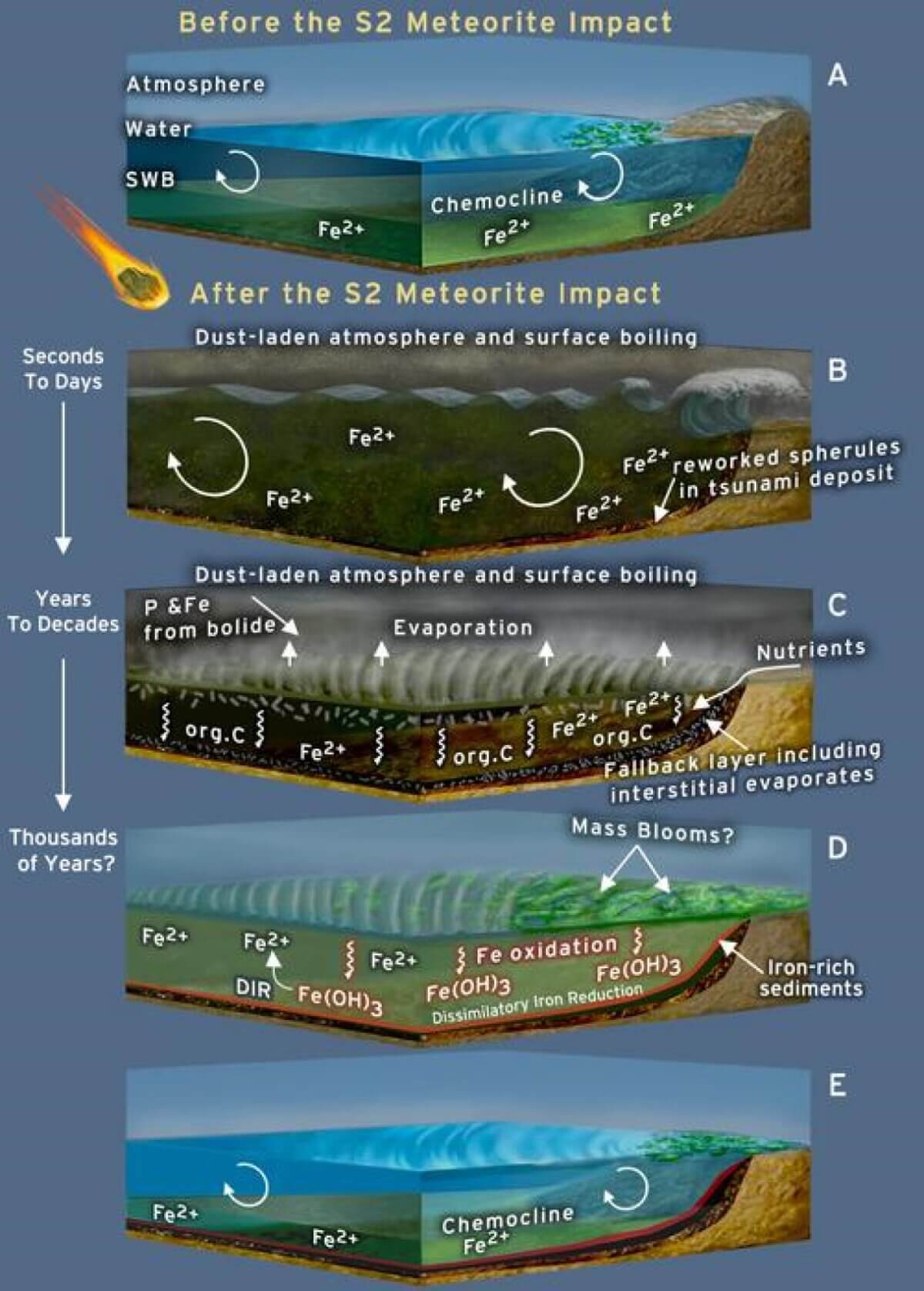
The meteorite, estimated to be about four times the size of Mount Everest and 200 times larger than the “dinosaur killer,” slammed into Earth with devastating immediate effects. It triggered massive tsunamis, boiled the ocean’s surface, and threw up so much dust that it temporarily blocked out the sun.
Despite all of that, life proved remarkably resilient. By analyzing ancient rock samples from South Africa’s Barberton Greenstone Belt, Drabon’s team discovered that bacteria not only survived – they thrived in the aftermath. The impact stirred up iron from the deep ocean, delivered phosphorus both from the meteorite itself, and increased erosion on land. This created perfect conditions for certain bacteria that feed on these elements to flourish.
“We think of impact events as being disastrous for life,” Drabon notes. “But what this study is highlighting is that these impacts would have had benefits to life, especially early on… these impacts might have actually allowed life to flourish.”
The research team reached these conclusions through meticulous fieldwork, collecting rock samples just centimeters apart and analyzing their chemical composition. These ancient rocks, preserved for over three billion years, contain chemical signatures that tell the story of that cataclysmic day and its aftermath.
The site in South Africa where this evidence was found contains clues to at least eight different major meteorite impacts from Earth’s early history. Drabon and her team plan to continue studying the area to uncover more secrets about how these cosmic collisions shaped our planet’s past and the evolution of life itself.
The findings suggest that while massive meteorite impacts are typically viewed as harbingers of destruction, they may have played a crucial role in creating conditions that helped Earth’s earliest life forms diversify and thrive.
Paper Summary
Methodology
The researchers focused on studying rocks from the Archean period, over 3 billion years ago, to understand how a massive meteorite impact affected Earth’s surface and early life. They collected samples of ancient rock layers in South Africa, which included evidence of a large meteorite strike. They analyzed these rock layers using a combination of methods—sedimentology (studying rock formations), petrography (examining rocks under microscopes), and geochemistry (studying chemical elements in rocks). These tools helped the team piece together how the impact changed the environment and influenced early microbial life.
They specifically looked for signs of physical changes caused by the meteorite, such as tsunamis, ocean evaporation, and atmospheric changes. They also examined the chemical composition of the rocks to determine how the impact may have altered the availability of key nutrients like phosphorus and iron, which could have influenced microbial life.
Key Results
The study found that the meteorite impact caused several big changes to Earth’s surface. First, it created a huge tsunami that brought deep ocean water up to the surface, mixing nutrients like iron into the shallower water. The heat from the impact also partially evaporated parts of the ocean. This caused a lot of harm to microbes living in shallow water, but it didn’t affect life in the deeper parts of the ocean as much.
After the initial destruction, the impact released nutrients into the environment that helped some types of microbes thrive, especially those that depend on iron for their survival. The study suggests that even though the impact was a disaster in the short term, it may have helped life bounce back by providing extra nutrients in the long run.
Study Limitations
One major limitation is that it’s difficult to know exactly how life responded to the meteorite impact, as evidence from over 3 billion years ago is scarce and often incomplete. The researchers relied heavily on the chemical signatures in the rocks to make their conclusions, but the specific types of life forms that existed at the time are still largely unknown. Additionally, while the study shows a link between the impact and environmental changes, it’s hard to determine the precise timeline of recovery for microbial life.
Another challenge is that the data collected only represents one region of Earth. Since the meteorite impact was so large, the effects may have varied in different parts of the world, which this study couldn’t fully explore.
Discussion & Takeaways
The research provides important insights into how giant meteorite impacts affected early Earth. While we often think of meteorites as purely destructive, this study suggests that they also played a role in shaping life. The impact caused short-term devastation, but it also introduced nutrients into the environment that allowed certain microbes to thrive afterward. This shows that meteorite impacts were not just catastrophic events but also opportunities for life to adapt and evolve.
A key takeaway is that Earth’s early history was full of dramatic events like this, which, despite being destructive, also created new conditions for life to flourish. It reminds us that even in the face of mass destruction, life finds ways to recover and adapt.
Funding & Disclosures
This research was funded through the Dean’s Competitive Fund from Harvard University and the Gerald J. Lieberman Fellowship and a grant from the Center for African studies from Stanford University. Additionally, all researchers who contributed to the study — including Nadja Drabon, Andrew H. Knoll, Donald R. Lowe, and their team — have declared that they have no competing interests or conflicts related to the research. The study underwent peer review by external experts to ensure its quality and integrity before being published in the journal PNAS.


