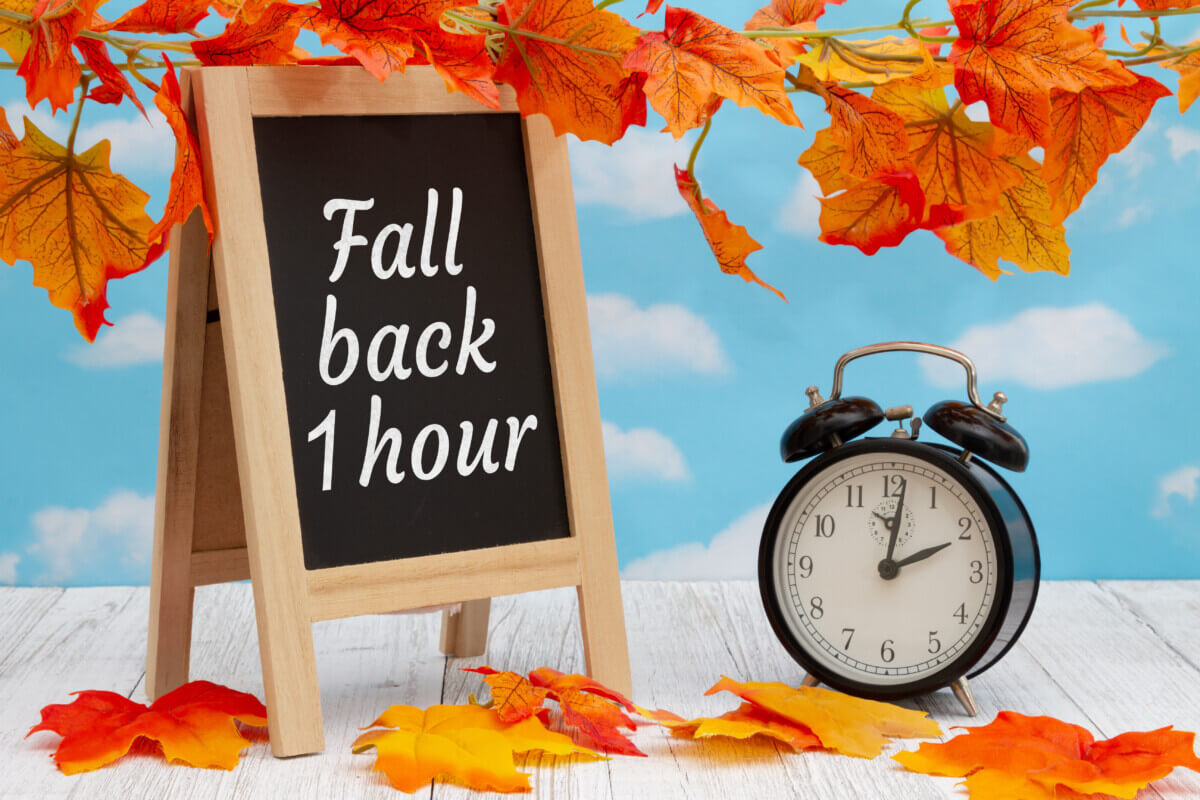
Daylight Saving Time fall back sign with alarm clock and standing blackboard on weathered wood with fall leaves (© Karen Roach - stock.adobe.com)
NEW YORK — Daylight Saving Time is about to end, and the clock-changing freak-out has already begun. A new poll finds two in five Americans will experience “Daylight Saving Scaries” when preparing to fall back in November.
The survey of 2,000 Americans revealed that 40% feel a sense of dread when preparing to set their clocks back by an hour, a feeling that lasts much longer than just the day or two after the time change. Results also find that this sense of dread sets in about 11 days prior to DST ending — starting around Oct. 23 this year. Moreover, people won’t get over the end of Daylight Saving Time for about 13 days, which will be Nov. 16.
Commissioned by Avocado Green Mattress and conducted by Talker Research, the survey dug into the “Daylight Saving Scaries” and how people feel about changing their clocks. Regardless of whether they experience the “Daylight Saving Scaries,” 59% of Americans would permanently stop the switch to and from Daylight Saving Time if given the chance.
Older generations are more eager to do so. While only half of millennials would choose to end DST permanently, two-thirds of baby boomers (69%) say it’s time to pick one time and stick with it.
Get Ready For Shorter Days
Only a third of respondents (35%) believe the trade-off in the fall — an extra hour of sleep for the night, versus less light in the evenings — is worth it. That might be due in part to the 77% of respondents who feel more energized when the Sun is out. After Daylight Saving Time ends, however, 70% feel like they start and end their day when it’s dark.
“The sudden shift to shorter days and darker nights throws off our sleep schedules,” says Mark Abrials, CMO at Avocado Green Mattress, in a statement. “Everyone is a bit cranky, grumpy, moody and lazy.”
Working Americans in the survey (48%) especially miss the daylight — 54% admit experiencing the “sunlight blues” after the time change, as they’re at work during all the hours of daylight. For employed respondents, 43% also said that the week after Daylight Saving Time ends is their most unproductive at work — with 31% admitting they make more mistakes than they typically would.
This includes falling asleep at their desk while typing a letter to the company’s president, showing up late after not changing their clocks the night before, and putting salt into their coffee instead of sugar. A fifth of respondents said changing the clocks harms their sleep schedule (21%).
Therefore, perhaps it’s no surprise that 37% of respondents need more sleep in the days or weeks after Daylight Saving Time ends, regardless of their employment status. For those respondents, they need an extra hour and 24 minutes in order to feel well-rested.
“The fall time change can be such a struggle,” says Amy Sieman, Affiliate Manager at Avocado Green Mattress. “The early darkness can make us tired early and more prone to be sedentary, skipping out on fun activities and time outdoors.”
Don’t Like DST? Head to These 2 States
Arizona and Hawaii are the only two states that do not observe DST. Arizona opted out of DST in 1968, citing the extreme heat of the summer months and the lack of energy savings. Hawaii never adopted DST in the first place due to its proximity to the equator and the fact that it experiences less variation in daylight hours throughout the year.
As for everyone else, blame Congress if you can’t stand changing the clocks. The U.S. Senate passed a measure in 2022 making Daylight Savings Time permanent but it stalled out in the House of Representatives — failing to become law.
Survey methodology
Talker Research surveyed 2,000 Americans who experience Daylight Saving Time; the survey was commissioned by Avocado Green Mattress and administered and conducted online by Talker Research between Oct. 3–7, 2024.


Standard time is the correct time. During standard time the high point of the sun occurs at noon, and the deepest of night occurs at midnight. Reclassifying these times as 1PM and 1AM so you think the day is longer is absurd. The 40% that ‘freak out’ are the same ones that can’t define what a woman is, and don’t know which bathroom to use at Target.
These are the consequences of playing along with mental illness, instead of correcting it.
Just end it and allow the states to adjust the present time zone boundaries to correct for any cases where ending standard time would be a detriment (places such as the UP of MI in the far west of Eastern time).
Oh, and what you want to end is STANDARD time (fall back). Daylight time is the one most people like with the later sunsets. I don’t know why so many people get this confused.